

Do a good job in handling citizen petitions.
(Baonghean) - Although not officially authorized to handle citizens' complaints and denunciations, the Standing Committee of the Provincial People's Council and the Nghe An National Assembly Delegation have effectively reformed their citizen reception and handling processes, as well as their efforts to receive and expedite the resolution of these issues by competent authorities, thereby building trust among the people.
A place to entrust your faith
Reforming the handling of citizen complaints and denunciations has always been a concern of the Standing Committee of the Provincial People's Council and the Delegation of National Assembly Deputies of Nghe An province since the beginning of their term (2011-2016). This is because it is one of the practical activities aimed at strengthening the relationship and consolidating the trust of the people in elected bodies, while also demonstrating the role of representing the will, aspirations, and legitimate rights and interests of the people.
Since the first public reception session on October 10, 2011, the Standing Committee of the Provincial People's Council and the Delegation of National Assembly Deputies of Nghe An Province have regularly held monthly public reception sessions on the 10th of each month, according to the "Plan for Receiving Citizens and Handling Complaints and Denunciations" issued by the Standing Committee of the Provincial People's Council in coordination with the Delegation of National Assembly Deputies of Nghe An Province on September 16, 2011 (later changed to the 15th of each month after the public reception schedule of the Provincial People's Committee). Accordingly, there have been 27 public reception sessions at the Office of the Provincial People's Council and the Delegation of National Assembly Deputies of the province, with over 1,500 citizens received and more than 700 complaints and denunciations received and forwarded to relevant agencies for resolution by the Standing Committee of the Provincial People's Council and the Delegation of National Assembly Deputies of the province.
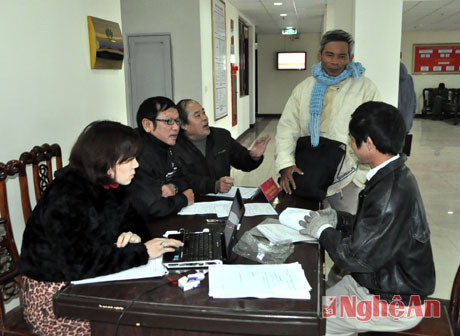 |
| Receiving citizens at the Office of the Provincial National Assembly Delegation and Provincial People's Council. |
Mr. Tran Van Mao, Standing Member of the Provincial People's Council, shared: To build trust among citizens when they come to the Office of the Provincial National Assembly Delegation and People's Council, the Standing Committee of the People's Council and the leaders of the Provincial National Assembly Delegation preside over citizen reception sessions with the participation of members of the Provincial People's Council committees, representatives of the Provincial Fatherland Front Committee, and a number of relevant departments and agencies who are truly knowledgeable about the law and have a deep understanding of the cases and the process of resolving each case. Each citizen who comes is able to directly present their case, submit petitions and related documents; and receive explanations, guidance, advice, and conclusions on how to handle the case from members of the citizen reception council. For cases that have been resolved correctly by competent authorities, the citizens are clearly explained and requested to comply strictly. Immediately after citizen reception sessions, the Standing Committee of the Provincial People's Council or the leaders of the Provincial National Assembly Delegation issue a notice summarizing the conclusions of the session, outlining the course of action and resolution for each citizen and specific case, in accordance with the principles of "openness, transparency, and legality".
Having directly observed several public consultation sessions at the offices of the Provincial National Assembly Delegation and the Provincial People's Council, our general observation is that the exchanges were open, democratic, and frank. Citizens were able to openly discuss their concerns; the Standing Committee of the Provincial People's Council and the National Assembly Delegation guided and assisted citizens in exercising their right to complain and denounce, while also receiving citizens' letters and forwarding them to the competent agencies, organizations, and individuals for resolution. Through this activity, many citizens have gained a clearer understanding of the "path and steps" in exercising their right to complain and denounce, and have also correctly identified the address to send their complaints, denunciations, and petitions; clearly identifying the content they need to complain about, denounce, or petition, avoiding unnecessary trips and repeated visits due to incorrect content or the wrong authority being involved.
On the other hand, through citizen reception sessions, the Standing Committee of the Provincial People's Council and the Delegation of National Assembly Deputies also explain and disseminate the Party's guidelines and policies, and the State's laws, thereby contributing to improving people's understanding and knowledge of the law. At the same time, they receive and record opinions, suggestions, and feedback from citizens on issues related to the Party's guidelines and policies, the State's laws, the activities of elected bodies, state management agencies, organizations, agencies, and units. This helps identify existing problems and limitations in various sectors and levels of government, obstacles in implementing mechanisms and policies, and other information related to the activities of state agencies in the province…
In addition to regular citizen reception sessions, the Office of the National Assembly Delegation and the Provincial People's Council also assigns full-time representatives to receive citizens regularly during working days at the Office; and sends personnel to participate in citizen reception sessions at the monthly regular citizen reception sessions of the Provincial People's Committee, thereby strengthening relationships and enhancing the responsibility of elected bodies in receiving citizens and resolving complaints and denunciations from citizens.
Promptly address complaints and petitions.
Along with receiving citizens and handling their complaints and denunciations for forwarding to competent authorities for resolution, the Standing Committee of the Provincial People's Council has also clearly demonstrated its responsibility in urging and supervising the resolution of citizens' complaints by all levels and sectors. The Standing Committee of the Provincial People's Council has selected protracted and complex cases to conduct surveys and work directly with relevant parties to thoroughly examine the obstacles, thereby urging, recommending, and enhancing the responsibility of competent agencies, organizations, and individuals in resolving citizens' complaints and denunciations. Accordingly, numerous surveys were conducted by the Standing Committee of the Provincial People's Council in Vinh City, Nghia Dan, Hung Nguyen, Tan Ky, Thai Hoa Town... and in the Departments of Labor - War Invalids and Social Affairs, Culture - Sports - Tourism, and Natural Resources - Environment.... A typical example is the survey on the handling of citizens' petitions related to land issues in the Cau Den project, Hung Loi commune (Hung Nguyen), and the final resolution results provided to citizens by the relevant authorities, avoiding repeated appeals and lawsuits.
For example, a survey and direct work with the Department of Labor, War Invalids and Social Affairs and the People's Committee of Hung Nguyen district regarding Mr. Ngo Ba Nhuong's complaint against Hung Linh commune for resolving issues related to policies for war invalids and martyrs clarified the responsibilities of each level and sector, as well as the existing obstacles. A written recommendation was also submitted to the Ministry of Labor, War Invalids and Social Affairs to further adjust regulations on dossiers, procedures, and conditions for receiving policies and benefits to better reflect the reality in Nghe An, avoiding situations where truly meritorious individuals are not receiving the benefits. Most recently, in January 2014, the Standing Committee of the Provincial People's Council conducted a survey on the complaints and petitions of citizens related to the dissolution and handover of Huu Nghi Private High School.
Through the survey, the Standing Committee of the Provincial People's Council directly listened to the relevant parties' "three-way" exchange regarding the reason why the initial valuation of assets on the land, agreed upon and signed by all parties, was 2.2 billion VND, but the Department of Culture, Sports and Tourism later submitted it to the Department of Finance for appraisal and presented it to the Provincial People's Committee for a decision at 1.965 billion VND. Currently, this amount is being transferred by the Department of Finance to the account of the Department of Culture, Sports and Tourism - the state management agency responsible for purchasing and taking over the assets of Huu Nghi Private High School. The conclusion of the survey team was agreed upon by all parties; once the Board of Directors of Huu Nghi Private High School submits a proposal agreeing on the account address and a specific plan for allocating the funds, the Department of Culture, Sports and Tourism will transfer the money in the first quarter of 2014, ensuring the rights of all parties involved.
Although not the direct body responsible for handling and responding to citizens' complaints and denunciations, or directing competent state agencies to resolve them, after receiving complaints and denunciations from citizens, the Standing Committee of the Provincial People's Council and the Provincial Delegation of National Assembly Deputies are responsible for studying the content, forwarding it to the competent agencies and organizations for consideration; and simultaneously monitoring, supervising, and urging functional agencies to promptly resolve the issues and protect the legitimate rights and interests of citizens. In particular, through surveys and exchanges between representatives of citizens making complaints and denunciations and relevant functional agencies, practical results have been achieved, resolving long-standing difficulties and obstacles for both functional agencies and citizens. While not all demands of the complaining citizens have been fully met, most long-standing unresolved cases have been addressed and resolved. There are cases where citizens' petitions have been satisfactorily and lawfully resolved by competent authorities, but citizens still continue to appeal and file complaints. The Standing Committee of the Provincial People's Council has also provided full explanations and guidance, stating that if citizens disagree, they have the right to file a lawsuit in court, while clearly expressing its firm stance that it will no longer accept such petitions.
Mr. Tran Van Mao stated: Monitoring the handling of citizens' complaints and denunciations reveals that some cases are still being handled slowly or with a shirking of responsibility by competent authorities, leading to citizen frustration due to long waits and repeated trips. Therefore, first and foremost, all levels, sectors, agencies, and especially their leaders, need to further enhance their responsibility in resolving citizens' complaints and denunciations. Emphasis should be placed on democratic, open, and transparent dialogue, combined with explanation, persuasion, and strengthening legal discipline. The Standing Committee of the Provincial People's Council and the National Assembly Delegation should continue to innovate the work of receiving citizens and resolving their complaints by strengthening surveys and monitoring the resolution of complaints at all levels and sectors. The Standing Committee of the Provincial People's Council has included in its 2014 monitoring program a thematic monitoring of the work of receiving citizens and resolving their complaints and denunciations. To accomplish this task, the Standing Committee of the Provincial People's Council and the National Assembly Delegation need to continue improving the effectiveness of coordination in receiving citizens with the Provincial Citizen Reception Council, the Provincial People's Committee, the Provincial Fatherland Front Committee, and other relevant agencies in order to leverage their combined strength to better perform this function and activity in elected bodies.
Minh Chi