

The wedding customs of the Khmu people
(Baonghean) - Each community has its own interesting wedding customs. For the Khmu people in western Nghe An, when going to ask for a wife's hand in marriage, it is essential to bring meat, fish, and especially squirrel meat; all of which are dried in the kitchen loft months before the wedding day...
For the Khmu people, after the harvest season comes the celebration of the new rice crop and also the wedding season. The wedding season continues until after Tet (Lunar New Year), when they prepare for the new farming season. After the harvest, when the villages are most prosperous and the weather is pleasantly cool, it's the perfect time for young couples to build new homes. Perhaps that's why, from September and October of the lunar calendar until after the first month of the new year, you'll often see more weddings than usual in Khmu villages...
The same is true for Pủng Cà Moong village (Lượng Minh commune - Tương Dương district), located next to the Bản Vẽ hydroelectric reservoir. From the harvest season until the Lunar New Year of the Year of the Horse (2014), dozens of weddings were held. The old village of 140 Khơ mú households was submerged under the reservoir. They relocated to a new place four Lunar New Years ago. Life at this resettlement site is not yet stable. Difficulties still pile up, but when organizing weddings for young couples, families still make sure to do it in a way that is comparable to that of their own village.
The Khmu people are believed to be one of the oldest communities living in western Nghe An province. Despite numerous upheavals and changes over the years, this community has preserved many unique cultural features, including wedding customs unlike any other ethnic group. We arrived at Pung Ca Moong village and met Mr. Cut Van Lien's family as they were preparing to send their youngest daughter, Cut Thi May, to her husband's home. Their joy was doubled as the wedding coincided with the traditional Lunar New Year. For many years now, the Khmu people in Pung Ca Moong village have celebrated the Lunar New Year like people in the lowlands, and weddings are gradually being modernized to avoid unnecessary extravagance and waste. Child marriage has significantly decreased. Mr. Lien only allows his daughters to marry when they turn 18.
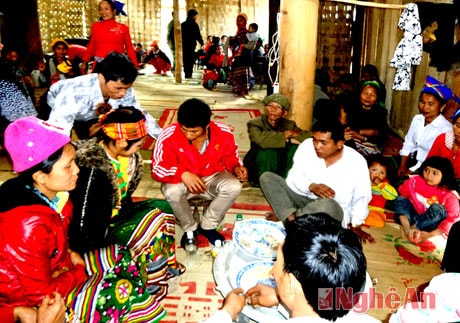 |
| A ceremony at a Khmu wedding in Pung Ca Moong village (Luong Minh - Tuong Duong). |
Over a pot of rice wine on his daughter's wedding day, Mr. Cụt Văn Liên recounted the wedding customs of the Khơ mú people... It's unclear when it started, but in the Khơ mú villages, there's a very unique wedding custom. When a son grows up and takes a liking to a girl from a certain village, he returns home to discuss it with his parents and set a date for the engagement ceremony. Months before the engagement, the groom's family must go down to the stream to fish, go up to the forest to gather resources, and slaughter a pig to make dried meat to store in the kitchen loft. Because meat, stream fish, and dried squirrel meat are indispensable gifts when proposing marriage. Furthermore, like the Thái or Mông people, the family chooses someone from their lineage to act as a "matchmaker" for their son's marriage proposal. The only difference is that the Thái people only have one matchmaker, while the Khơ mú people have two.
In the community, few can explain this rather unusual custom of asking for a wife's hand in marriage. People only know that it is a tradition passed down from their ancestors. During the engagement ceremony, the bride's family would set conditions for the dowry. Even now, many places still maintain the custom of demanding chickens, pigs, and silver ingots as dowry demands. However, in Pủng Cà Moong village, the custom of demanding silver ingots has been abolished, because nowadays a silver ingot is worth nearly 20 million dong and is very difficult to obtain. It must be said that the custom of demanding a dowry has become a burden for many families, especially in communities in the past. Mr. Cụt Văn Liên said that in the past, when he went to ask for his daughter's hand in marriage, his family had to sell their entire herd of cattle to afford a proper wedding. Therefore, when the groom's family came to ask for his daughter's hand in marriage, he no longer demanded a heavy dowry like before. The wedding only included pigs, chickens, wine, and rice to offer to the ancestors, in accordance with custom. Naturally, in both engagement and wedding ceremonies, rice wine and rice wine brewed in a traditional steamer (làu xiêu) are indispensable, usually two jars of rice wine and four bottles of "làu xiêu". During the engagement ceremony, the two families will set the wedding date for the young couple. The date for both the small wedding and the main wedding is usually decided by the groom's family. We also see this custom among the Thai people in Con Cuông, Tương Dương, etc. However, among the Khmu people, the small wedding must have two matchmakers present (compared to only one matchmaker among the Thai people). On the day of the engagement ceremony, the groom's family must also have many relatives present, so the small wedding is often just as grand as the main wedding.
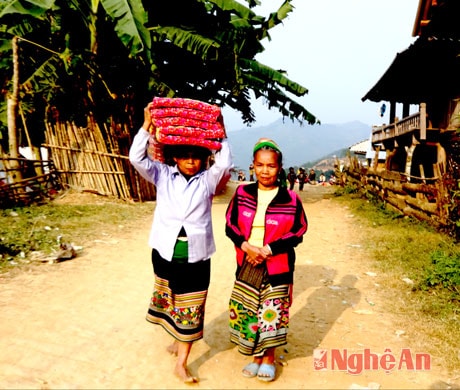 |
| Bring a mattress for the bride when she goes to her husband's home. |
According to our observations during visits to Khmu villages in Ky Son district, in many areas such as Muong Ai and Keng Du, wedding customs have been simplified. For example, in Muong Ai commune, the bride's family only asks for a dowry of about 300,000 VND as a formality. This is thanks to years of propaganda efforts by the district's Culture Department. Mr. Moong Van Nhi, Head of the Culture Department of Ky Son district, said: Following Resolution 27 of the Politburo, the District People's Council also issued a resolution on implementing village regulations in funerals and weddings, many outdated customs have been eliminated, and weddings are now held on a single day. The official wedding day is the most anticipated day. On the wedding day, the bride's family usually organizes the most elaborate celebration. All tasks, from slaughtering pigs and chickens to arranging the food and even the dishes, are handled by the groom's family. The Khmu people believe: "When you marry someone's daughter, you must take care of everything yourself." At this point, the bride's family is just like invited guests.
Regarding the wedding procession custom, the Khmu people in Ky Son (Keng Du commune) usually bring the bride home at night. The Khmu wedding procession in Keng Du typically takes place just before dawn. According to their beliefs, this is a peaceful time, usually free from obstacles on the journey to the bride's home and in their lives afterward. Another segment of the community holds the wedding procession during the day. The custom of nighttime wedding processions can also be found in many Thai communities in Con Cuong district.
In the wedding procession, the groom's family usually sends 12 or 16 people. Those chosen to go to the wedding are typically from well-established families, financially comfortable compared to their relatives, and with a certain social standing. This reflects the wish for the newlyweds' family to also become prosperous and peaceful in the future. The number of people in the wedding procession, both on the way to and from the groom's house, must be an even number.
As the wedding procession returns and prepares to enter the house, the groom personally sweeps a small area in front of the house and spreads out two mats. Next to the mats are two basins of water with towels prepared. When the bride's family members are about to step onto the mats, the newlywed couple wash each person's face and hands. At this time, the matchmaker sings the "Asking for the Bride" song, after which the bride's family presents the dowry and wedding gifts to the bride right at the ceremony in the front yard. Only then is the bride escorted to the stilt house. When the feast is served, the bride's family eats first, followed by the invited guests. However, according to our observations in Pủng village, before going to her husband's house, the girl receives gifts and dowry at her parents' home. This custom is also seen among the Thai people in the southwestern districts of Nghe An province. The dowry for highland girls is usually handcrafted pillows and mattresses made by the mountain people, received from their parents and relatives.
About a month after the wedding, the groom's family must hold another ceremony to "show gratitude" to the bride's parents. At this point, all the preparations and rituals of the wedding can be considered complete.
During a business trip to Hat Ta Ven village (Keng Du - Ky Son) a few years ago, we witnessed a rather unusual wedding in this predominantly Khmu community. The bride and groom had been living together and had a child before holding the wedding ceremony. Upon inquiry, we learned that the groom's family was poor and lacked the funds to hold a proper wedding. Therefore, they had to send their son to live with his wife's family until the couple could earn enough money to cover the wedding expenses. This is also a unique aspect of the Khmu wedding customs...
Huu Vi