
Albert Einstein was wrong; there are no black holes in the universe?
The brilliant British physicist Stephen Hawking – widely regarded as the greatest living mind – shook the scientific world when he reversed his lifelong research to say that cosmic black holes do not exist.
The brilliant British physicist Stephen Hawking – widely regarded as the greatest living mind – shook the scientific world when he reversed his lifelong research to say that cosmic black holes do not exist.
This disabled genius has published a scientific report that completely dismantles the modern theory of black holes. He argues that the idea of an event horizon, where light cannot escape, is flawed.
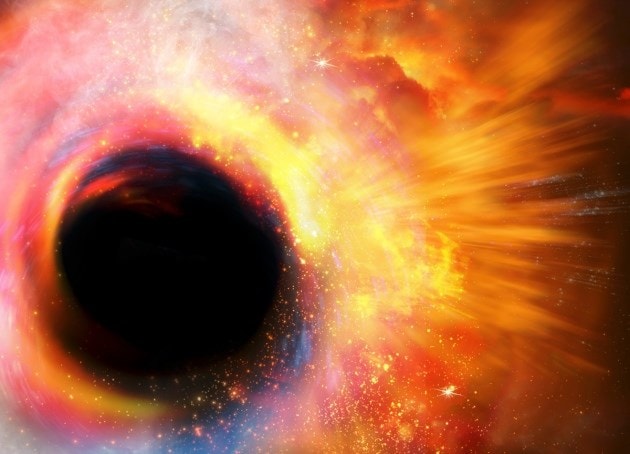 |
| Graphic image of a black hole in the universe (Source: Nature) |
One of the pillars of physics states that the immense gravitational force created by the collapse of a star is so powerful that nothing can escape its pull. This pillar owes a great deal to Hawking's efforts.
But Hawking challenged this idea, saying that instead of having an event horizon like that, we should think of a "less distinct horizon." And this idea of his contradicted Albert Einstein's views.
He expressed his views in an article titled "Information Preservation and Weather Forecasting For Black Holes," which seems likely to plunge scientists into a whirlwind of controversy.
Hawking wrote: "The absence of event horizons means there would be no black holes—which would forever imprison light."
He said that light rays attempting to escape the center of a black hole would be trapped, much like being stuck on a treadmill, and would gradually shrink through emission.
Hawking told the scientific journal Nature: "In classical theory, there is no escape from black holes. But quantum theory allows energy and information to escape from black holes."
The professor's new hypothesis about so-called gray holes would allow matter and energy to be trapped for a certain period of time before being released and returning to space.
The physicist acknowledged that his new idea would require a new theory that would integrate gravity with other fundamental natural forces. But he added, "The exact solution remains a mystery."
Hawking's latest work was inspired by a speech he delivered via Skype to a meeting at the Kavli Institute for Theoretical Physics in Santa Barbara, California, in August 2013.
He intends to solve the black hole firewall paradox, which has been baffling scientists for nearly two years. This problem arose from a "thought experiment" where scientists tried to imagine what would happen if an astronaut were unlucky enough to fall into a black hole.
Event horizons are a simple mathematical consequence of Einstein's theory of relativity.
Black hole expert Don Page of the University of Alberta in Edmonton, Canada, admitted: "The picture Hawking painted sounds very plausible."
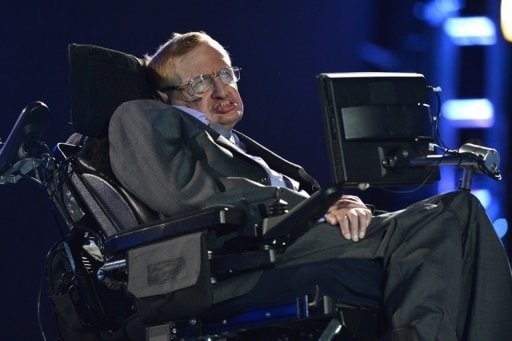 |
| Stephen Hawking suffered from polio, but is considered the greatest mind we have ever seen (Source: AFP). |
But theoretical physicist Joseph Polchinski of the Kavli Institute is skeptical and asserts: "In Einstein's theory of relativity, the black hole horizon is not so different from other parts of the universe. We will never see space and time changing erratically right next to us. This phenomenon is too rare on a large scale."
Raphael Bousso, a theoretical physicist at the University of California, Berkeley and a former student of Hawking, acknowledges that many physicists will find Hawking's new research "disgusting."
He said: "The idea that there is no point from which you cannot escape a black hole is even more extreme and reveals more problems than existing firewall theories. But the fact that we are still discussing such questions, 40 years after Hawking's first studies of black holes and information, is proof of their enormous importance."
According to VNA