
Reduce unnecessary travel, limit expenses.
Over the years, along with the implementation of the project "Improving medical ethics in medical examination and treatment facilities," the Nghe An Health Department has focused on directing and investing in the development of advanced techniques and adopting many new techniques at medical facilities. This has contributed to reducing the number of patients seeking treatment outside their designated areas and easing the financial burden on the people.
(Baonghean)Over the years, along with the implementation of the project "Improving medical ethics in medical examination and treatment facilities," the Nghe An Health Department has focused on directing and investing in the development of advanced techniques and adopting many new techniques at medical facilities. This has contributed to reducing the number of patients seeking treatment outside their designated areas and easing the financial burden on the people.
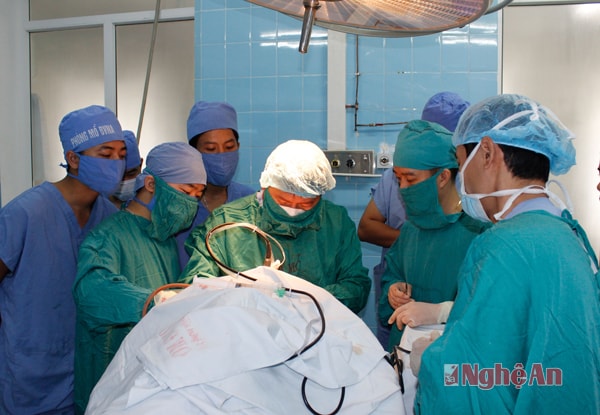 |
| Brain tumor surgery at Nghe An Friendship General Hospital. |
As one of the leading provincial hospitals, Nghe An Friendship General Hospital is highly regarded for its practical contributions to public health care and is striving to become a leading hospital in the North Central region. The hospital aims to develop 10 new techniques per year and has exceeded this target, introducing 25-30 new techniques into its diagnostic and treatment programs. Currently, at the hospital, techniques such as knee arthroscopy and cervical spine trauma surgery are no longer considered difficult and are performed proficiently. Techniques such as endoscopic surgery, kidney cyst surgery, bladder stone removal, prostate adenoma removal, colorectal and gastric resection, abdominal tumor removal, laser lithotripsy, basic endoscopic surgery for nasal polyps and sinusitis, and phacoemulsification of the eye using new technology have become routine and have been transferred to lower-level hospitals. 2014 marked the third year that the hospital has focused on developing thoracic surgery techniques such as open-heart surgery, coronary stenting, ductus arteriosus closure, pulmonary valve dilation, and pacemaker implantation. By the end of 2013, 167 patients with congenital heart defects had been saved. Even in smaller departments like the ENT department, all the techniques available at the central level have been successfully implemented, such as treating congenital deafness by replacing the ossicles in the ear.
Constantly learning and adopting new techniques, the hospital regularly sends its staff and doctors for specialized and advanced training at major hospitals both domestically and internationally, conducts online consultations on difficult cases with leading experts at the central level, and explores, researches, innovates, and applies high-tech techniques in diagnosis, treatment, and care. For example, at the 2013 Provincial Science and Technology Innovation Award, doctors Duong Dinh Chinh, Nguyen Tat Thang, and Nguyen Van Huong from the Friendship General Hospital were awarded second prize for two highly effective projects: "Treatment of cerebral vascular malformations by endovascular intervention" and "Treatment of gastric cancer by laparoscopic surgery with lymph node dissection"... Successfully mastering a new technique means that many patients no longer need to be transferred to central hospitals, reducing the financial burden.
Mr. Tang Dinh Hung, 49 years old, from Dien Nguyen commune, Dien Chau district, a brain tumor patient who was saved by surgery at the Neurosurgery and Spinal Surgery Department of the Friendship General Hospital, expressed: “Before the surgery, I couldn't move, my eyesight was poor, and I had pain in the back of my head. After the surgery using the new method with a Navigation system, within 2-3 days, I was able to sit up on my own and do light activities, my mind was clearer, and my health recovered well. Luckily, the surgery was done at the provincial hospital; going to Ho Chi Minh City would have been too expensive.” According to Dr. Le Thi Thanh Tra, Head of the General Planning Department of Friendship General Hospital: “On December 6, 2013, with the assistance of the 198 Hospitals of the Ministry of Public Security and Belgian experts, the hospital successfully performed its first kidney transplant. The kidney donor was Ms. Vo Thi Huong, born in 1966, residing in Block 7, Nghi Thuy Ward, Cua Lo Town. The recipient was Hoang Van Hoa, born in 1988 - Ms. Huong's son. This is a success for the hospital because currently not many hospitals in Vietnam can perform this procedure.”
Although only operational since August 8, 2011, the Oncology Hospital has quickly become a regional specialized nuclear hospital. Since its establishment, the Oncology Hospital has successfully performed many complex procedures previously only performed at the central level, such as: successful surgery for lung tumors, mediastinal tumors, and esophageal tumors; gastrectomy, total gastrectomy with lymph node dissection; colon resection; and liver lobectomy... In June 2013, the Oncology Hospital successfully performed its first bone marrow transplant on Hoang Thi Hang, a 22-year-old woman from Trung Thanh commune, Yen Thanh district. Ms. Hoang Thi Hang was diagnosed with malignant lymphoma.
Subsequently, the patient received treatment at Nghe An Oncology Hospital using traditional methods, including chemotherapy. After meeting the necessary infrastructure requirements, the hospital successfully performed a bone marrow transplant for Ms. Hang. On January 18, 2014, Ms. Hang was discharged from the hospital, her health recovering well. Associate Professor, Doctor, Colonel Nguyen Trung Chinh, Senior Advisor of Nghe An Oncology Hospital, stated that bone marrow transplantation is the most advanced, modern, and effective method in cancer treatment currently available worldwide and in Vietnam. This is especially true for blood cancers such as acute and chronic leukemia, bone marrow failure, and malignant lymphoma. The transplant procedure takes approximately 4 hours, and the patient only feels similar to receiving a blood transfusion, so they can watch television normally during the procedure. After the transplant, patients do not need to use anti-rejection medication, and the remission rate after 5 years will reach 80-90%, while other methods such as surgery, chemotherapy, or radiotherapy only achieve a success rate of 50-60%. Nghe An Oncology Hospital is the first provincial-level hospital to successfully implement bone marrow transplantation.
Nghe An Obstetrics and Pediatrics Hospital has achieved great success in open-heart surgery techniques. Dr. Phan Van Tu, Director of the hospital, stated that the hospital has incorporated open-heart surgery into routine procedures and aims to successfully treat approximately 40%–50% of children with congenital heart defects by 2014. Alongside receiving the technology transfer for open-heart surgery, the hospital is also adopting maintenance therapy techniques for leukemia (also known as acute myeloid leukemia) from the National Children's Hospital (i.e., using maintenance medication, as childhood cancer has many different pathological aspects and treatment methods compared to adult cancer).
The implementation of the Ministry of Health's Project 1816 on technical support for grassroots healthcare has created positive changes. In the Northwest Regional General Hospital, Vinh City Hospital, and the general hospitals of Nghi Loc, Yen Thanh, and Dien Chau districts, laparoscopic surgery has been performed proficiently and has become routine. Not relying solely on higher-level hospitals, lower-level hospitals have proactively embraced new scientific and technological advancements. Dr. Tang Viet Ha, Director of the Northwest Regional General Hospital, stated: “Currently, the hospital has mastered several complex techniques, ensuring that it can meet the local healthcare needs of the people in the region, such as brain surgery and extracorporeal shockwave lithotripsy… To meet the increasingly high demands for healthcare from the people, the hospital has invested in modern equipment through various means, including state funding and social mobilization. In addition, we have sent staff for advanced training at the central and provincial levels…”
Dr. Bui Dinh Long, Director of the Nghe An Department of Health, said: With the goal of becoming a high-tech medical center in the North Central region, since 2010, the research and application of science and technology in medical examination and treatment has been strongly promoted. Since 2010, provincial and district hospitals have successfully applied many high-tech techniques in treatment and diagnosis. Priority has been given to developing science and technology in the fields of disease prevention, treatment, and rehabilitation. Information technology is strongly applied in hospital management, and all medical examination and treatment units are responsible for selecting and developing new techniques appropriate to their approved technical classification. The quality of healthcare services provided to the people is the measure of the medical ethics of healthcare workers. Focus on training, attracting, and developing medical human resources in a way that is both general and specialized, training doctors for all levels to meet the needs of healthcare, protection, and improvement of people's health in all situations, and fulfilling the task of developing the healthcare sector in the short and long term; Hospitals should focus on training to implement technical procedures according to the roadmap, emphasizing the training of high-quality human resources by sending capable young staff and forming specialized technical teams to study domestically and internationally.
Thanh Son - Tu Thanh