

Zhou Yongkang and his son pay the price.
Following the arrest and public trial of Politburo member and former Chongqing Party Secretary Bo Xilai, which shook domestic and international public opinion, observers have recently focused particular attention on the arrest of Zhou Bin, the son of a former high-ranking leader in the Chinese Communist Party, Zhou Yongkang, who once served on the Politburo Standing Committee.
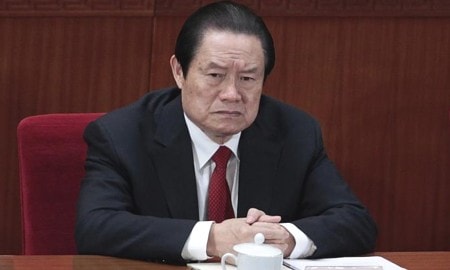 |
| Many people close to Zhou Yongkang have been arrested. |
Zhou Yongkang was born in 1942 in Jiangsu Province. He joined the Communist Party of China in 1964 and subsequently participated in geological surveys in northeastern China in 1966. In the early years of his career, he spent most of his time working in the oil and gas industry. By the mid-1980s, he was Vice Minister of the oil and gas industry, and from 1996 served as General Manager of the China National Petroleum Corporation. In 1998, he became Minister of Natural Resources and Environment, and in 1999, he was Party Secretary of Sichuan Province. In 2002, he was appointed Minister of Public Security, serving from 2002 to 2007.
Zhou Yongkang's rapid rise in his political career was due to bribery and the support of Jiang Zemin (Zhou married Jiang's niece after his first wife died in a traffic accident; there were rumors that Zhou was the mastermind behind the accident). When Jiang Zemin launched the crackdown on Falun Gong, Zhou Yongkang was one of the most active participants and supporters. Furthermore, he is believed to have carried out extremely brutal repression and implemented various related measures to cut off their financial resources, such as dismissing children whose parents practiced Falun Gong and vice versa. As a result of these actions, thousands of people were killed or disappeared.
In addition to the crimes committed against Falun Gong practitioners, during his time in office at the Ministry of Public Security, as well as before as Party Secretary of Sichuan Province and holding important positions in other ministries and departments, Zhou directly or indirectly assisted subordinates in corruption, causing great public outrage in the world's most populous country. However, at that time, Zhou Yongkang's power was too great due to the absolute support of Jiang Zemin. Zhou retained his position until he relinquished power and retired in May 2012.
In August 2013, Chinese media reported that Zhou Yongkang and his close family members were under investigation by a corruption investigation team personally established by the General Secretary of the Communist Party of China, Xi Jinping. After nearly four months of investigation, on December 1, 2013, the Director of the Central Office of the Communist Party of China, along with security personnel, went to Zhou Yongkang's home to read the arrest warrant for him and his second wife, Jia Xiaoye. Shortly after Zhou Yongkang's arrest, Zhou Bin (Zhou Yongkang's eldest son), who was believed to have used his father's influence to profit through business deals, land transactions, interference in oil and gas projects, bribing officials, and extorting protection money, was also arrested after a period of house arrest in the suburbs of Beijing.
Given their crimes, the Chu father and son and their accomplices will certainly be held accountable before the law and the Chinese people. It's worth noting that since Xi Jinping succeeded his predecessor Hu Jintao, he has continued to implement policies aimed at further boosting the world's second-largest economy and flexible foreign policies to realize the "Chinese Dream." Another important priority is his tough anti-corruption campaign, with very firm statements. He once said: "Whether central or local officials, whether high or low-ranking, all must be dealt with according to the law if they engage in corruption, extravagance, or decadence. Corruption, in his view, is an incurable disease that affects the survival of the Party. Corruption brings 'happiness' to some, but causes suffering to the people…"
Canh Nam