

Milk prices are rising again.
Despite the Ministry of Finance's regulations on milk price management, from the end of 2013 to the beginning of 2014, the price of powdered milk for children continued to rise, and it is predicted that many milk products will increase in price even further in the near future.
Although no official announcement has been made regarding milk price increases, market surveys conducted in early 2014 showed that the prices of powdered milk for children from companies such as Abbott Vietnam and Mead Johnson had already been adjusted upwards.
Leading the new wave of milk price increases was Mead Johnson, which raised its prices by 5-7% on December 12, 2013, shortly after the Ministry of Finance issued Circular 30 requiring milk companies to reduce costs to lower selling prices. Abbott, another major milk brand in Vietnam, also informed its distributors about the price increase. Thus, despite Circular 30 on managing the prices of milk and nutritional foods for children under 6 years old, which officially came into effect on November 20th, and the continuous issuance of documents by the Ministry of Finance, many milk companies still increased prices at the end of last year.
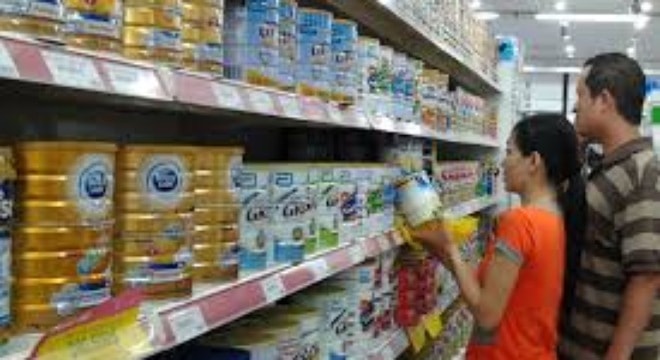 |
Mr. Truong Van Toan, Director of Legal and External Relations at FrieslandCampina, also stated that the price of raw milk is the main reason why FrieslandCampina's leadership is expected to meet next week to calculate selling prices, and it is highly likely that they will have to increase the price of finished milk products.
Unlike foreign dairy companies that quietly raise prices, some domestic dairy companies have announced price increases in advance due to fluctuations in raw material prices. According to Vinamilk, since the third quarter of 2013, the prices of food, including dairy raw materials, on the world market have been fluctuating and increasing continuously, reaching a severe crisis compared to previous years.
By early 2014, many global dairy raw material suppliers continued to raise prices and only agreed to supply raw materials on a short-term basis to dairy raw material importers. Even Vinamilk, which in previous years had the advantage of securing import contracts for the entire year, found itself in a similar situation this year, unable to secure contracts for the year's production.
Since the beginning of 2014, the prices of key raw materials (milk powder, butter oil) on the world market have increased by 30-57% compared to the same period of the previous year. Specifically, skim milk powder increased by approximately US$1,250/ton (imported to Ho Chi Minh City) compared to the same period in 2013 (from US$3,650/ton to US$4,900/ton), equivalent to a 34% increase; whole milk powder increased by approximately US$1,555/ton, from US$3,600/ton to US$5,155/ton, equivalent to a 43% increase compared to the same period in 2013; and butter oil increased from US$3,650/ton to US$5,746/ton.
Domestically, the purchase price of raw fresh milk from farmers has also increased. For example, Vinamilk increased the purchase price from farmers by about 22% by the end of 2013 compared to the beginning of 2013. A Vinamilk representative stated: "In the coming time, the input costs for production will be a major headache for milk production and trading businesses. Therefore, adjusting domestic milk prices in the near future may be an unavoidable issue."
Incompetence in management
At the end of 2013, the Ministry of Finance requested provincial and city finance departments to strictly manage milk prices in accordance with regulations. The Ministry also requested these units to take the lead and coordinate with tax authorities, customs, and other relevant agencies in their respective areas to strengthen inspections and audits of compliance with current pricing laws for milk and milk products included in the list of milk products for children under 6 years old as stipulated...
This is considered another decisive move by the Ministry of Finance to strengthen the management of milk prices by milk production and trading businesses. However, according to economic experts, Circular 30 only requires businesses to declare prices, but it cannot thoroughly control the price of imported milk or the price of finished milk products after production. Furthermore, the current Price Law allows milk businesses to increase prices by 15-20%, with each increase separated by at least 15 days. Thus, milk businesses can still freely increase prices several times a year, even twice a month, without violating the law.
Mr. Tran Quang Thang, Director of the Institute of Economics and Management of Ho Chi Minh City, commented: "With such a high price ceiling and a short period during which price increases are prohibited, it's tantamount to creating an opportunity for dairy businesses to freely raise prices. Therefore, this circular needs to be revised. On the other hand, when businesses give reasons for price increases, the legitimacy of those reasons must be considered by presenting and comparing them with relevant standards to decide whether or not the increase is permissible."
According to Vietnam.net