

Sea clam billionaire
(Baonghean)Near the sea, that area was once a wild, overgrown alluvial plain, inhabited only by mangroves and other coastal species. But one man transformed this desolate land into a "gold mine," becoming a billionaire through clam farming and supplying clam seedlings, creating jobs for many people in this coastal region. That man is Thai Ba Khang from Son Hai, Quynh Luu.
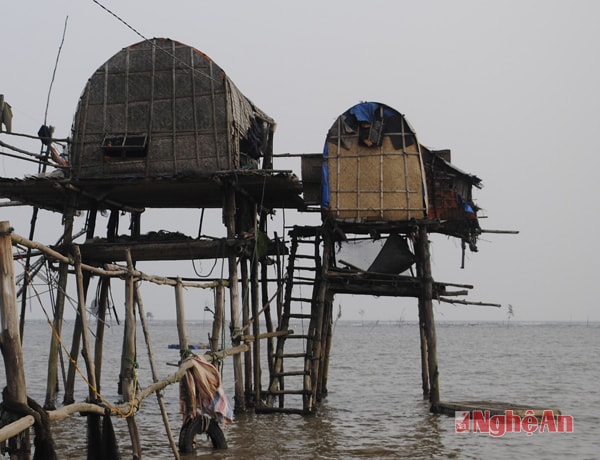 |
| Commercial clam farming area. |
We visited the "clam farming hub" of Son Hai - Quynh Tho - Quynh Luu in the early days of the year. The cold rain felt like it was cutting into our skin, but Mr. Thai Ba Khang still went out to his watchtower to tend to his sea clams. Beneath the shimmering, magical silver waves lies a "treasure trove" worth tens of billions of dong. Khang recalled: "For over a decade, I struggled with sea clam farming, and there were times I thought I would lose everything, but with the determination to escape poverty, I decided to bring clam farming to the Quynh Luu coastal area."
Born in 1969 into a poor family, Thai Ba Khang had to drop out of school after the 8th grade to work catching crabs and raking for clams when the tide receded, and then going out to sea with his father to catch seafood. After nearly 20 years in the fishing industry, Khang suddenly had an idea: The entire Son Hai and Quynh Tho alluvial plains had been a laborious source of income for locals, yet they still couldn't make ends meet, while the market for clams was booming. He thought he could transform the alluvial plains to raise clams and get rich on his own land. Khang discussed this idea with his wife and relatives, but everyone discouraged him, fearing that borrowing money to buy clam seedlings and "throwing" them into the sea wouldn't be successful. But with unwavering determination, Khang decided to pursue clam farming. After obtaining approval from the Son Hai commune, in 2001 he began reclaiming the barren coastal alluvial plains. After more than a year of battling the sun and wind, Khang transformed the alluvial plains into a flat clam farming area.
In 2002, Khang saved up and borrowed nearly 200 million dong, then packed his bags and went to Ben Tre to buy 12 tons of clam seedlings to stock. He was overjoyed to bring the seedlings back, but before he could even worry about the consequences, nearly 80% of them died. The cause was the hot weather, which couldn't maintain the temperature. Many thought Khang had given up, but unexpectedly, he decided to sell his land and house for 180 million dong to continue his clam farming venture. Khang even took the money back to Ben Tre to buy more seedlings. This time, he allocated funds to hire an "expert" to help transport the seedlings. Because they were protected in temperature-controlled equipment, the survival rate of the clams reached over 90%. Only after stocking them in the tidal flats did Khang feel relieved.
Khang started with a clam farming area of about 3 hectares, and the first harvest was a success, earning him much admiration. Seeing that clam farming was well-suited to the local climate, Khang continued to invest, expanding his area to 6 hectares of tidal flats. He went to Giao Thuy, Nam Dinh province to obtain clam seedlings, saving on travel costs and resulting in a higher survival rate. With consistent clam sales, his profits sometimes reached 3-4 billion VND per year. In other years, when prices dropped, he could only sell 30% of his harvest, with the rest remaining in the ponds. But according to Khang, business has its ups and downs; one must accept them and wait for the right time. The potential for sea clam farming is enormous, while many tidal flat areas remain uncultivated. Khang has leased additional land from the commune and local people in Quynh Tho, increasing the area for commercial clam farming to over 30 hectares (the largest clam farming area in Nghe An province), creating jobs for 20 permanent workers and over 100 seasonal workers in the locality.
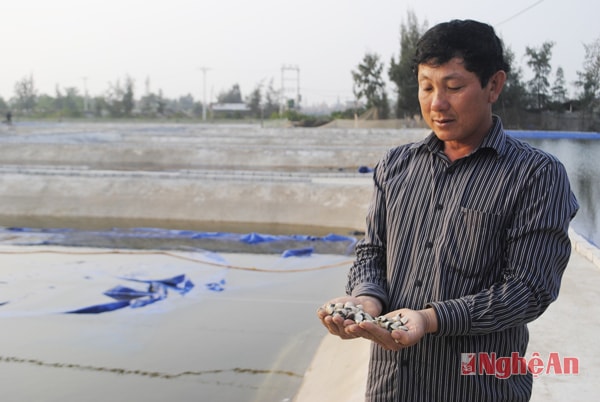 |
| Mr. Thai Ba Khang inspects the clam seedlings. |
Mr. Khang led me to the tidal flat and excitedly examined the clams he had collected: "The main market for clams is China. They really like our clams because they are uniform in size, have a beautiful white color, and are of guaranteed quality. Thanks to proper care and technical procedures, the clam beds are developing steadily, achieving an average yield of 30 tons/hectare. The price of commercial clams reached 24,000 VND/kg in some years, but has now dropped to only 13,000 VND/kg, and even at that price, we are still profitable. In 2013 alone, Khang's family earned over 12 billion VND from clam farming. Clams can be harvested after 15-16 months, which is quite a long time, so Khang applies year-round stocking to ensure staggered harvesting." Mr. Khang added: "Clam farming is also very laborious; you have to constantly learn techniques and gain experience. To sustainably farm sea clams, you must first choose the right farming area. Clam farming areas are usually tidal flats, where there is a certain amount of freshwater flowing in." The seabed consists of sandy mud, with a salinity of 15-25‰, and the beach is exposed to the elements for no more than 4-5 hours per day.
Special attention must be paid to improving the hygiene of the clam beds. When the tide recedes, the surface of the bed should be plowed to a depth of about 5-10 cm and leveled to allow the clam spat to easily burrow in, preventing them from being swept away by the tide. Create raised beds aligned with the ebb and flow of the tide. Each bed should be 1.5m wide, with a walkway between them to prevent trampling after stocking. In clam farming areas where the bed is exposed for more than 5 hours/day, measures are needed to retain water and maintain moisture in the farming area. Enclose the farming area with netting, using a mesh size of 2a = 1cm and a height of 80cm. Use bamboo or wooden stakes to support the netting. Select and stock high-quality clam spat; small clams should be round and uniform in shape, pinkish-white in color. The size of the spat depends on the size, but the minimum size should be 0.5-1cm/clam. Clams do not need to be fed, as their food consists of plankton and phytoplankton in the water. However, due to their sensitivity to sudden temperature changes and water pollution, mass clam mortality is common. Under unfavorable conditions, clams may surface and migrate elsewhere. Therefore, monitoring and timely intervention are necessary. Daily, when the tide recedes, it is essential to remove debris and dead clams and clean the farming area to prevent contamination.
Clam farming has always faced a shortage of seedlings; in some years, the entire area was left fallow due to seed scarcity. Therefore, to ensure a reliable seed source, since 2005, Mr. Khang has boldly cultivated clam seedlings on 1 hectare, primarily using seedlings from China and Nam Dinh. To completely self-supply clam seedlings and meet market demand, since 2009, Mr. Khang has conducted research and organized experimental production of breeding clam seedlings, but experienced more failures than successes. After much hard work and dedication, in 2013, Mr. Khang, along with aquaculture experts, successfully produced breeding clam seedlings using technology transferred from Taiwan. To date, he has established a professional clam farming facility encompassing seed production, cultivation, harvesting, and product distribution. Leading us to his approximately 3-hectare clam seed production area, we saw that the ponds and tanks were all concreted and equipped with modern machinery such as water filtration systems and clam spawning tanks. With a total investment of over 7 billion VND, in 2013 alone, he produced nearly 1 billion clam seedlings, meeting his own needs and supplying seedlings to many other establishments in the area. It is known that Mr. Khang's facility is the first in the Central provinces to successfully produce clam seedlings. Not content with his success, Mr. Khang also has the idea of collecting and propagating the native clam species in Nghe An province, as this species has the advantage of being hardy, adapting well to the local marine environment, and producing a product with many distinctive flavors and brand value.
Van Truong