

A mark left on the border
(Baonghean)Along with the task of patrolling and firmly protecting the 419.5 km border, the Nghe An Border Guard also has many specific and practical action programs to help ethnic minorities develop their economy and stabilize their lives. These officers and soldiers in green uniforms have contributed to transforming the border region, affirming the trust of the local people in the army, government, and Party organization.
Where border guards are scarce
The journey to Co Phat and Bung villages in Mon Son commune, Con Cuong district, remains challenging, requiring navigating rapids and waterfalls upstream along the Giang River. This is also the only route to reach the Dan Lai ethnic group in Khe Khang. Despite the hardships, the Dan Lai people no longer flee; they have formed villages, living peacefully, learning to cultivate rice, and raising livestock. To achieve this, the Provincial Border Guard, along with the local government and various departments of Con Cuong district, have deployed numerous officers and soldiers to closely engage with the people, employing a persistent and gradual approach, and ensuring that actions match words. Mr. La Van Linh, head of Co Phat village, said: “Thanks to the help of the border guards and the government, the villagers now have sturdy houses and no longer have to sleep on the roadside like before. Now, the villagers also know how to cultivate rice, raise chickens and cows, and plant various crops to have a stable food supply. Their children are also learning to read and write. Every day, the border guards visit and encourage them, so the villagers are happy and content in their village. Before the recent Lunar New Year, 19 out of 67 people intended to return to their old homes, but the border guards persuaded them to stay in Co Phat…”
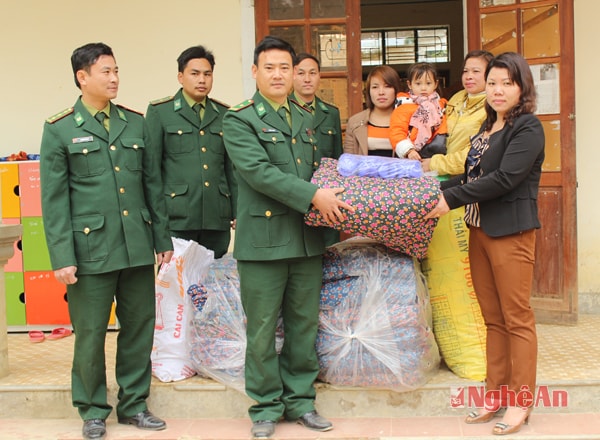 |
| The My Ly Border Guard Post donated blankets to students of Bac Ly Commune Kindergarten in Ky Son District. |
As for the people of Huoi Son village, Tam Hop commune, Tuong Duong district, they are truly delighted after several years of "descending from the mountains." Previously, the 47 Mong households in the village practiced nomadic farming, clearing forests for cultivation, and even freely migrating to Laos. Their lives were constantly on the move, marked by poverty and hardship. Faced with this situation, the Border Guard actively encouraged the people to settle down and cultivate land, helping them develop their economy towards a market-oriented approach. Border guard officers and soldiers called for and directly assisted in building 47 "Great Solidarity" houses for the 47 Mong households. They also established model economic zones by selecting reputable individuals in the village and focusing on assisting and guiding them in developing the VAC (Garden-Pond-Livestock) model. The success of these families has inspired and motivated the villagers to follow suit. From a single fish pond, a cattle shed, or a rice paddy, those numbers have now increased tenfold. The villagers trusted the soldiers, so they were determined to stay in their villages, no longer living a nomadic lifestyle as before. Now, Huoi Son village is becoming a shining example on the border of the Fatherland. "The lives of our villagers have improved significantly compared to before. Thanks to the help of the Border Guard, our people have houses, electricity, and know how to cultivate rice..." - Village head, Mr. Vu Tong Long, shared.
There are many other models of assistance for ethnic minorities in mountainous areas that the Border Guard Force has jointly implemented. In recent years, along with increasing outreach to local communities, the provincial Border Guard Force has also provided assistance to three impoverished communes: Mon Son (Con Cuong district), Tam Hop (Tuong Duong district), and Bac Ly (Ky Son district). To carry out this work, the Border Guard Force established a Steering Committee for assisting impoverished communes with seven members, including Party Committee members, commanders, and heads and deputy heads of functional departments. Immediately afterward, the Steering Committee assigned officers and border guard posts stationed in the districts to survey the communes, assess their needs, and develop implementation plans.
Simultaneously, the Border Guard Force mobilized contributions from officers and soldiers, as well as the cooperation of businesses, to create resources and funding for assisting impoverished communes. With this systematic approach, the Border Guard Force mobilized nearly 10 billion VND and thousands of man-days to build schools, clinics, and support housing construction for the people. In addition, they organized free medical examinations and provided free medicine, donated books and school supplies to the people in the communes. Notably, the Border Guard Force sent officers directly to the communes, using a hands-on approach to strengthen the political system and grassroots organizations; they introduced suitable plant and animal breeds for each area and provided technical guidance on cultivation and farming. This activity encouraged the people to abandon outdated production and livestock farming methods, increasing crop and livestock productivity.
According to the assessment of the Steering Committee for supporting poor communes in the western part of the province, the Border Guard is a leading unit in both methods and effectiveness in assisting poor communes. Not only does it assist the assigned communes, but the Border Guard also helps most communes along the border to strengthen their political systems and raise people's awareness in all aspects. Lieutenant Colonel Le Nhu Cuong, Deputy Head of Political Affairs, Border Guard of Nghe An province, said: “Assisting poor communes along the border is considered a crucial political task by the Nghe An Border Guard. Therefore, each unit and assigned officer strives their best. In particular, we have mobilized the Truong Son Solidarity Program to provide very active financial support for the construction of projects. Our activities help the people with both ‘the fish and the fishing rod,’ contributing to solving immediate difficulties and ensuring long-term stability and development...”
Firmly committed to responsibility, unwavering in belief.
To strengthen the grassroots political system, the Nghe An Border Guard Command has deployed hundreds of Party members to participate in activities with village Party branches and assigned officers to serve as deputy secretaries and secretaries of commune Party committees in border communes. Currently, there are 65 border guard officers temporarily residing in village Party branches in key areas, and 19 officers assigned to serve as deputy secretaries of border commune Party committees. Major Dam Thien Thuong, currently serving as Deputy Secretary of the Party Committee of Tri Le commune, Que Phong district, said: “During the deployment to the commune, we have had more opportunities to visit villages, interact with the people, and understand their thoughts and feelings in order to make suggestions to the Party committee and government in managing economic development and stabilizing their lives. To do that, the officers assigned must learn the local language, understand their customs and traditions, and live and work alongside them...”
Among the officers assigned to serve as deputy secretaries of the commune Party committees, Lieutenant Colonel Ha Dinh Tin is a comrade who has left a significant mark. In September 2005, he was assigned to serve as Deputy Secretary of the Party Committee of Bac Ly commune. With 30 years of service in the force, he always understood that the only path to success for an officer is to be deeply involved with the people. Every day, he went down to the villages to help the people clear land, plow fields, and sow seeds. He worked with the commune Party committee to consolidate and develop Party branches. When he first arrived, the entire commune only had 5 Party branches; by 2008, this had increased to 19 branches, eliminating villages without Party branches. The number of Party members increased from 98 to 202. In principle, border guards are only assigned to serve as deputy secretaries of the commune Party committees, but since May 2010, with the trust of the villagers and his comrades in the border region, Lieutenant Colonel Ha Dinh Tin has been elected as the Secretary of the Bac Ly Commune Party Committee. This is a remarkable achievement, a result of Lieutenant Colonel Tin's own efforts and the trust and affection of the people. Speaking to us, he said: "In our thoughts and actions, we always strive to fulfill our assigned duties. The most crucial thing is to strengthen unity within the Party and among the people, discussing and reaching a consensus on action."
Contributing to the building and strengthening of the grassroots political system and assisting the people in economic development is considered a key element in the Border Guard Force's strategy for mass mobilization work. Throughout the villages, the imprint of Border Guard officers and soldiers is deeply ingrained, strengthening the bond between the military and the people and fostering a sense of responsibility among ethnic minority communities in protecting the border. Through this approach, for the past 55 years, generations of Border Guard officers and soldiers have built a solid border defense posture with the consensus of Party committees and authorities, and the active participation of the people.
Colonel Nguyen Viet Ha, Deputy Political Commissar of the Nghe An Border Guard, affirmed: “Clearly recognizing our responsibilities, every officer and soldier of the border guard must always immerse themselves in the villages, working diligently and setting an example in all labor, production, and cultural development movements. This further deepens the bond between the border guard and the local people, making a significant contribution to firmly protecting the nation's borders. In reality, many of the heroic achievements of the border guard have always been accompanied by the support of the ethnic minority people. They have provided hundreds of thousands of valuable pieces of information, helping the force successfully combat various types of crime, and the people have also nurtured, protected, and shared with officers and soldiers during their duties on the border...”
The lives of people in border areas have improved significantly, and the construction of a "People's Border Defense" posture has been implemented comprehensively by the Nghe An Border Guard Command through various solutions. Over the years, trust, responsibility, and sharing with the people in border regions have been paramount. This is a crucial motivation that encourages Border Guard officers and soldiers to continue to excel in their duties, proving themselves worthy of being heroic soldiers in green uniforms on the front lines of the Fatherland.
Nguyen Son