
A treasure of Vietnam-Japan diplomatic relations.
The texts and paintings in the Japanese Culture exhibition at the Vietnam National History Museum in Hanoi (from January 16 to March 9) show that Japan and Vietnam established diplomatic relations more than 400 years ago.
The texts and paintings in the Japanese Culture exhibition at the Vietnam National History Museum in Hanoi (from January 16 to March 9) show that Japan and Vietnam established diplomatic relations more than 400 years ago.
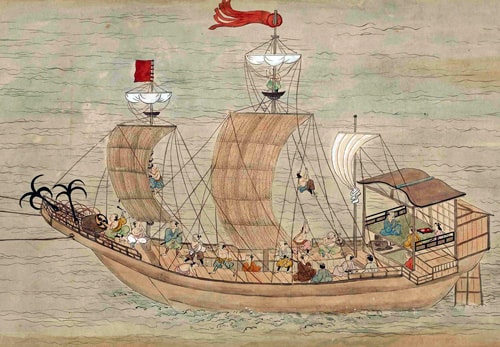 |
| Color painting on paper, illustrating the journey of the Shuin-sen merchant ship to Vietnam - Photo: provided by the Vietnam National History Museum. |
Many scholars have spoken of Lord Nguyen Hoang's achievements in expanding the territory and asserting sovereignty over the seas and islands. Now, this exhibition highlights another of his accomplishments: establishing diplomatic relations between the two countries. This is demonstrated through a diplomatic letter sent by Lord Nguyen Hoang's government to the Hideyoshi Shogunate (Japan) to establish trade relations. The letter is dated the 14th year of the Quang Hung era, Le Trung Hung Dynasty, 1591.
“In the late 16th and 17th centuries, cultural and commercial exchanges between Vietnam and Japan flourished. The Nguyen Lords allowed Japanese merchants to establish a Japanese quarter in Hoi An for trade. Many Japanese merchants married Vietnamese women, had children, and settled permanently in Hoi An,” said Associate Professor Dr. Nguyen Dinh Chien, Deputy Director of the Vietnam National Museum of History. Vietnamese merchants are also considered to have brought the first elephant to Japan. Japanese archaeology has also uncovered many ancient Vietnamese ceramics dating from after the 14th century.
Another artifact that demonstrates the Vietnam-Japan exchange is the painting "People of Many Nations." The painting is divided into approximately 40 panels, each depicting a group of people. "These are images the Japanese imagined of people from various countries. The third section includes a picture related to Vietnam. This panel depicts women and men. Next to the woman is the inscription 'Dong Kinh,' referring to women from Northern Vietnam. Next to it is the inscription 'Giao Chi,' referring to men from Central Vietnam," a Japanese representative explained.
Other noteworthy artifacts include: a red-stamped permit issued by the Tokugawa Shogunate to a ship sailing to Giao Chi (Southern Vietnam) for trade, during the Edo period in 1614; and a scroll painting depicting a ship sailing to Hoi An (Southern Vietnam) for trade, during the Edo period, 17th-18th centuries.
The exhibition also features many other valuable artifacts.
According to Thanh Nien newspaper