
The engineer returned to his hometown to raise chickens.
(Baonghean) - Graduating from the Agricultural University 1 with a good degree in Animal Husbandry and Veterinary Medicine, Nguyen Van Sinh (born in 1982), from Cau Da village, Yen Hop commune, Quy Hop district, harbored a simple dream: to own a chicken farm in his impoverished homeland. With that aspiration, he opened a chicken farm in his village, initially achieving success and igniting the potential for genuine wealth creation right in his hometown...
(Baonghean) - Graduating from the Agricultural University 1 with a good degree in Animal Husbandry and Veterinary Medicine, Nguyen Van Sinh (born in 1982), from Cau Da village, Yen Hop commune, Quy Hop district, harbored a simple dream: to own a chicken farm in his impoverished homeland. With that aspiration, he opened a chicken farm in his village, initially achieving success and igniting the potential for genuine wealth creation right in his hometown...
In the days leading up to the Lunar New Year of the Horse (2014), we visited Yen Hop commune and heard many people praising the chicken farm of young man Nguyen Van Sinh. From Khe De bridge on National Highway 48, the section passing through Cau Da village, Yen Hop commune, we followed a dirt road for about 500 meters to reach his chicken farm. Because it was the Tet holiday, Sinh was very busy with his flock of chickens to produce batches of high-quality eggs for customers. Sinh confided: "This chicken farming business never runs out of work. In return, it's very enjoyable because I have a steady income. From feeding the chickens to harvesting eggs, marketing the eggs, cleaning the coops… I handle everything myself. Therefore, this farming business requires passion to succeed. When I was in high school in the district, I saw people raising chickens and I was fascinated. But I still realized that to succeed in farming, you need knowledge of animal husbandry and veterinary medicine to make it sustainable." Driven by that aspiration, after finishing 12th grade, I applied to Hanoi University of Agriculture 1.
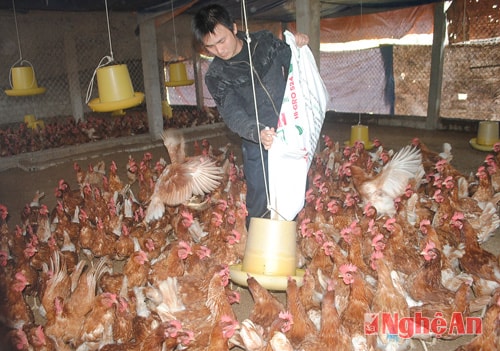 |
| Mr. Nguyen Van Sinh takes care of his flock of chickens. |
In 2007, Nguyen Van Sinh graduated from the Animal Husbandry and Veterinary Science Faculty of the University of Agriculture 1. Upon graduation, he always dreamed of finding a profession to earn a living, rather than applying for a job in a government agency. However, finding a profession that suited his academic knowledge and was close to the farmers was very difficult. After watching television many times about people successfully raising laying hens, he came up with the idea, "Maybe I should... raise chickens too?" No one in this area was raising chickens commercially; all the chicken and duck eggs sold at kiosks and markets here had to be imported from the lowlands. The idea of a laying hen farm was formed, motivating him to give it a try.
From then on, he stopped looking for a job, temporarily setting aside his engineering degree to raise chickens. His family owned a large plot of land in the hills, so he decided to give it a try. He'd rather fail and gain experience than remain dependent on his family. Thinking it over, at the beginning of 2009, Sinh discussed with his parents and pooled all their savings, borrowing from relatives and friends to invest in chicken farming. With his parents' approval, the capital he raised was only enough to build a farm large enough to raise 500 hens, and cover the cost of commercial feed from breeding to egg laying. The breed he chose was the high-egg-laying chicken. After preparing the coop, he went all the way to Thai Nguyen to find a reputable chicken breeder to buy the chicks. This breed is large, strong, and therefore has high resistance to disease and produces large eggs.
Thanks to the investment in suitable commercial feed, combined with timely and appropriate vaccinations, his chickens have developed well and have not experienced any disease outbreaks. He takes care of the chickens himself, while his parents take turns transporting the eggs laid daily to stalls and markets in the surrounding commune and beyond. During 2010 and 2011, chicken eggs fetched good prices, and with a high egg-laying rate, he earned a profit of over 300,000 VND per day. In addition, he also raises broiler chickens for special occasions throughout the year, such as holidays, Tet (Lunar New Year), or June and October, which are peak wedding months. In this hilly area, the broiler chickens he raises are free-range, reaching a weight of only 1.3-1.5 kg per bird at slaughter. Their meat is firm, flavorful, and popular with customers. With demand exceeding supply, and using the capital he had accumulated from the annual profits of selling eggs, he boldly proposed to the local authorities and the bank to provide loans to expand his farm.
In early 2012, he was given a loan of 100 million VND from the District Social Policy Bank's job creation fund. Empowered by this, he invested in building a larger chicken farm. Currently, his two farms house over 1,000 laying hens. Despite the busy and arduous work during the day, waking up each morning to collect the eggs and fill a basket is an immense source of joy.
Mr. Sinh said that due to the low temperatures at the end of the year, the egg-laying rate of his chickens only reached 75%. With such a low egg-laying rate and falling egg prices, poultry farmers are not making much profit. Each day, they harvest 750 eggs, selling them at 2,000 VND/egg. After deducting all expenses, each egg only yields a profit of 200 VND. In the days leading up to Tet (Lunar New Year), the price of chicken eggs rises to 2,200 VND/egg. Therefore, at this time, his family only earns a profit of 150,000 - 200,000 VND per day from raising laying hens. This income is low compared to the investment capital and labor involved. However, he is not discouraged. In agriculture, especially in livestock farming, one must accept the market. Prices vary from year to year, and farmers must accept this. Having products to sell on the market at any given time helps build customer trust and maintain operations while waiting for opportunities.
Speaking about his experience raising laying hens, Sinh shared: "When buying chicks, choose those that are 17 weeks old. The supplier must ensure they are fully vaccinated against diseases. After purchasing, feed them commercial feed for 4-5 weeks until they start laying eggs. During the rearing process, vaccinate them against various diseases every 3 months, and disinfect with chemicals. The chicken coop must be designed to be cool in the summer and warm in the winter. The floor should be cemented and covered with a layer of rice husks about 5 cm thick. These tasks are not difficult for Sinh; he learned them during his four years of university. Each batch of chickens should be kept for one year before being replaced, as the egg-laying rate decreases if kept for too long."
Confident in his work and holding a Bachelor's degree in Agricultural Engineering, in 2012, following Decision 159 of the Provincial People's Committee on attracting young intellectuals to serve poor mountainous communes, he applied and was assigned by the province and district to work in Yen Hop commune. He was assigned to work in the commune's Agricultural Department. Using his academic knowledge and practical experience gained from many years of farming, he developed a highly effective working style. Sinh confided: "The farmers here lack knowledge in livestock farming and production, so we face many difficulties in encouraging them to apply scientific and technological advancements. As a cadre, and a young, well-trained individual, I must be proactive in all movements, with the main focus being on encouraging farmers to adopt advancements in livestock farming and crop cultivation." Many people in the village have come to visit and learn about raising laying hens, and he is always ready to help them by diligently guiding them on how to build coops, choose breeds, and care for the chickens… If any young people want to open a farm, he is willing to cooperate to help them escape the hardship of leaving their hometown to work far away. Seeing his friends and young people in the village leave to work far away and return empty-handed, he feels even more compassion for them...
Sinh added that his current success is the foundation for the future, and he plans to invest even more to expand his chicken farm on a larger scale. At a young age, without a family of his own, starting life with such substantial results as Nguyen Van Sinh has achieved is the aspiration of many young people today!
Text and photos:Xuan Hoang