

Night squid fishing in Cua Lo
(Baonghean)After enjoying a refreshing swim in the sea and a delicious seafood meal, Huong said, "I wish we had a bonfire on the beach!...". Huong works at VTC and was on a business trip from Hanoi to Nghe An with her colleagues, stopping by Cua Lo beach for a swim...
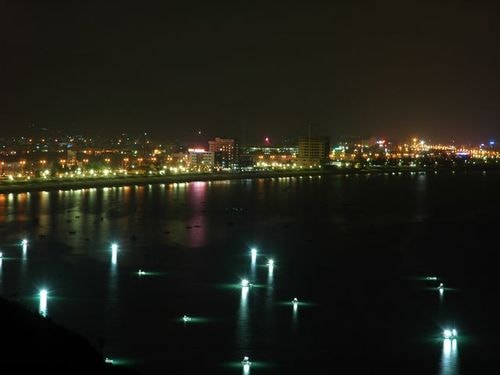 |
| A stunning image of Cua Lo at night. Photo: Internet |
I went to see the beach security and lifeguard in Thu Thuy ward. At first, he waved his hand dismissively, saying, "No, no, it's too unsanitary! No one has ever lit a campfire on the beach before!" I pleaded, explaining that the beach was quiet at the beginning of the season, and besides, tourists were potential customers! I promised, I promised, I would clean it up… Finally, the lifeguard nodded in agreement.
We needed firewood for the campfire. We had to ask friends at the 2nd Border Guard Squadron in Cua Hoi to buy some for us, loading a cartload of casuarina wood. We gathered around the fire. The strumming of guitars filled the air, and the atmosphere gradually became more lively as a few young people started dancing and singing. Tourists on the beach gradually joined us. The flickering fire cast wild human figures on the sand, spreading out in the gentle night sea breeze and the rustling waves at the shore… Why don’t we go squid fishing? Someone shouted! And Huong grabbed my hand, saying, “Let’s plan a night squid fishing trip!”
Oh, I've never been squid fishing at night before, even though I go swimming at Cua Lo beach at least five or seven times a year. But I heard that night squid fishing is a real thrill, and the "highlight" is when you catch one, you grill that wonderful gift from the sea yourself over a blowtorch, then savor it, daydreaming about sailors like Simbat or Robinson... So let's go! The water's edge is already waiting for the small fishing boats; just call out and several boat owners will come over. How much per trip? At the beginning of the season, it's cheaper at 50,000 dong...
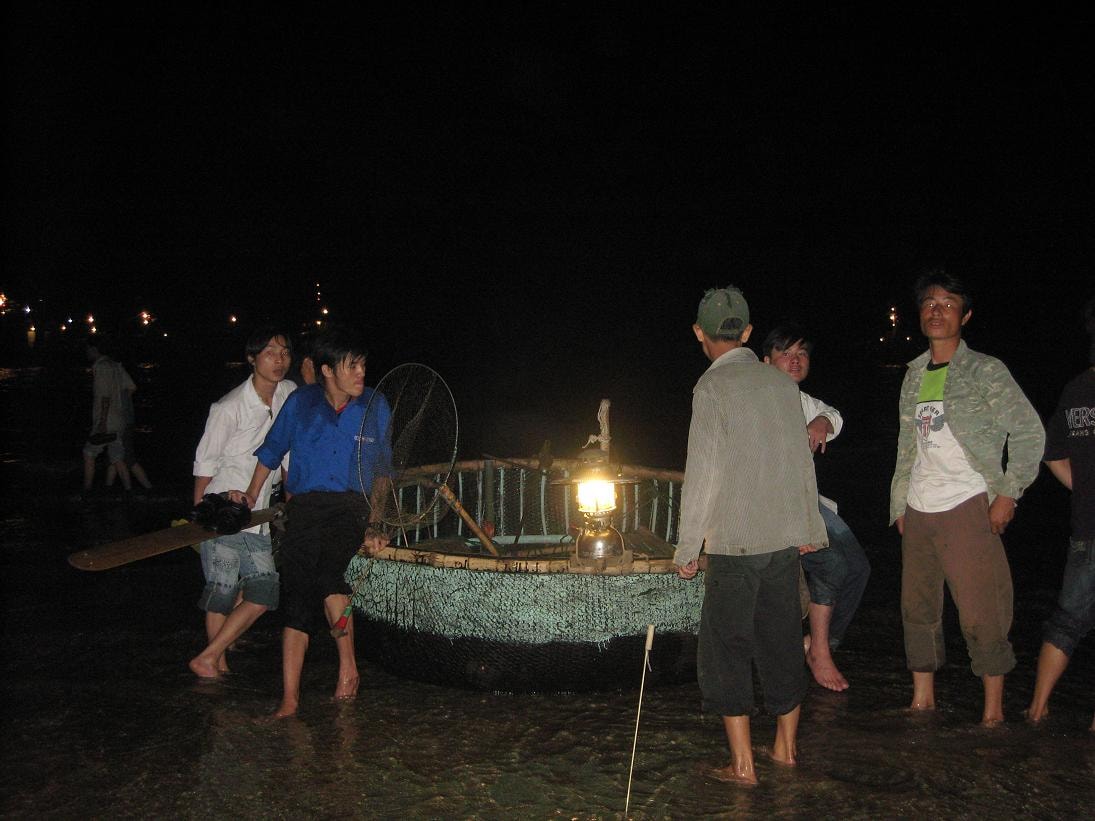 |
| Get ready to board the boat and head out to sea. |
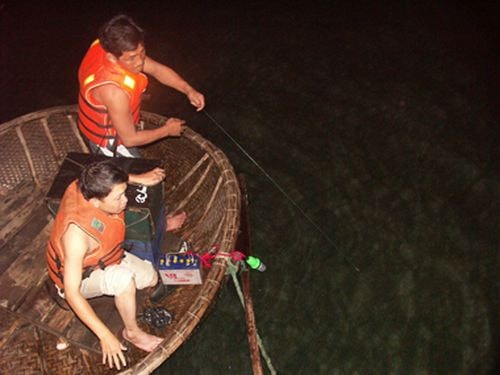 |
| Fishing boats usually carry 2 to 3 people. |
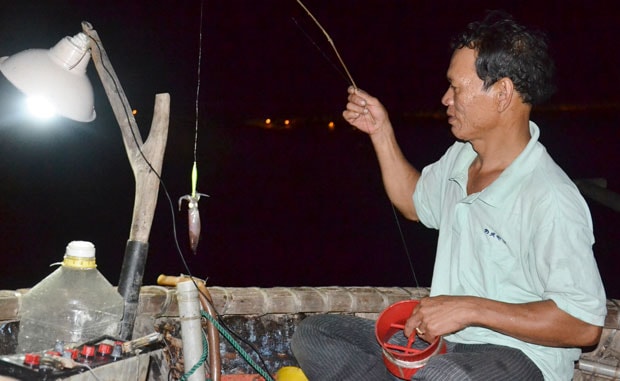
For safety, each boat only carried three people. The fisherman, around 50 years old, with bulging muscles reflected the light from behind his thin brown shirt. He busily prepared his fishing rods and a bag laden with unknown items. He hooked a kerosene lamp onto the boat's pole, set down the oars, and said: "Put on your life jackets, everyone. The sea is calm today, let's go a little further out!" The sound of the oars splashing filled the air. The boat surged forward against the waves. The cool breeze was inviting. The light from the sandy shore faded, and around the campfire, a group of tourists still huddled together, singing and playing music. A few waved to the "reluctant sailors" venturing into the night sea. Besides Huong, my boat had another tourist who had just joined us. He was a teacher from Thai Binh province who had come to Cua Lo beach for a swim. He said he wanted to try some "jumping" squid, and that he'd heard it was only "authentic" if he caught and grilled it himself right on the beach! I need to correct the teacher; it's "flashing" squid, not "jumping." It's squid that's just been caught at night, still fresh, with a shimmering, reflective body. The locals in Cua Lo pronounce "flashing" in their dialect, which sounds like "jumping." Catching and enjoying "flashing" squid in Cua Lo is partly why it's considered the most enjoyable in Vietnam! Hearing me say this, Huong also exclaimed, "Oh, I always thought that's why fresh squid jumped!"
"How far from shore?" "About a kilometer!" the fisherman replied, deciding to "drop anchor," or rather, letting go of the oars to let the boat drift with the waves. The wind was a little stronger now, and every now and then the boat would lurch, tiny splashes of water hitting my face, cool and refreshing. The fisherman reassured me, "Don't worry, even if the wind gets stronger, it'll still be safe." I stood up and looked around. The night sea was a deep blue. Many squid fishing boats had already "dropped anchor." Towards the shore, the Cua Lo coastline shone brightly with lights like a giant battleship; further out, hundreds of fishing boats with hundreds of horsepower belonging to fishermen and boats waiting to "load" cargo at Cua Lo Port were anchored, stretching from Ngư Island, looking like a mysterious floating city. Our fleet of squid fishing boats, like ours, easily numbered in the hundreds, each with a torch, flickering like stars in a galaxy – a truly wonderful feeling. Huong stood up and called out, "Our 'fleet' of four boats has assembled!" Good luck catching lots of squid! Remember to save some to grill over the campfire! The shouts echo across the night sea, filled with the eager spirit of "conquering" the ocean!
 |
 |
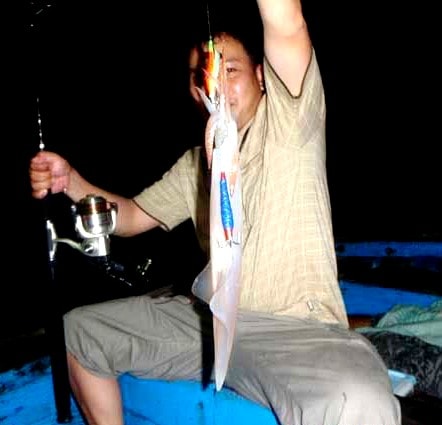 |
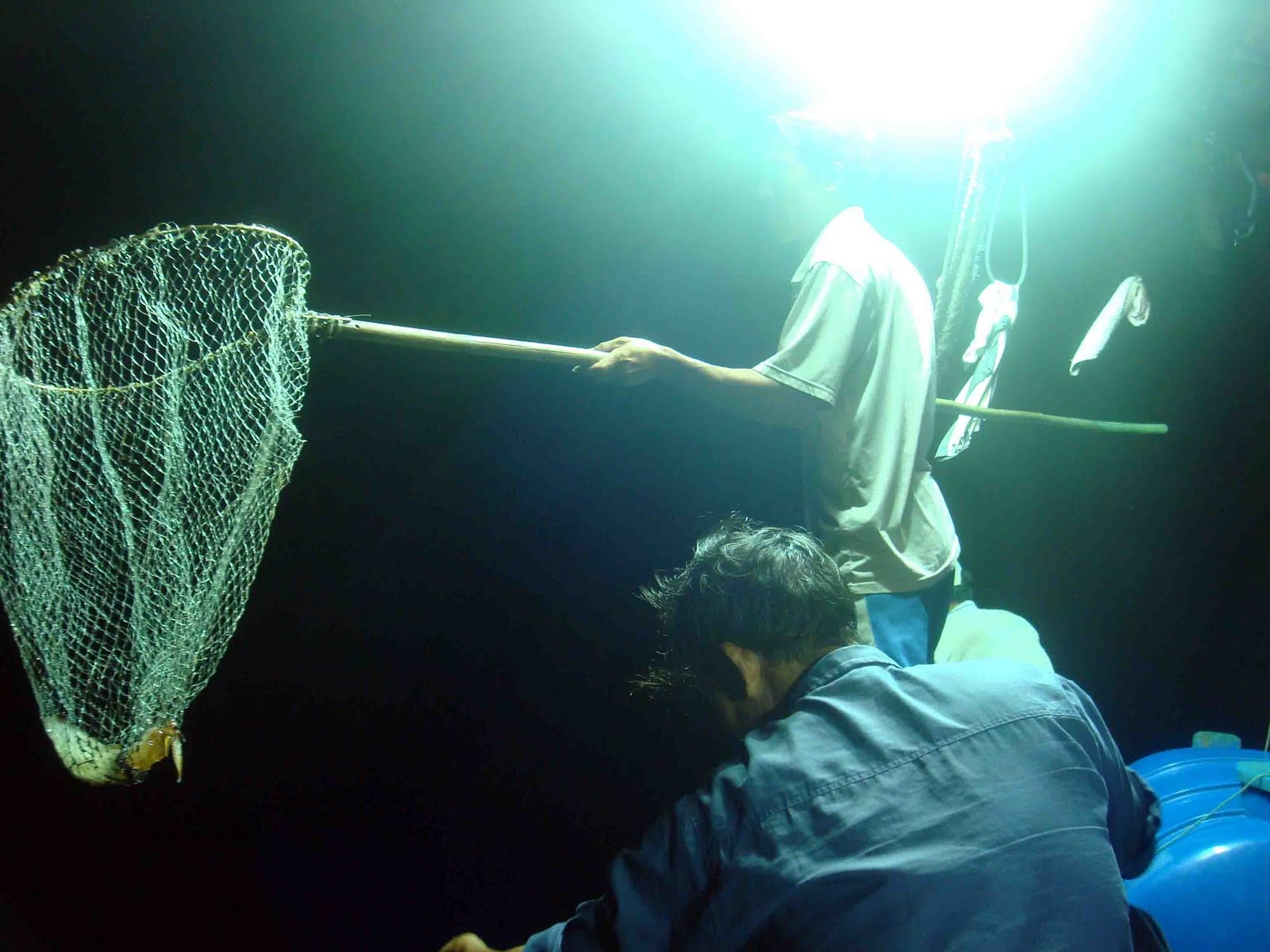
| The catch after a while of fishing. |
The fishermen busied themselves loading gas to light their torch. The flames flared up rapidly, then subsided in the vacuum, casting a white halo around the sides of the boat. We cast our lines, the bait being just plastic rods and nylon sheets resembling shimmering, multicolored shrimp. Beneath the surface of the seawater, tiny parasitic organisms glistened with silver scales. Occasionally, a small fish would flick its tail and dart towards the light. The fisherman would lower his rod to scare it away; it would pause, then dart off, its scales flashing under the water like a shooting star. Oh look, a squid! Huong tugged at my hand and whispered a suppressed cry of excitement. At that moment, it was a magnificent sight of the sea. The squid, its translucent garments spread out in a graceful, undulating dance beneath the surface. The boat drifted gently with the soft waves. We let Huong cast her line after the squid. The fisherman advised, "Don't swing the net around, you might fall. If it bites, when you feel a slight weight on the hook, lift it straight up!"
Huong suddenly burst with joy as the fishing line tightened and a large squid, about half the size of her hand, was pulled into the basket. The fisherman skillfully used his net to catch the squid as it released the line, then lowered it onto the bottom of the basket. The squid was so fresh it shimmered with countless tiny droplets. All three of us put down our rods, our eyes eagerly fixed on the squid as it slowly turned a milky white, gradually developing a brownish film. The fisherman flashed a generous smile, then leisurely lifted the squid and gently placed it over the lid of the blowtorch. The squid slightly arched its back and gradually dried under the heat from the blowtorch. A gentle, salty aroma of the sea wafted up. Involuntarily, we all inhaled deeply. The fisherman said, "Grill it until the outer layer is just cooked through! The squid will be sweet. This squid was just caught from the sea; it's very healthy to eat raw!" Then the fisherman reached into his bag and pulled out a small bottle: "This is homemade liquor. Let's have a drink to thank the sea for its gift!" Ah, is this the romanticism of the coastal people or the traditional custom of the fishing village in relation to the ocean? Well, let's enjoy it first!
How should I put it? First, there was an indescribable, yet intensely fragrant aroma that stirred my sense of smell. Then, my taste buds perceived something tangible on my tongue, something that had been eagerly anticipated. And, I couldn't resist any longer! My teeth sank in, and immediately the rich, savory, sweet, slightly bitter, and aromatic flavors of all the world's delicacies, along with the salty taste of the vast ocean, took over and dominated my senses. Savoring each strand of grilled squid, tilting my head back to take a small sip of homemade rice wine, and letting out a hearty "ah" amidst the boundless sea and sky—it was truly an amazing feeling! Seeing us immersed in the joy of enjoying the squid we'd caught, the fisherman said: "If we catch a lot, you can grill them yourselves, one each, bite into the squid, chew it, it's incredibly delicious!" Yes, that's right! We eagerly cast our lines again...
Each time the boat drifted a short distance towards the shore, the fishermen would swiftly paddle out into the middle of the "Milky Way." In the other boats, there were occasional bursts of joy when they caught squid. Our "squad" remained tightly formed. It turned out that Huong was a much better fisherman than me and the teacher, as she caught half of the more than twenty squid. After about an hour, we each savored and then almost devoured a few "flashing" squid grilled over a blowtorch, and we agreed to take the rest back to the campfire to grill. Huong used a megaphone to call for the team to assemble, and the shouts and commotion of "reports" of their catches echoed, with some boats easily catching several kilograms of squid.
The wind was cooler. Laughter and chatter echoed across the sea. The intoxicating taste of local rice wine had permeated the air. The atmosphere was incredibly lively. Having overcome the initial excitement, joy, and even a little... fear, the Simbats and Robinsons, returning to shore in their boat, now dared to "act" dignified and inquire about the fishermen at the oars. Our father and son, the captains of our "battleship," would each take a small boat out to sea during the tourist season to register and serve customers who came to catch squid. During peak season, on busy nights, they could make three or four trips, each earning over 100,000 dong, with some customers giving extra tips, resulting in a decent income. This profession also had regular customers, many of whom were particular, bringing their own alcohol lamps, kerosene, herbs, and spices. They would grill the squid and then steam it right there in their boats. That's how you truly appreciate a good meal.
Squid caught and preserved alive in seawater are brought to restaurants and meticulously prepared into delicious dishes from various regions while still incredibly fresh. However, the "stunning" taste of squid caught right after being caught is hard to find! Fishermen even claim that, in both the North and South, nowhere else tastes as good as squid caught at night as in Cua Lo. That's what tourists who come to fish for squid at night all say. Having worked in this profession for nearly a decade, the fishermen have heard many stories from tourists who fish for squid at night, and they're sure they're not joking. I've also read somewhere that "in Cua Lo, Nghe An province, with its advantageous salinity, the sea extending deep inland, and few large waves, Cua Lo beach becomes a suitable place for squid to live close to the shore." Therefore, catching and enjoying squid in a unique way is only possible in Cua Lo!
Feeling as satisfied as if they had just finished a real sea voyage, everyone excitedly commented and boasted about their squid-catching achievements. Then, all of them eagerly set about grilling the squid over the campfire, determined to devour this wonderful delicacy from Cua Lo beach. The teacher from Thai Binh province clasped my hand tightly, saying this was a Cua Lo memory he would never forget and promising to meet again in future beach seasons! Huong gazed thoughtfully at the campfire, then said, with a very serious expression: "During my time here, I'll definitely try all the dishes made from fresh squid!" Yes, I believe you and your colleagues, as well as other tourists who come to swim here, will enjoy and forever remember the dishes made from the unique "flashing" squid specialty of my hometown, Cua Lo, which has already made it into international culinary and tourism guides!
Dinh Sam