

The glorious past guides our steps forward.
(Baonghean) - For the past 60 years, the Dien Bien Phu Victory has been a source of immense pride for the entire Vietnamese nation in general, and for each person who participated in the campaign, and for successive generations in particular. Looking back at the Dien Bien Phu Victory, we can clearly see that it is a "museum" containing many valuable lessons for today and tomorrow...
Museum of Memory
For veteran soldier Nguyen Xuan Tinh (84 years old, residing in Trung Do Ward, Vinh City), participating in and contributing to the world-shaking Dien Bien Phu Victory was an immense honor and source of pride. For him, the museum of memories needs to be preserved and continuously opened and shared. Among his countless personal stories, the most moving are "the interrogation of General De Castries" and "the Foreign Legion soldier bearing the surname of President Ho Chi Minh."
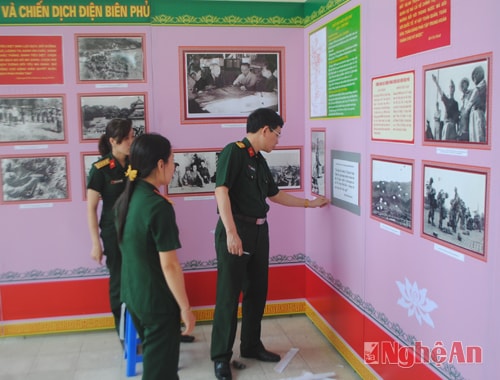 |
| Officers and soldiers of the 4th Military Region Museum prepare for the exhibition "Dien Bien Phu - A Golden Epic". |
At 5:30 PM on May 7, 1954, Company Commander Ta Quoc Luat and several soldiers stormed the command bunker, captured General De Castries, and brought him back to the headquarters of the 312th Division. With his French language skills, Nguyen Xuan Tinh was assigned to translate the interrogation of the general. Mr. Tinh recounted: De Castries wore a beret, a neatly pressed summer uniform, his face was pale, but he spoke in a very affected manner. Initially, Le Trong Tan, the commander of the 312th Division, spoke directly to the prisoners in French, but when De Castries was interrogated, officers from the division's command asked questions in Vietnamese, and Mr. Tinh and several other comrades took on the responsibility of translating.
The content of the interrogation was:
- You and the French Expeditionary Command in Indochina declared "Dien Bien Phu is an impregnable fortress," and you yourself ordered planes to drop leaflets inviting us into the trap you had set at Dien Bien Phu. What do you think of that place now?
Bitter De Castries:
- Yes, we had the pleasure of meeting you today. - How do you assess your artillery forces at Dien Bien Phu and Pirot? Your artillery commander declared: "Just 10 minutes of counter-artillery fire will silence the Viet Minh's artillery, and after two days your artillery will crush us?" De Castries replied: "We did not expect you to bring heavy artillery to Dien Bien Phu and use it effectively, thus suppressing our artillery."
- You received a telegram from General Navarre authorizing you to carry out the Albatross plan, to break the encirclement and escape to Laos, why didn't you do it?
De Castries: You have tightened the encirclement and positioned forces to intercept us, so we cannot take the risk.
- Failing to break through the encirclement means you will suffer defeat and have to surrender. When did you realize that?
De Castries: When you detonated the large explosive charge on Hill A1 and played Stalinist orchestra, we knew the moment of defeat had arrived.
Mr. Nguyen Xuan Tinh will never forget his comrades and fellow soldiers who fought side-by-side, "sleeping in bunkers, enduring torrential rain, and eating meager rations." One comrade-in-arms he will always remember is the Foreign Legion soldier Stefan Kubiak – Ho Chi Toan. Stefan Kubiak, a Polish citizen, was forcibly conscripted into the French colonial Foreign Legion and then brought to Vietnam. Recognizing the just cause of the Vietnamese people's war, Stefan Kubiak left the Foreign Legion to join the Viet Minh, fighting as a communist.
“At Dien Bien Phu, Stefan Kubiak was assigned to command an artillery unit. With his precise calculations, he and his unit achieved many victories. With the appearance of a French soldier, Stefan Kubiak donned a French officer's uniform to infiltrate the enemy's most difficult-to-attack bunker, paving the way for other soldiers to storm and capture it,” recalled veteran Nguyen Xuan Tinh.
“Our meeting on the battlefield marked the beginning of a friendship between me and Stefan. I promised to teach him Vietnamese. In return, Stefan would teach me mathematics and French. The war intensified, so we didn't have many opportunities to meet. After the victory at Dien Bien Phu, we kept in touch for a while longer. But then, due to work and the fierce war against the US, correspondence was interrupted and contact was lost.” Stefan Kubiak made a significant contribution to the victory at Dien Bien Phu. After the campaign, President Ho Chi Minh adopted Stefan Kubiak as his son and allowed him to bear his surname. The very Vietnamese name – Ho Chi Toan – has been associated with him ever since. For Mr. Tinh: Stefan Kubiak – Ho Chi Toan has become a symbol of peace, justice, and independence for a peace-loving nation.
Echoes of Dien Bien Phu
The stories of living witnesses like Mr. Nguyen Xuan Tinh are always deeply moving; they are a part of history, shaping history. These stories, which would normally remain in memory, are revived and retold so that future generations may know about the glorious past of their ancestors…
On the afternoon of April 28th, commemorating the 60th anniversary of the Dien Bien Phu Victory, many more emotionally charged stories of life and campaign were revealed. This was the thematic exhibition "Dien Bien Phu - A Golden Epic" organized by the Political Department of Military Region 4 at the Military Region 4 Museum.
Colonel Nguyen Cong Thanh, Director of the 4th Military Region Museum, stated: The exhibition runs from April 28th to May 9th, 2014. It features three main themes: the 1953-1954 Winter-Spring Campaign and the Dien Bien Phu Campaign (40%); the 4th Inter-Region and the Dien Bien Phu Victory (40%); and the Echoes of Dien Bien Phu (20%). The exhibition aims to highlight the glorious achievements and immense historical value of the Dien Bien Phu Victory, which ended the nine-year resistance war against French colonialism, through images, documents, and artifacts. It emphasizes the significant role and contributions of the military and people of the 4th Military Region in this victory 60 years ago. From this, it contributes to the dissemination of information, education, and instilling in officers, soldiers of the armed forces, and all citizens a greater sense of pride in the heroic fighting traditions of their ancestors, inspiring them to strive and contribute to the cause of national construction and defense today.
The 280 images and artifacts displayed at this exhibition tell 280 stories about historical periods, about famous heroes, and also about the silent dedication and sacrifice of farmers for the future of the nation. These include: an excerpt from the Politburo's Resolution deciding on the military strategy for the 1953-1954 Winter-Spring campaign; a series of images such as: the Central Military Commission and the General Staff deciding on the 1953-1954 Winter-Spring operational plan; the Khánh Thiện - Ninh Bình guerrillas shooting down a French plane during the Southwest Ninh Bình Campaign in October 1953; the Vietnamese-Lao joint forces launching the Lower Laos campaign, attacking Atôpơ in January 1954; General Navarre, General C.I., and De Castries discussing the plan to build the Điện Biên Phủ fortified complex; The heroic deeds of the army and people of Military Region 4 in this historic campaign are embodied in artifacts belonging to the heroic sons of Nghe An province, such as the bamboo hat of Martyr Tran Can, the submachine gun of Martyr Phan Dinh Giot…
This exhibition once again affirms that the Dien Bien Phu Victory was the highest direct result of the 1953-1954 Winter-Spring campaign and the culmination of our nation's nine-year sacred resistance war. This historic victory created the fundamental conditions for a successful diplomatic struggle.
From the legendary spirit of Dien Bien Phu came many more victories, culminating in the victorious Ho Chi Minh Campaign and the reunification of the country. The epic of Dien Bien Phu and the Ho Chi Minh Campaign propelled the entire nation towards socialism, achieving tremendous and historically significant accomplishments in the nearly 40 years of reform and development...
Text and photos:Thanh Son