

"The Turtle King" in Yen Thanh
(Baonghean)Mr. Dao Van Khai, residing in Hamlet 3A, Tang Thanh Commune, Yen Thanh District, is known as the "king of turtles." He was the first person to successfully raise turtles on a large scale in his rice-growing hometown, and after nearly 8 years of starting his business, his commercial turtle farming business generates nearly 2.1 billion VND in revenue per year. Remarkably, in the movement to develop the economy and build new rural areas, he has shared his secrets and helped over 100 turtle-farming households in Tang Thanh Commune overcome poverty.
Previously, Mr. Dao Van Khai had tried his hand at various jobs, but his life remained difficult year after year. In 2006, after learning about the effectiveness of turtle farming through the media, he packed his bags and traveled to Hung Yen and then to Ha Tinh to visit and learn from successful models. In 2007, he invested in renovating his ponds and raising over 1,000 turtle hatchlings, totaling over 200 million VND. Initially, he was filled with worries when he released the hatchlings into the pond. After nearly a year of care, the turtles reached a weight of almost 1 kg each. Mr. Khai went to restaurants and specialty shops to inquire about the price and learned it was 250,000 VND/kg. He and his wife thought they would strike it rich and have enough money to pay off their bank loan. However, unexpectedly, the turtles began dying one by one, with 15-20 dying each day for no apparent reason. After that incident, he had to call in experts to check for disease outbreaks, and finally discovered that the cause of the turtle deaths was that the breeding stock purchased from Hung Yen was not suitable for the local climate, and furthermore, he lacked experience in raising them, stocking them too densely, and the water source was not hygienic. That time, over 500 turtles died in the pond.
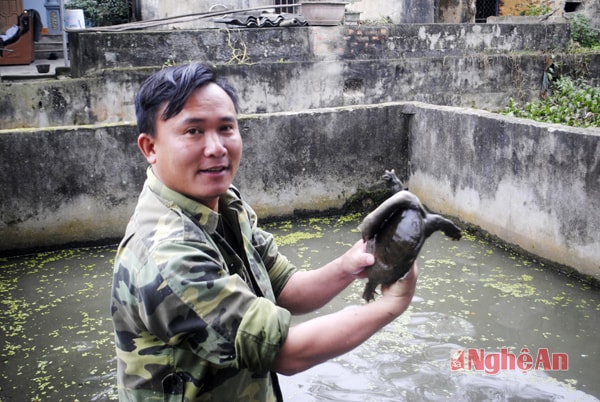 |
| Mr. Dao Van Khai stands beside his turtle breeding pond. |
Having suffered losses from raising turtles, his wife became discouraged and suggested he switch to fish farming, but Dao Van Khai was determined to stick to his chosen path. After a period of research and study, Khai borrowed money again to buy turtle hatchlings. This time, following the advice of experienced people, he traveled to Ha Tinh province to buy hatchlings, as the similar climate would be suitable for the land in Yen Thanh. Fortunately, the owner of a turtle farm in Ha Tinh was very enthusiastic in teaching him his secrets and promised to take care of the sales as well.
In 2008, Mr. Khai continued to raise over 1000 turtle hatchlings in a 600 m2 pond. Thanks to following the correct technical procedures, he achieved great success, harvesting approximately 650 kg of turtles, which he sold at 250,000 VND/kg, generating revenue of over 162 million VND. He invested the profits in upgrading and expanding his ponds, bringing the total to 4 ponds covering over 1,300 m2. All pond banks were reinforced with stones and fences were built to prevent theft, with water hyacinths planted above to provide shade. Turtle farming takes two years before harvest, so to increase efficiency, he implemented a "mixed crop" system, raising hatchlings in multiple batches throughout the year to ensure year-round sales to restaurants and hotels. For several consecutive years, Mr. Khai has had a successful turtle farming season. In 2013 alone, he released over 1,200 hatchlings, averaging 700 kg in weight. With a market price of 300,000 VND/kg, he generated a revenue of 210 million VND.
According to Mr. Khai, raising softshell turtles is both easy and difficult. To raise them for meat, ensuring rapid growth and a high survival rate, proper technical procedures are essential. Before stocking, it's necessary to prepare ponds and tanks with clean water. Stocking early allows for optimal growth during the months with the most suitable temperatures, ideally March and April. The size of the hatchlings should be 100-200g/each. In a pond, select healthy, disease-free hatchlings of the same size. Softshell turtle feed can be divided into three main types: live animal feed, dried animal feed, and processed or commercial feed. Mr. Khai primarily buys small fish from the Dien Chau coastal area, supplementing it with bran and banana leaves. Besides raising commercial softshell turtles, he also raises spiny softshell turtles (forest turtles). This type of forest turtle is rare and expensive; he can only buy 2-3 at a time. The spiny softshell turtle is characterized by its rapid growth, reaching a weight of 5 kg, with a selling price of 600,000 VND/kg. Currently, the pond has over 50 spiny softshell turtles ready for sale. Raising spiny softshell turtles is not overly complicated; raising them in separate tanks is even better, with a density of 3-4 turtles/m². Spiny softshell turtles thrive on a diet of shrimp, prawns, worms, frogs, toads, snails, and fish, and should be fed 1-2 times per day.
To ensure a reliable source of breeding stock, he also learned the skill of incubating turtle eggs. He went to Ha Tinh to buy turtle eggs to try incubating them, and when he achieved an 80-90% hatching rate, he expanded his business to include breeding stock. According to Mr. Khai, a suitable incubation room is necessary for successful hatching. He uses trays or containers made of aluminum, enameled iron, or plastic, with each aluminum container holding 200-300 eggs. The containers are filled with fine, moist, and loose sand. During the incubation period of over 50 days, maintaining a stable temperature and humidity in the sand is crucial. Every 1-2 days, the surface layer of sand dries out due to evaporation, so it needs to be sprayed with water to restore its normal moisture level. When the turtles hatch, he selects the healthy ones that have shed their umbilical cords to transfer them to rearing tanks. By securing a reliable source of breeding stock, he can supply many turtle-farming households in Tang Thanh commune, generating an additional income of over 100 million VND annually from turtle egg incubation. Currently, Mr. Dao Van Khai's turtle farm provides employment for 10 workers with a salary of 4 million VND per person per month.
Mr. Le Van Tue, Chairman of the People's Committee of Tang Thanh commune, happily stated: "What is most commendable about Mr. Dao Van Khai is that for those who come to buy turtle hatchlings, besides ensuring quality, he always provides guidance on techniques and experience in raising turtles. Furthermore, he dedicates his time and effort to visiting many households starting out, guiding them from planning and pond digging techniques to raising and stocking, for new turtle farmers. To date, Tang Thanh commune has over 100 households raising turtles on a scale of 300-400 turtles, many of whom have risen out of poverty and even become wealthy. To further improve the lives of the people, Tang Thanh commune is encouraging farmers to develop the potential of turtle farming."
Van Truong