

Will the four-party talks find a way out for Ukraine?
The convening of the first four-party meeting in Geneva since the Ukraine crisis, aimed at de-escalating tensions in the southeast and finding a final peaceful solution, is receiving strong support in the international community. However, the negotiating representatives from the European Union (EU), Russia, the United States, and Ukraine are not overly optimistic about the possibility of the parties quickly resolving their differences, as their positions remain quite far apart.
Furthermore, the mutual accusations made ahead of the meeting regarding the presence of US and Russian special forces in eastern Ukrainian provinces, the presence of CIA Director John Brennan in Kyiv, and the deployment of Russian troops along the border with Ukraine, further fueled public skepticism about the success of this four-party meeting.
Ahead of today's conference on April 17th, the situation in eastern Ukraine has become "extremely serious," with pro-Russian forces occupying the headquarters of nearly a dozen provincial and municipal governments, and Kyiv deploying troops and tanks to "restore order." While the US is calling for increased pressure on Moscow, many key EU countries, including Italy, Germany, and France, do not support new sanctions against Russia. Moscow has strongly supported the establishment of a federal state in Ukraine and does not recognize the interim government in Kyiv, claiming that this new government was created after a coup.
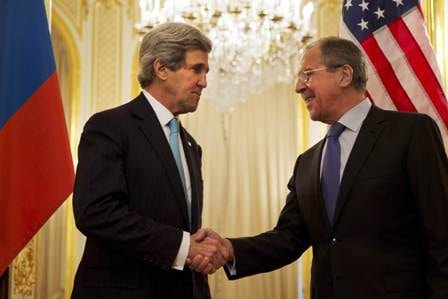 |
| Russian Foreign Minister Lavrov (right) and US Secretary of State Kerry. Photo: AFP-TTXVN |
As the current chair of the Organization for Security and Cooperation in Europe (OSCE), Switzerland has urged the international community to unite efforts to find a political solution, increasing the number of international observers in Ukraine from the current 85 to 300. Meanwhile, UN Special Envoy Rita Izsak, who was in Ukraine from April 7 to 14, urged nationwide dialogue, the protection of the rights of ethnic minorities as part of the confidence-building process, and the achievement of stronger unity in Ukraine's diversity. EU High Representative for Security and Foreign Policy Catherine Ashton stated that a fair election next month would be the best way to demonstrate the will of the people and the constitutional reform process in Ukraine.
To date, US and EU sanctions against Russia appear to have been ineffective. Moscow is even considering suing the US at the World Trade Organization (WTO) over Washington's sanctions targeting Russian banks. However, anti-Russian sentiment is rising in Western European countries. If the Ukraine crisis worsens with increased sanctions against Moscow, it will certainly harm the global economy, as Russia is the world's leading exporter of natural gas and oil, minerals such as platinum, nickel, diamonds, grains, and timber.
Ukraine occupies a strategically important location and shares cultural, historical, and religious ties with Russia. Both Russian and Ukrainian are widely spoken in Ukraine. Following the ouster of President Viktor Yanukovych, Ukraine has placed its bets on reorienting its economy toward Western Europe, while its economy remains dependent on the Russian market. Ukraine also shares a border with the EU, and the EU does not want to disappoint its "friends in Kyiv."
Although the North Atlantic Treaty Organization (NATO) has announced that it will immediately deploy additional naval, land, and air forces to Eastern Europe to address the worsening crisis in Ukraine, the EU will seek to prevent the escalation of the conflict and avoid military action in its own interests. Meanwhile, the US is pursuing its own objectives in Ukraine. Economic considerations are not the driving force behind Washington's leniency in punishing Moscow, as the US market accounts for only 4% of Russia's total exports.
Nevertheless, the US administration still has to carefully consider its approach with Russia for geopolitical reasons: American soldiers returning from Afghanistan must pass through Russian territory. Furthermore, Washington needs Moscow's voice and coordinated actions in the fight against terrorism, as well as in resolving pressing issues related to Iran's and North Korea's nuclear programs and the Syrian crisis. Compared to Armenia, Azerbaijan, Georgia, and Moldova, Ukraine holds a far more strategically important position for Russia, allowing Moscow to take more decisive steps. Russia emphasizes that a peaceful solution to the crisis requires consideration of the perspectives of all segments of Ukrainian society. Moscow also stresses that if the majority of Ukrainian public opinion is ignored and its economic and political interests are threatened, international negotiations will be fruitless, despite the assessment that the Geneva meeting of Russia, the US, Ukraine, and the EU was a milestone in the current Ukrainian crisis.
A preliminary agenda for the four-party international talks on Ukraine has been agreed upon. Representatives from Russia, the US, the EU, and Ukraine are expected to negotiate to prevent escalating tensions, disarm illegal armed forces, discuss constitutional reforms, and hold nationwide elections in Ukraine on May 25th.
Hope for constructive discussions in Geneva remains, despite numerous obstacles. If the situation in southeastern Ukraine is resolved peacefully, the representatives participating in the Geneva talks could consider a range of issues wisely in an attempt to find a way out of the current crisis in Ukraine. However, Moscow has bluntly stated that if Kyiv uses force in eastern Ukraine, the possibility of negotiations in Geneva will be zero.
According to news