

Irrigation for tea plants: Effective methods
(Baonghean)This season, in Thanh Thuy, Thanh Mai, Hanh Lam… (Thanh Chuong), the joy of high-priced tea leaves is clearly visible on the faces of the farmers. After harvesting, the people begin a new phase of caring for the tea plants. The drought is threatening tea yields, but many families, thanks to investing in irrigation systems, are achieving very high efficiency.
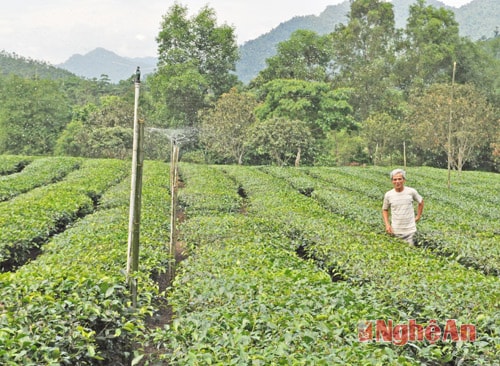 |
| This is the sprinkler irrigation system for tea plants at the home of Ms. Tran Thi Binh in Hamlet 1, Thanh Thuy Commune, Thanh Chuong District. |
We visited the high-yield tea garden of Ms. Tran Thi Binh's family, belonging to Team 1 of the 5th Youth Volunteer Brigade in Thanh Thuy - Thanh Chuong. Under the midday sun, her tea garden was cooled by an automatic sprinkler system. Ms. Binh recounted: "Thanks to investing in tea cultivation, chicken farming, and vegetable growing, my family has gradually improved our economic situation, allowing us to build a brick house and provide for our children's education. Seeing the readily available water source on the mountain, my family invested in a pipeline system to irrigate the tea garden. Dozens of fixed steel pipes, about 3 meters high, automatically spray water throughout the garden."
Because they don't use electricity, the family spends almost nothing, only a few tens of minutes moving around to adjust the irrigation water from one area to another. Ms. Binh said: "The sprinkler irrigation system has a water circle 8 meters wide. Starting in April when the sun comes out, I start irrigating until August. I irrigate several times a week, each time for a day and a night. The tea plants are cooled by the irrigation, and the soil in Thanh Thuy is quite good, so the yield is very high. While other families harvest 1 ton of tea buds per hectare, my family harvests 1.5 tons. The current price of tea buds in Thanh Thuy, Thanh Chuong is 54,000 VND/10 kg, so each harvest brings in about 8 million VND. Thanks to this, one hectare of tea can generate nearly 90 million VND per year (with about 10-11 harvests per year)."
Ms. Binh invested 30 million VND in an irrigation system for her tea plants in 2005. Next to Ms. Binh's house is Mr. Tran Van Sinh, who has 1 hectare of tea plantation. Mr. Sinh also followed Ms. Binh's example and installed a PEP irrigation system for his tea plants. Mr. Sinh said: "Thanks to the investment in irrigation, the amount of fertilizer and pesticides used for the tea plants has decreased, and the plants are able to absorb all the nutrients from the soil and fertilizer."
Currently, hundreds of tea-growing households are submitting applications to the Department of Agriculture and Rural Development hoping to receive government support for investing in irrigation systems for their tea plants. This is a good approach to investing in and caring for tea plants.
Despite the clear benefits of irrigation for tea plants, currently, in the entire province, with nearly 8,000 hectares of tea plantations, only a handful of irrigation models are in place. Besides Thanh Thuy - Thanh Chuong, Hung Son commune - Anh Son district also has a highly effective sprinkler irrigation model invested in by the Hung Son Tea Enterprise. Hung Son currently has 360 hectares of industrial tea plantations, of which 240 hectares are for commercial purposes. The irrigation model in Hung Son uses drilled wells and electric pumps to irrigate the tea hills. According to Mr. Vo Van Hien, Chairman of the Hung Son Commune People's Committee, the commune has dammed streams and built 53 large and small lakes and dams to create moisture for the tea plants and to combat drought during the dry season. In 2011, Hung Son commune continued to implement the industrial irrigation model for tea plants during the dry season. This represents a new step forward in economic thinking in Hung Son – as the area is implementing the VietGAP tea production model to meet the growing demands of international customers.
Currently, tea cultivation is not only a means of poverty alleviation for people in many districts of Nghe An province. Tea has provided a stable income for thousands of families, with monthly earnings ranging from 3 to 10 million VND depending on the cultivated area. In addition, various care methods can be combined through irrigation systems, such as spraying pesticides, herbicides, transporting and applying liquid microbial fertilizers. Irrigation also allows for proactive watering and improves the efficiency of fertilization, as fertilizers dissolve and penetrate directly into the soil. Tea is a leaf-harvesting crop; adequate irrigation increases the number of harvests and improves the quantity and quality of tea in each harvest by approximately 30% - 50%.
According to current surveys, the investment cost for an irrigation system for 1 hectare of tea is approximately 30 million VND. With a tea yield of 10-12 tons/ha/year and an average selling price of 5,000 VND/kg, the added value can reach 15-20 million VND/ha/year. Meanwhile, electricity costs are negligible, and each hectare of tea requires 15-20 irrigations per year, each lasting 4-8 hours. Thus, the investment can be recovered in just 2 years.
Chau Lan