

The song "Victory at Dien Bien Phu" - The pride of our entire nation!
(Baonghean.vn) - Following the glorious Him Lam victory, which began with a bloody battle, composer Do Nhuan promptly created the song "On Him Lam Hill". This song, drawing musical elements from Zone IV and Zone III, was a bold initiative that broadened the scope for musical development and was therefore welcomed by experts at the time.
Today we won our first battle.
The enemy's corpses fell, our flag was planted on Him Lam hill.
We used this new road to bring in the artillery.
Through hardship and toil
We understand the sentiments of the people who have come here…
Interestingly, in the song "On Him Lam Hill," composer Do Nhuan confidently predicted that the final victory would belong to us:
President Ho Chi Minh was very happy to hear about the victory.
The lush green rice fields bring even more joy.
Offer it to our beloved homeland that awaits.
We will achieve complete victory at Dien Bien Phu!
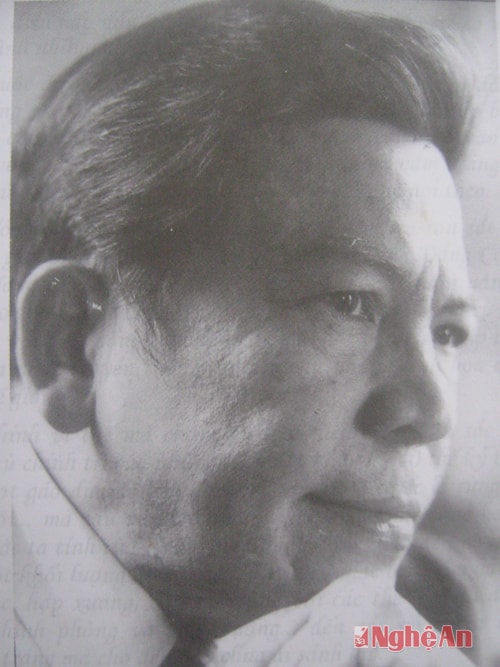 |
| Portrait of composer Do Nhuan |
From the Him Lam battlefield, several soldiers involved in cultural activities followed the trenches back to their cultural unit to receive new assignments. In his memoir, "Do Nhuan - The Sounds of Life" (Kim Dong Publishing House, 2006), he recorded in detail: "The military cultural workers, armed with hoes and shovels, went out to the road surface, spreading soil, rocks, and aggregate (small stones)."
Every night we would go out to the main road to see what our modern artillery looked like. Rumors said the Katyusha rockets imported from Russia had incredibly destructive power! Every day I would wake up early to urge the men out to the road. My hands were still hoeing, but my mind was preoccupied with the song of victory. Hoang Xuan Tuy, who was inspecting the road, met me and said:
- Do Nhuan should start preparing to write a victory song for Dien Bien Phu!
"It will definitely be there, Mr. Van reminded me already!"
The suggestion from a traffic officer at the time coincidentally matched the thoughts brewing in composer Do Nhuan's mind. However, the question was how to write it? In the two songs "Marching Far Away" and "On Him Lam Hill," the composer had used folk music from the lowlands. But now, the musical language of "Victory at Dien Bien Phu" had to be different; it had to have the musical essence of the Northwest region because the battle took place in the Northwest.
The question of how to write well has occupied the mind of composer Do Nhuan these days. The joy of victory belongs to the whole nation. The Kinh, Thai, Hmong, Dao, Tay, and other ethnic groups across the country have contributed their efforts, resources, and even their lives to make history. It's necessary to harmonize the ethnic groups, because the Vietnamese nation is one. But one cannot be "greedy" and write too long. It must be authentic, concise, easy to sing, easy to remember, and easy to pass on… Looking in his notebook, Do Nhuan has already filled five pages with notes.
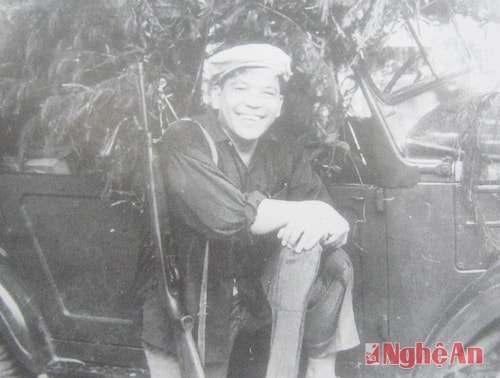 |
| Composer Do Nhuan went on a field trip to Military Region 4 during the war against the US to save the country. |
Unnecessary elements must be removed, leaving only realistic, moving, albeit seemingly chaotic, images such as "The Girl Spreading Flowers," "The Swarm of White Butterflies," "Camouflage Leaves," "Cannons," "Liberation of Dien Bien Phu," etc.
Then, the long-awaited historic day arrived. May 7, 1954. While we were digging the soil and laying stones to build a road, a liaison officer from the front suddenly cycled past, shouting:
- The enemy has surrendered at Muong Thanh! Dien Bien Phu has been liberated!
In his memoirs, composer Do Nhuan recounts that he felt goosebumps all over his body. The entire performing arts troupe stopped digging, hugged each other, and danced without any musical accompaniment. Do Nhuan, however, didn't hug anyone; he danced alone, wildly, with the phrase "Liberating Dien Bien" echoing in his head… Then, that night, by the fire in the stilt house, he sat up all night until dawn. He plucked the strings of his violin, humming softly, afraid of disturbing his comrades. He composed while peeling cassava roots roasted in the charcoal fire to regain his strength. That's how the song "Liberating Dien Bien" was born.
Liberation of Dien Bien
Our troops are marching back.
Flowers bloom in the middle of this season.
The Northwest region is bustling with joy.
In the old Muong village, the rice paddies were newly planted.
Look, little children are lying in the field, their hands outstretched like flowers.
Along the road to victory, we advance
Frontline civilian labor force
Wave goodbye to the passing artillery.
Cannon wrapped in camouflage leaves.
Swarms of white butterflies frolic among the camouflage leaves.
How joyful and happy I've been since I came to Northwest Vietnam!
Our people eagerly await our return.
The day of victory has come when we return.
We are delighted to welcome you on your journey.
Mountains and rivers burst forth
Our country shines brightly.
Dien Bien field
The flag of victory flutters proudly in the sky…
The first handwritten copy was given by Do Nhuan to the Performing Arts Troupe. The author then sang it himself for his comrades to hear, and later he went around popularizing it in an artillery unit with his distinctive, slightly slurred voice... From that moment on, the song resonated, becoming a triumphant anthem that left a profound mark on the historical journey of our army and our people.
Thus, regarding the theme of Dien Bien Phu alone, composer Do Nhuan has three songs, "Marching Far Away," "On Him Lam Hill," and "Victory at Dien Bien Phu," which have endured and will continue to endure through time, along with other songs such as "Guerrilla Song" (1944), "Guerrillas of the Thao River" (1949), and "Vietnam, My Homeland" (1960).
Born in 1922 in Vac village, formerly Hai Duong province, after many years of dedicated service to contemporary Vietnamese art, composer Do Nhuan passed away in Hanoi in 1991. He was awarded the first Ho Chi Minh Prize for Culture and Arts by the Party and State, along with four other composers: Van Cao, Nguyen Xuan Khoat, Luu Huu Phuoc, and Hoang Viet. This was a well-deserved reward for the outstanding contributions of all five composers in general, and Do Nhuan in particular. His contributions, through his talent and his very being, as composer Vu Tu Lan (Music Magazine, issue 6/1996) affirmed, are "priceless and will be recorded in golden words in the history of Vietnamese music"!
Nguyen Van Hung