

Stevia: Medicine or dietary supplement?
"Stevia is not yet a medicine," affirmed Associate Professor Dr. Huynh Ngoc Thuy, Department of Medicinal Plants, Ho Chi Minh City University of Medicine and Pharmacy. However, on the market, stevia is being promoted and sold as a medicinal herb.
 |
Various forms of preparations
The most popular product made from stevia is dried stevia, also known as stevia tea, which is sold in most traditional medicine pharmacies, especially in District 5, Ho Chi Minh City. At Vinh Thanh Pharmacy (District 5, Ho Chi Minh City), stevia is sold in the form of whole, dried leaves for brewing as a drink, priced at 85,000 VND/kg. The seller said that the price is higher this year because of the scarcity of supply, whereas last year it was only 50,000 VND/kg.
According to the seller's instructions, "just rinse it, boil it a little, and it's ready to drink" (!?). The price of stevia tea varies considerably depending on the location. Bao Khang Pharmacy (Nguyen Hong Dao Street, Tan Binh District, Ho Chi Minh City) quotes over 100,000 VND/kg; some online sellers offer it for up to 120,000 VND/kg… Trung Tam Traditional Medicine Pharmacy (District 5, Ho Chi Minh City) sells it in tea bags for 45,000 VND/box. The seller said: "It's good for diabetics because stevia has a lower sugar content than other types (?). People without the disease can also drink it because it helps to cool and detoxify."
Furthermore, many websites such as Caythuoc.org and thaoduocviet.vn advertise stevia tea as a panacea: helping to regulate blood sugar, acting as a diuretic, combating obesity and aiding weight loss; a tonic that helps fight stomach disorders, reduces pain and improves digestion; preventing bleeding gums in people with gingivitis due to its strong antibacterial properties; preventing acne, reducing sebum secretion, and fighting inflammation to maintain smooth and radiant skin; and helping to reduce wrinkles and brighten the complexion…
Recently, the market has seen the emergence of stevia extract products, both domestically produced and imported, in various forms: liquid, tablets, etc. Stevia sweeteners are sold at relatively high prices: liquid form from 28,000-30,000 VND/10ml; tablet form: 36,000 VND/25g. The product packaging clearly states: "a sugar substitute for sugar in food, suitable for everyone; especially a flavor enhancer for people with diabetes and those at risk of obesity." The manufacturer also advises using it with coffee or tea.
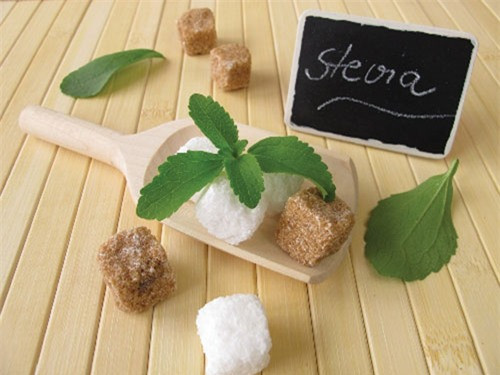 |
| Stevia leaves and stevia extract |
It should only be used as a dietary supplement.
Stevia rebaudiana was introduced to Vietnam around the early 1980s. The main component responsible for its sweetness is stevioside, which is about 300 times sweeter than sucrose (cane sugar). Associate Professor Dr. Huynh Ngoc Thuy (who conducted a research project on stevia) stated: Because of its intense sweetness without providing calories, stevia sugar is used as a substitute for regular sugar, making it suitable for people on diets or those who are obese. Another advantage of stevia is that it can satisfy the sweet cravings of people with diabetes without increasing their blood sugar levels.
Many South American countries such as Brazil, Colombia, Paraguay, Uruguay, etc., use stevia as a dietary supplement and sugar substitute. In Asia, especially China, Japan, and South Korea, stevia has been used as a sugar substitute for people on diets, with diabetes, or obesity.
However, Associate Professor Huynh Ngoc Thuy emphasized that stevia is not yet a medicine; to date, people only use sugar extracted from stevia as a food supplement. The US Food and Drug Administration (FDA) also only permits its use as a food substitute. Stevioside extracted from stevia will not raise blood sugar levels in diabetics like regular sugar, but there is also no evidence of stevia's effect on lowering blood sugar in diabetic patients.
The European Commission recommends that stevia should only be consumed in maximum amounts of 4mg/kg of body weight per day.
According to the FDA, some studies have shown that consuming raw stevia leaves has adverse effects on reproduction, cardiovascular health, and kidney function. Epidemiologically, it has been observed that some regions where raw stevia leaves are widely grown and used tend to have very low reproductive rates.
Another point to note is that stevia plants are susceptible to pests and diseases, so they require frequent use of pesticides during cultivation. Therefore, if proper procedures to minimize pesticide residue are not followed, stevia can pose many health risks.
According to AloBacsi.vn