
Luang Prabang: The ancient capital on the plateau
Previously, to reach the Luang Prabang plateau in northern Laos, we had to travel a long distance by road from the Nam Can border crossing, then up to Phonsavan town in Xieng Khouang, crossing countless mountain passes before finally reaching the Phu Khuon junction in Luang Prabang. Now, with the opening of the Vinh - Vientiane flight route, everyone will have an easier option to reach this charming and culturally rich land.
(Baonghean)Previously, to reach the Luang Prabang plateau in northern Laos, we had to travel a long distance by road from the Nam Can border crossing, then up to Phonsavan town in Xieng Khouang, crossing countless mountain passes before finally reaching the Phu Khuon junction in Luang Prabang. Now, with the opening of the Vinh - Vientiane flight route, everyone will have an easier option to reach this charming and culturally rich land.
We arrived in Luang Prabang in mid-April in search of a fascinating Bunbymay season. Luang Prabang welcomed us with the first rains of the upcoming water festival. The rain brings fulfillment, joy, peace, prosperity, and purifies human life.
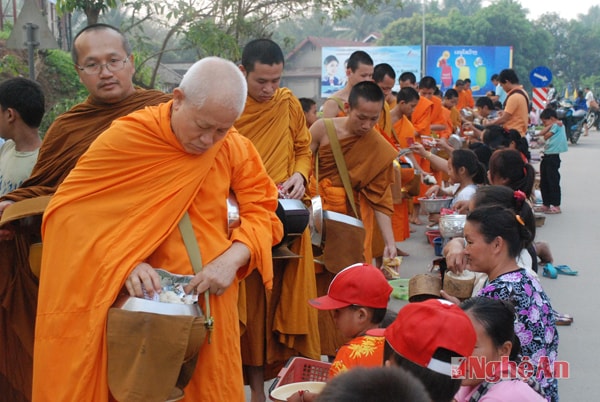 |
| Begging for alms in Luang Prabang. Photo by Tran Duy Ngoan. |
On our first morning, Luang Prabang awaited us atop Mount Phu Sy. The feeling of discovering and conquering the mountain rising in the heart of the ancient capital made our steps strong and steady. 328 steps is the only way to reach the Chom Sy stupa perched on the mountaintop. 328 steps, filled with countless memories of the ancient capital. Somewhere, the footprints of virtuous and noble figures still seem to linger on the earthen pavement of the plateau. Occasionally, the scent of herbs and incense from the queens and beloved children still lingers in the wind, as if they have sought inner peace in this Buddhist sanctuary. The stories of yesterday always evoke a sense of nostalgia for a bygone era. The Chom Sy stupa and the Phu Sy architectural complex were built in 1804. The architecture of the stupa retains its elegant features, with its tiled roof soaring like the clear, crisp notes of the Tơrưng lute reaching its climax. Those who designed and built this temple were surely not just talented architects and artisans with profound admiration and unwavering faith in the Buddhist realm. They were truly artists, carving strokes and poetic verses into the heavens and earth to bridge the gap between spirituality and everyday life.
Looking down from That Chom Sy, one sees a giant carpet of vibrant pink. Interspersed among the houses and tiled roofs are rows of dark green coconut trees, easily reminiscent of the hair of young women during the enchanting Bun season. But nature has bestowed even more favor upon Luang Prabang. From the mountaintop, one can clearly see the Mekong River and the Nam Khan River. I suddenly remembered the words of Hum Peng – an editor at the Lao National Television Station – during a stroll with him through the ancient capital of Luang Prabang under the ancient frangipani trees with their deep purple blossoms: "The Nam Khan River is the lifeblood of the ancient capital, giving vitality to the magnificent Mekong River." And many people share the same opinion: If the Mekong is likened to a mother flowing tirelessly, forgetting all the pleasures of life, then the Nam Khan is the mischievous child, trying to run parallel to the Mekong for a while before finally merging with its mother river.
Interestingly, in Lao, "Khan" has two meanings: firstly, "Khan" means a child who hasn't learned to walk yet; secondly, "Khan" means a carrying pole. Of course, everyone can find their own interpretation to suit their thoughts, moods, and personal feelings. For us, Nam Khan is the child that, together with the Mekong River, has created a poetic confluence and transformed Luang Prabang into a peninsula on the plateau. But Luang Prabang's charm also comes from the rich character of its many generations of local inhabitants. And it's not that they attract tourists with strange mystique, but rather with their inherent tranquility. The concept of a "non-polluting industry" (tourism) is certainly not in the mindset of most of the local population. Therefore, in Luang Prabang, it's difficult to find luxurious services, high-end restaurants and hotels, or the flashy, opulent tourism practices of the Lao people. And it seems that whether or not tourists arrive, the people of Luang Prabang maintain their kind and gentle way of life and work, just as they have for generations.
At the foot of Mount Phu Sy lies the palace of the ancient Kingdom of Laos, now the National Museum of Laos. It is difficult to express the thoughts hidden in one's heart. The capital Luang Prabang belongs to history, but what the ancient city possesses today is present in all its noble colors that anyone would admire. The royal palace of the Kingdom still shows a period of great prosperity of the feudal dynasties before the capital moved to Vientiane in 1566. The royal palace complex consists of three main architectural structures arranged in a triangular formation. In the middle is the main palace, associated with the name of King Si-Xa-Vang-Vong. It was once the place where people gathered to discuss strategies for the prosperity of the kingdom situated along the legendary Mekong River…
To the right of the Royal Palace is the Golden Pagoda in Prabang – a place that houses sacred relics dedicated to the Buddha. The people of Laos have traditionally preferred a secluded and private life, using tranquility as a measure of all their material and spiritual activities. Therefore, only by looking at the exquisite reliefs and the soft, delicate architectural lines can one truly see the soul of the people of the Land of a Million Elephants. The Golden Pagoda was built to worship the Buddha of Prabang. According to Lao custom, one day before the New Year, the Royal Palace prepares offerings and escorts the statue of the Buddha of Prabang from the main palace to Xieng Thong Pagoda for a ritual bathing with Champa perfume. The Buddha of Prabang resides at Xieng Thong Pagoda for three days and three nights. The procession carrying the Buddha of Prabang consists of 16 strong young men.
It is often said that Laos is the jewel of the Mekong River. But we believe that the ancient capital has contributed to making the land of the Champa flower more complete and full, with its faith in the Western paradise. At an altitude of about 700 meters, with its gently sloping terrain, Luang Prabang always maintains a serene and charming atmosphere; its dreamy and poetic nature immerses anyone who visits this ancient city in its own enchanting space. It is no coincidence that Luang Prabang was recognized as a UNESCO World Heritage Site in 1995. But this natural and coincidental recognition has not changed the lives of the nearly 20,000 inhabitants of this city at the confluence of three rivers. The clearest evidence is the rows of houses that remain intact as when they were first built. The insightful vision of the early urban planners has created a peaceful and elegant Luang Prabang.
In the ancient capital of Luang Prabang, nestled in a hammock-like shape on the plateau, three main ethnic groups—Lao Lum, Lao Thong, and Lao Sung—are coexisting. Yet, it's virtually impossible to distinguish between the houses of the Khmu and the Hmong. All share a common architectural style: elegant, simple, yet warm and charming. The grid-like urban planning further enhances the balance and harmony within the overall development space. For the people of Luang Prabang, each house they inhabit is a sacred structure, aspiring to enlightenment. Living in an environment steeped in the mystical essence of Buddhism, the inhabitants of this ancient capital believe that present life is merely a temporary moment in the cycle of birth and death.
That's why it's easy to understand why, in Laos, especially in Luang Prabang, large houses are rare. Most houses are no more than two stories high, and each story is no more than 2.8 meters tall. These subtle touches create a sense of intimacy and friendliness, reflected in the gentle gaze of Luang Prabang towards visitors. The architecture of the residential buildings not only clearly reflects the character, virtues, and beliefs of the ancient capital's inhabitants but also demonstrates the harmonious connection between humanity and nature. At an altitude of 700 meters, with a characteristic tropical climate and distinct seasons – the rainy and dry seasons – this highland city in northern central Laos constantly endures the harsh effects of nature.
Therefore, building low-lying houses with double-layered tile roofs has helped to mitigate the harsh sun during the dry season and keep family living spaces warm during the cold rainy season. It must also be acknowledged that the preservation of the original identity, architecture, and landscape of Luang Prabang, besides the self-awareness of the local residents, is also significantly contributed to by the local government. This is evident in the specific regulations for heritage management. Previously, the preservation of Luang Prabang's heritage belonged to the Department of Culture, but now it is the responsibility of the local UNESCO Heritage Management Board. A few years ago, if a household wanted to renovate their house, the Heritage Management Board would provide 50% of the funding, provided they maintained the original structure and architecture.
Luang Prabang is peaceful and charming, dreamy and dreamy. But it's not just a nostalgic remembrance of a faded golden age. This ancient highland capital embraces the present and the future in its own way. With heartfelt sincerity and simplicity. That's something that has never changed in this land, once the capital of emperors and countless people of the land of temples. Surely, that's what has kept visitors coming to this poetic highland.
Dao Tuan