

Bring the letters back, Oh Oh, Old Man Hop
(Baonghean)Whenever the name of teacher Ha Van Tam is mentioned, the people of O O and Gia Hop villages in Tuong Son commune (Anh Son district) always express their respect. For nearly 20 years, Mr. Tam has quietly contributed to bringing literacy to the children, helping to improve the lives of the villagers.
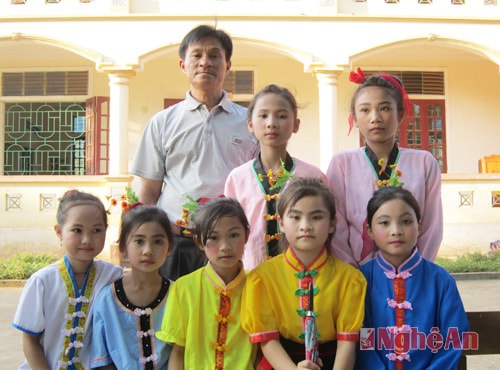 |
| Teacher Ha Van Tam and the students of O O village. |
Mr. Tam was born in 1963 in Tam Son commune, a remote area of Anh Son district. After finishing high school, this young man of the Thai ethnic group enlisted in the army. After 7 years in the military (1982-1989), Ha Van Tam returned to his hometown to work in production. At that time, the lives of ethnic minorities in Anh Son were still very difficult; many children of school age could not attend school due to a lack of schools, classrooms, and teachers. Faced with this situation, Ha Van Tam decided to apply to the Mountain Teacher Training School to become a teacher and bring literacy to the children of remote villages. After 2 years of studying education, in 1996, Ha Van Tam graduated and was assigned to Tuong Son Primary School. At that time, the two villages of O O and Gia Hop were still lacking teachers, so Mr. Tam volunteered to teach there.
To this day, Mr. Tam still cannot forget those difficult years, having to walk about 10 kilometers through the forest, following trails along streams to reach his students. The lives of the Thai ethnic people in O O and Gia Hop were extremely poor; most families were struggling to make ends meet, and few cared about education. Mr. Tam's first task upon arriving was to go to the village head's house to ask for help in mobilizing the villagers to contribute thatch, bamboo, and wood to build a classroom. Without a suitable location, Mr. Tam persuaded the village head to agree to build the classroom right in his garden. And so, every new school year, Mr. Tam worked to mobilize the villagers to build the classroom and school, and it wasn't until nearly 10 years later (in 2005) that O O and Gia Hop received investment for school construction. The next step was for Mr. Tam to go to each house to encourage people to send their children to school.
Initially, some parents were reluctant to send their children to school because of the expense of textbooks and supplies, and the lack of someone to help look after the children while they worked in the fields or tended to the cattle. Faced with this situation, Mr. Tâm kindly advised the villagers, helping them gradually understand the benefits of sending their children to school. Compared to students in the central areas, the learning ability of students in Ồ Ồ - Già Hóp was slower. Mr. Hà Văn Tâm determined that he had to patiently and diligently guide the children in writing each letter and solving each calculation. At night, he and the village head went to each student's home to check on their studies, understand their family circumstances, and grasp the thoughts and aspirations of the parents.
To date, life has changed somewhat, and the road to the village has been paved, but compared to other areas, the people of O O and Gia Hop still face many difficulties and hardships. Teacher Ha Van Tam continues to dedicate himself to the children here. Besides teaching, he also spends time traveling around to solicit donations of books and school supplies so that his students can have the best possible learning conditions. Teacher Tam shared: "Compared to the main school, the students here are more disadvantaged, so I hope to have a library to serve their learning, to meet their needs for knowledge enhancement and entertainment, especially during the summer."
Speaking with us, Mr. Nguyen Duc Vinh, Head of the Education and Training Department of Anh Son district, said: “We acknowledge and highly appreciate the sense of responsibility of Mr. Ha Van Tam. He has made a great contribution to maintaining the number of students, helping the department to do a good job of managing and advising on teaching and learning in O O and Gia Hop villages...”.
Tuong Anh