
Replicate best practices.
(Baonghean) - Building new rural areas is a major policy of the Party and the State, and a central task of the entire political system and society. Over the past three years of implementing the National Target Program for building new rural areas, agricultural production, rural areas, and the lives of farmers throughout the province have significantly improved. The practical experiences in three communes – Nghia Dong (Tan Ky district), Nghia My (Thai Hoa town), and Phuc Thanh (Yen Thanh district) – have highlighted innovative and effective approaches that need to be replicated.
(Baonghean) - Building new rural areas is a major policy of the Party and the State, and a central task of the entire political system and society. Over the past three years of implementing the National Target Program for building new rural areas, agricultural production, rural areas, and the lives of farmers throughout the province have significantly improved. The practical experiences in three communes – Nghia Dong (Tan Ky district), Nghia My (Thai Hoa town), and Phuc Thanh (Yen Thanh district) – have highlighted innovative and effective approaches that need to be replicated.
Mobilize the entire political system to participate.
As one of the 14 communes that registered to strive to achieve all 19/19 criteria for new rural development in 2014, Nghia Dong (Tan Ky district) has currently achieved 16/19 criteria, including difficult ones such as income, poverty reduction, and irrigation. To date, the average per capita income of the commune is 18 million VND/year. More than 32 km of canals managed by the commune have been reinforced. 100% of households have regular access to electricity with a power system including 8 transformer stations and 25 km of 3-phase low-voltage power lines, and all 4 schools in the commune have met national standards... One of the main reasons for these results is that over the past 3 years, the entire grassroots political system, under the leadership of the commune Party Committee, has been involved decisively and synchronously. The commune has identified and promoted the role of the entire political system and society as a whole in building new rural areas, considering this a central task, ensuring that no one is left out, and effectively implementing grassroots democracy regulations so that "the people know, the people discuss, the people do, the people inspect, and the people benefit."
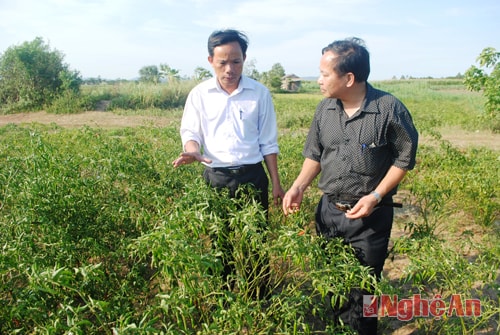 |
| Model for growing chili peppers for export in Nghia My commune, Thai Hoa town. |
The commune Party Committee issued resolutions and thematic reports on building new rural areas, and based on their assigned tasks, mass organizations developed action programs to successfully implement the resolution's objectives. The Fatherland Front Committee carried out propaganda work, implemented grassroots democracy regulations, and built a cultural life. The Farmers' Association was responsible for mobilizing its members to take the lead in building economic models and environmental sanitation. The Youth Union took the lead in the self-reliance and entrepreneurship movement and in protecting the commune's security and order. Mr. Tran Van Trung, Deputy Secretary of the commune Party Committee, said: Identifying the construction of new rural areas as a comprehensive, long-term socio-economic development program in rural areas, this is therefore a task for the entire political system. In particular, it is determined that the construction of new rural areas must be spearheaded by the people, primarily mobilizing internal resources through social contributions, with the State only playing a supporting role, so that the construction of new rural areas will be sustainably successful. This has helped overcome the mindset of waiting and relying on the State. As a result, over the past three years, the commune has mobilized nearly 38 billion VND in capital for rural development, with the people contributing more than 10 billion VND.
Similar to Nghia Dong, the achievements of Phuc Thanh commune (Yen Thanh district) to date are the result of the efforts and endeavors of the entire political system and the people over the past three years. Originally a purely agricultural commune with a sprawling terrain, fragmented production, and difficult economic conditions, mobilizing resources from the people for rural development was extremely challenging. However, recognizing that rural development relies primarily on internal strength, Phuc Thanh has adopted effective methods to ensure high levels of public support and proactive participation. Firstly, by issuing resolutions on promoting rural development, the commune Party Committee mobilized the entire grassroots political system, from the commune to the hamlets, through specific action programs.
The Veterans Association took the lead in mobilizing people to donate land for rural road construction, the Cooperative took responsibility for irrigation criteria, the Farmers Association mobilized members to participate in building economic models and improving income criteria, and the Women's Association was in charge of environmental issues... Thanks to this, the organizations and associations have closely followed and created high consensus among the people. Mr. Nguyen Trong Nuoi, Chairman of the Veterans Association of the commune, said: Identifying its political nhiệm vụ, the association has assigned its members to actively participate in disseminating information and mobilizing people in the commune to participate in building new rural areas. Each member is tasked with helping 2-3 neighboring households to contribute and donate land for road construction and other criteria.
Household economic development
Identifying the core objective of the new rural development program as improving people's lives, many localities have implemented policies to encourage people to develop economic models to increase their income. In Nghia My commune (Thai Hoa town), one of the criteria that the commune government is very concerned about is the poverty line. To strive to achieve this criterion, over the past three years, the commune has coordinated with the Provincial Farmers' Association and various departments of the town to open 8 vocational training classes on clean vegetable cultivation, and 4 classes on beekeeping, broiler chicken farming, mushroom cultivation, and veterinary medicine... to give people the opportunity to learn and apply the skills to their families.
Currently, the commune has initially developed several new occupations such as beekeeping for honey production, industrial-scale broiler chicken farming, goat and cattle breeding, and some models that bring high economic efficiency: green asparagus cultivation, export-oriented chili pepper cultivation in Lang Co fields, oyster mushroom and reishi mushroom cultivation... Mr. Nguyen Huu Hoang, Vice Chairman of the Commune People's Committee, said: The commune's goal is to reduce the poverty rate from 7.58% to below 5% in 2014. Besides introducing new models and occupations, the commune will review and prioritize loan capital from the Social Policy Bank for households with labor capacity and the conditions for efficient production and livestock farming.
In order to improve farmers' income to meet criteria No. 10 (income) and No. 13 (form of production organization), over the past three years, Phuc Thanh commune has focused on building production models for people to learn from. As a purely agricultural commune, mainly relying on rice cultivation, the commune has developed a model for F1 hybrid rice production and many other demonstration models. In addition, the commune has also developed a medicinal herb production model on an area of 1 hectare, and an improved intensive rice cultivation (SRI) model on an area of 50 hectares. To create momentum for the development of these models, the commune previously focused on promoting land conversion with the criterion of one area per hamlet, one plot per household. Furthermore, the commune has promoted the development of production methods by encouraging, supporting, and creating favorable conditions for two incense stick making villages and one cooperative to operate effectively, creating jobs for hundreds of unemployed workers and increasing their income. Mr. Dinh Van Duong, Chairman of the People's Committee of the commune, said: "To mobilize the people's strength, we must first increase their income. Therefore, the commune has actively used capital to implement these two criteria. As a result, people's income has continuously increased. In 2011, it reached 17.4 million VND, in 2012 it increased to 20.9 million VND, and by 2013 it had reached 24.65 million VND per person per year."
With the same goal of increasing people's income, Nghia Dong commune chose a different approach: improving agricultural land use planning to transform the crop and livestock structure for higher economic efficiency. The commune has planned to convert 350 hectares of barren land to sugarcane cultivation and 100 hectares of farmland for grass cultivation combined with commercial buffalo and cattle farming. In addition, the commune has planned three large specialized farming areas: 70 hectares for mulberry cultivation and silkworm farming, 100 hectares for corn cultivation, and 350 hectares for rice cultivation to ensure food security. Along with land planning, the commune's Steering Committee implemented economic projects to encourage people's participation. As a result, the efficiency of agricultural land use has continuously increased, from 45 million VND/hectare in 2010 to 72 million VND/hectare in 2013. People's income has also increased, reaching 18 million VND/person/year in 2013.
Mr. Vo Duy Hien, Vice Chairman of the People's Committee of Nghia Dong commune, said: Recognizing that the people are the main actors in building new rural areas, the commune has proactively and actively developed projects and issued policies to support people's participation in economic development. Thanks to this, over the past three years, the face of rural areas in Nghia Dong commune has changed significantly. Besides the rural road system, schools, and health stations, the lives of the people have improved considerably. People are confident and enthusiastic to continue participating in building new rural areas, striving to achieve all 19 criteria in 2014.
It can be said that the achievements of the three communes of Nghia Dong, Nghia My, and Phuc Thanh, besides the help and support from all levels, are primarily due to the internal strength of the people. These are good and creative approaches that need to be promoted and replicated.
Text and photos:Pham Bang