

Noodle-making village in Nghi Hoa
(Baonghean) - In early May 2014, Nghi Hoa commune (Nghi Loc district) received a certificate recognizing the "Production and processing of agricultural products and food" craft village in Hau Hoa and Trung Thanh hamlets, awarded by the People's Committee of Nghe An province. This serves as a "catalyst" to help the craft village create a new direction and achieve sustainable development…
Together with Mr. Nguyen Dinh Duong, Deputy Head of Trung Thanh Hamlet, we visited the noodle production facility of Mr. Nguyen Van Duc - one of the pioneering households to invest in a noodle production line system. Standing beside the gleaming, clean stainless steel machinery, Mr. Duc happily shared: “My secret to making delicious rice noodles is encapsulated in four words: ‘white rice, clear water.’ In our grandparents' time, making rice noodles was not only arduous but also very elaborate. From the first step (selecting the rice) to the last step (shaping the noodles into strands), it involved 13 stages over a period of about 7 days. The ingenious secret was keeping the noodles from turning sour (in winter, they could be kept for 2 days, in summer for 1 day). Anyone in the profession knows that the flour must be soaked thoroughly, changing the water many times; in summer, the rice must be soaked for at least 3 days, in winter 7 days, but not every household could produce noodles that met the standards of being ‘fragrant, chewy, and crispy.’ Now, machinery replaces the strenuous steps, shortening the time and increasing productivity 10-15 times compared to manual noodle making.”
Recalling the past, Mr. Nguyen Van Toan (from Hau Hoa hamlet) shared: "Now that we no longer do it manually, it's much easier. In the past, when we did it by hand, the whole family could only mill about 10 kg of rice a day. In the morning, my wife would carry it around to sell at the local markets. Now, with machinery, we can easily make several hundred kg of vermicelli every day. Even with the same machine and rice, the quality of the vermicelli differs because of the flour processing stage. First, we have to choose rice grains that are dry when cooked, like Khang Dan; sticky rice is the worst. The rice is washed thoroughly, dried, naturally fermented, and then soaked. Mr. Toan likened it to: Making rice wine, making tofu, and making vermicelli are three brothers; natural fermentation is essential for the best taste. Many people spread rumors about using chemicals to treat the rice to prevent fermentation, but that's unfounded. During the soaking process, just by feeling and smelling the rice, the craftsmen can tell if the fermentation is just right." Currently, my family produces an average of about 70 kg of rice per day. In the summer, when sales are higher, we increase it to 100 kg. After deducting raw materials and electricity costs, we earn a profit of about 200,000 VND.”
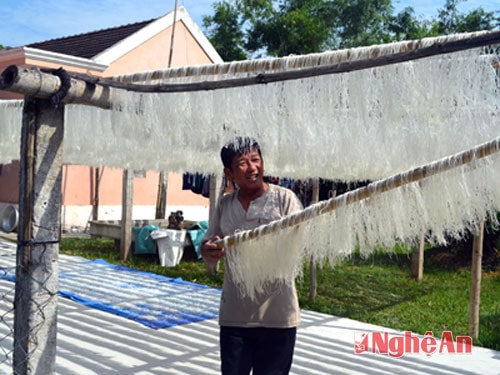 |
| Rice vermicelli production in Trung Thanh hamlet, Nghi Hoa commune (Nghi Loc district). |
Famous since ancient times not only for its delicious flavor but also for the fact that Nghi Hoa rice noodles are produced without any additives. Therefore, when information surfaced in the media about some households in other areas using additives, it caused great indignation among the villagers. “We always prioritize integrity in our work. A few bad apples can affect the reputation of our profession to some extent. Now that the economy is better, many households here have invested in modern machinery, closed production processes, and expanded workshops, so food safety and hygiene are much more assured,” shared Mr. Nguyen Van Duc.
Besides the traditional product of rice noodles, for the past 10 years or so, the people of Nghi Hoa have been actively learning and processing new products to suit consumer tastes, such as rice vermicelli, sticky rice cakes, glutinous rice cakes, rice crackers, peanut candy, etc. Having just finished making the last batch of rice vermicelli to dry in time for the day's sales, Mr. Nguyen Ngoc Thong (Trung Thanh hamlet) said: "Nowadays, the vermicelli production process is completely automated, but the skill and technique of the machine operators are also crucial factors in determining product quality. This means that the process of feeding the flour into the press must be done to the right degree for the rice to cook properly so that the vermicelli strands are white and chewy. Vermicelli dried in the sun will be shiny, fragrant, and tastier. The vermicelli making profession depends heavily on the weather; if operating at full capacity on sunny days, each machine can process an average of 200-220 kg of rice per day, producing about 180-200 kg of vermicelli."
According to statistics from the Nghi Hoa Commune People's Committee, there are currently 157 households engaged in these trades; including 51 households producing rice noodles, 7 households producing vermicelli, 21 households producing peanut candy, and 71 households making various types of sticky rice cakes (banh chung and banh nep). The total production value in 2013 reached 6.4 billion VND, an increase of 9.7% compared to 2012; average per capita income reached nearly 21 million VND/year. Regarding the dried rice noodle and vermicelli production, over 10 households have invested in specialized machinery (averaging about 60 million VND/rice noodle production line, 20 million VND/vermicelli production line) to expand production. For households producing confectionery and "cu do" candy, along with using machinery to replace traditional manual methods such as ingredient mixers, cutters, and bag sealing machines, production facilities have also paid more attention to food safety and hygiene. Some manufacturers have registered trademarks for their products to compete in the market.
Mr. Dang Tho Thien, Vice Chairman of the Nghi Hoa Commune People's Committee, said: "Each household producing vermicelli and rice cakes discharges at least 3 cubic meters of wastewater daily from soaking rice. Due to poor treatment, this has led to environmental pollution. To address the pollution, the commune organized meetings with residents of Hau Hoa and Trung Thanh hamlets. After several meetings, it was agreed to establish an environmental sanitation fund, with each household contributing 2,000 VND per month to form a team to collect household waste and transport it to the commune's waste collection garage. Simultaneously, using loan capital from the National Program on Clean Water and Sanitation, we are mobilizing residents to build facilities such as bathrooms, water tanks, and toilets..."
Being recognized as a traditional craft village is an opportunity for the people of Nghi Hoa to further strengthen the brand value of their products after many years of building and preserving the craft. At the same time, it helps the local government build a more sustainable craft village, thereby creating conditions for economic development and stabilizing the lives of the people. However, alongside the achievements, production in some establishments remains scattered, with cramped production spaces; the wastewater treatment system, although receiving investment, is not yet fully integrated… To ensure the sustainable development of the craft village, the local government needs to plan a concentrated production area, encourage and guide people to properly and sustainably handle waste generated during the crafting process, ensuring compliance with the criteria for building new rural areas.
Ngoc Anh