

President Ho Chi Minh - The soul of the Dien Bien Phu campaign
President Ho Chi Minh was the great leader of the entire nation; in the historic Dien Bien Phu Campaign, he was also the supreme commander.
Throughout the campaign, President Ho Chi Minh attended and chaired many meetings of the Politburo, serving as the soul of our Party in formulating correct and creative resistance strategies and policies, and providing timely encouragement and motivation to our army and people throughout the strategic offensive of the 1953-1954 Winter-Spring campaign, leading to victory in the Dien Bien Phu Campaign.
"The general is out in command" and "a sure victory is guaranteed"
After becoming bogged down on the battlefields, in late 1953, France decided to build the Dien Bien Phu complex as an impregnable fortress that our troops could not breach. The West considered this a strategic shift by General Navarre.
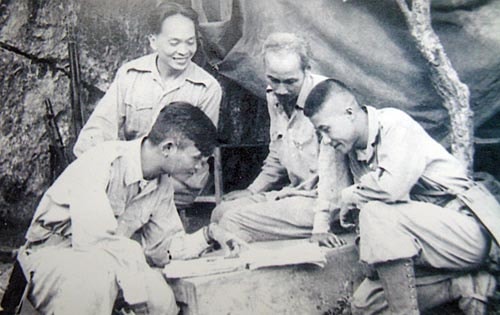 |
| President Ho Chi Minh and General Vo Nguyen Giap studying the battle plan for the Dien Bien Phu Campaign. (Archival photo) |
In October 1953, during a meeting of the Politburo of the Central Committee of the Communist Party of Vietnam in Tin Keo, Dinh Hoa district, Thai Nguyen province, chaired by President Ho Chi Minh, to discuss the strategic plan for the 1953-1954 Winter-Spring campaign, General Vo Nguyen Giap presented the audacious intention of French General H. Nava to concentrate a very large mobile force in the Northern Delta to provoke a battle, wear down our main forces, create conditions to gain the initiative, and achieve a decisive victory within 18 months. President Ho Chi Minh listened attentively and then said: “The enemy is concentrating mobile forces to create strength. Don’t be afraid! We will force them to disperse their forces, and then that strength will be gone.” President Ho Chi Minh opened his hand, each finger pointing in a different direction. Following this guiding principle, we studied the Winter-Spring plan, directing our main forces to advance in five strategic directions, targeting the enemy’s vulnerable and relatively weak points, with Lai Chau in the Northwest being the main direction.
President Ho Chi Minh appointed the leadership and command of the campaign, deployed forces to the Northwest, and assigned General Vo Nguyen Giap as the Commander-in-Chief. Our determination was: "To destroy the Dien Bien Phu stronghold to create a new turning point in the war."
In early January 1954, before heading to the front lines, General Vo Nguyen Giap visited Uncle Ho in Khuoi Tat to bid him farewell. Uncle Ho asked, "Are you facing any difficulties on this trip to the front?" General Vo Nguyen Giap replied, "The only difficulty is being far from the rear, so when important and urgent issues arise, it will be difficult to seek your and the Politburo's advice." Uncle Ho said, "The Commander-in-Chief is at the front, the general is in command; I entrust you with full authority." Upon parting, Uncle Ho reminded him, "This battle is important; we must fight to win. Only fight if victory is certain; do not fight if victory is uncertain." Researchers consider this a crucial, strategic directive.
Colonel Tran Ngoc Long, Deputy Director of the Vietnam Military History Institute, affirmed: “President Ho Chi Minh determined this to be the decisive blow. The victory or defeat of the Battle of Dien Bien Phu had a significant impact on the entire war, going beyond the scope of a typical battle in Vietnamese military history as well as in world military history. The guiding strategic thought was that only victory could solve the problems of the resistance war that had been ongoing for nine years. He demonstrated strategic vision, analyzing the domestic and international context before generalizing to this point.”
Researchers believe that Ho Chi Minh's guiding ideology was a beacon illuminating the path to complete and glorious victory. It was thanks to his guiding principles of "the general is in command" and "fight to win" that General Vo Nguyen Giap changed the strategy of warfare. This change led to the historic victory of our army in the Dien Bien Phu campaign.
Following the motto "fight surely, advance surely," after 56 days and nights of tenacious fighting, our army completely destroyed the Dien Bien Phu stronghold. This victory cemented Vo Nguyen Giap's reputation as a legendary general.
After the victory at Dien Bien Phu, in response to a foreign politician, General Vo Nguyen Giap said: “The victory at Dien Bien Phu is primarily thanks to President Ho Chi Minh – Ho Chi Minh was a brilliant strategist, the beloved father of the Vietnamese people's armed forces. The extraordinary changes in Vietnamese history over the past few decades are all linked to the contributions and achievements of President Ho Chi Minh.”
General H. Nava, who confronted General Vo Nguyen Giap in the Battle of Dien Bien Phu, said: "The Vietnamese victory was justified. Because throughout the 9 years of war, they had only one military commander, General Vo Nguyen Giap, and one supreme political commander, Ho Chi Minh." Meanwhile, the French had 20 governments, 7 commanders-in-chief, and 8 high commissioners who successively commanded in Indochina, yet still failed."
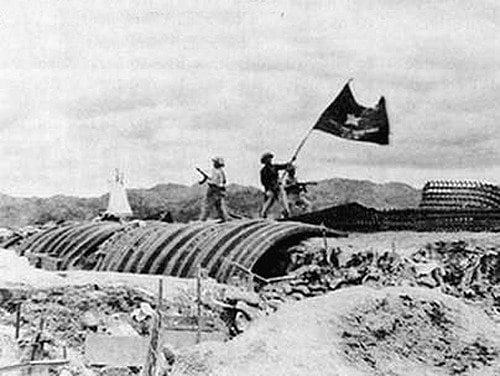 |
| The Dien Bien Phu Victory, May 7, 1954 |
"Nothing is more precious than independence and freedom."
President Ho Chi Minh was the soul of the historic Dien Bien Phu campaign. Throughout the preparation process leading up to the decisive victory, he paid special attention to educating the troops on the spirit of fighting determination, sending many letters to officers and soldiers on the front lines. He instilled in our army and people the extraordinary strength of the ideology that "Nothing is more precious than independence and freedom."
Uncle Ho analyzed profoundly: "The Central Committee's determination is not enough; you must carefully consider and clearly see the easy and difficult aspects before conveying that determination to you. The Central Committee and you must also be determined; that determination must reach every soldier... That determination must become a unified force from top to bottom and from bottom to top."
The President instructed the officers and soldiers participating in the campaign: “This campaign is a very important one. You must fight to win. All of you, officers and soldiers alike, must: be determined to fight, strictly obey orders; be persistent and resilient, overcome all hardships and difficulties; eliminate as many enemies as possible, and achieve complete victory.”
He instructed: Our officers and soldiers "must fight more bravely, endure greater hardships, and maintain their determination in all circumstances: determined to annihilate the enemy; determined to uphold the policy; determined to achieve many victories."
The strategic determination of the Party and President Ho Chi Minh to annihilate all enemy forces at Dien Bien Phu was transformed into the will and actions of our entire army and people. Upon our complete victory, President Ho Chi Minh immediately sent a congratulatory message and decided to award the "Dien Bien Phu Warrior" badge to the comrades who participated in this historic campaign.
In a letter praising the soldiers, civilian workers, youth volunteers, and people of Northwest Vietnam—those who directly contributed to this great victory—Uncle Ho wrote: “Our army has liberated Dien Bien Phu. Uncle Ho and the Government affectionately send our praise to the cadres, soldiers, civilian workers, youth volunteers, and local people who have gloriously fulfilled their duties… Uncle Ho and the Government will reward those cadres, soldiers, civilian workers, youth volunteers, and local people who have made exceptional contributions.”
By closely following the Battle of Dien Bien Phu, gathering news day by day, hour by hour, Ho Chi Minh instilled in our army and people immense strength and unwavering faith in victory—a faith rooted in himself and in humanity. He believed in the correct and wise leadership of the Party and the brilliant direction of the Front Command. He had unwavering faith in ultimate victory because our struggle was a just war to protect human dignity, for the independence, freedom, and peace of mankind. "Nothing is more precious than independence and freedom"—that was an unbreakable belief in ultimate victory.
According to congly.com.vn