

Nguyen Phong Sac Street - A Street Full of Emotions
(Baonghean) - Once a "rain-soaked road" in the memories of many people in the city, evoking nostalgia for the humble appearance of the scenery and people; and despite many glamorous changes, that charm still remains in the street life today… That is Nguyen Phong Sac Street in Vinh City, more than a kilometer long, starting from the Customs roundabout and connecting Le Viet Thuat Street at the intersection with Nguyen Sy Sach Street.
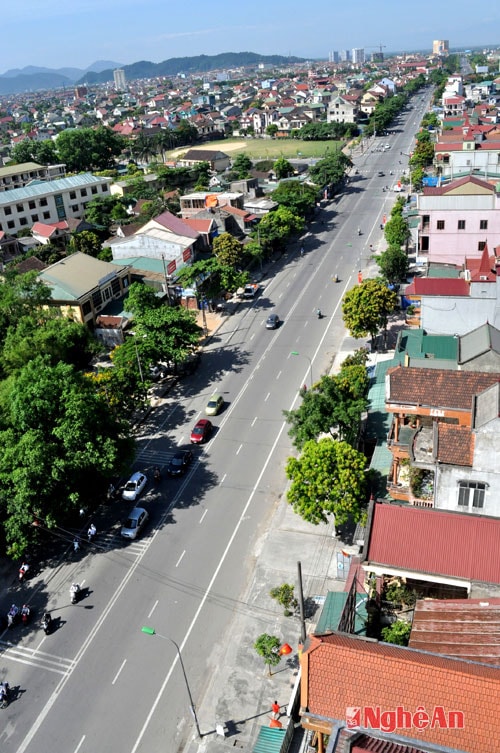 |
| Nguyen Phong Sac Street (Vinh City). |
I tried to return to the city with the same mindset as when I returned to the village roads of my central highlands. Because, how many people have been like me, who, over ten years ago, sat in the small cafes of this city, silently listening to the wind and rain murmuring over the old bamboo groves and banana trees in someone's garden; remembering their distant homeland, washing away the joys and sorrows of life in the bustling city! Few streets in Vinh evoke such feelings as Nguyen Phong Sac Street.
You might ask me: Vinh City is now expanding, with countless named streets on the outskirts, bustling with tube houses and flat houses that still haven't replaced the charm of ponds and quiet gardens... why not go there and reminisce? No! Because not everywhere can give us the experience of "place" in our "arrival" and "return." This road was originally a path that led to the discovery and research of traces of the Dong Son culture in a part of Vinh City, from which researchers confirmed that a strip of land along the left bank of the Lam River estuary was once the territory of the Viet Thuong Kingdom thousands of years ago. Nguyen Phong Sac Street, centuries ago, was also a village road in Hung Dung – the famous revolutionary village of Do, with a vast geographical boundary, connecting to a gateway to Vinh city and down to the Cua Hoi coastal area; it is the road that most clearly witnesses the shifting landscape of Vinh's urban space, which originated from a village. When villages were consolidated into urban blocks in the 1960s, Nguyen Phong Sac Street remained a vital artery connecting the surrounding rice paddies and rural landscapes. And during the city's reconstruction after the reunification of the country in 1975, the street was chosen as the site for the Provincial General Hospital (Vietnam-Poland Friendship Hospital) – the largest public health center in North Central Vietnam. The street quickly became a familiar thoroughfare for both city dwellers and people from the countryside…
Nguyen Phong Sac (birth name Nguyen Van Sac), was born on February 1, 1902, in Bach Mai village, Hanoi. As a child, Nguyen Phong Sac attended Buoi School and graduated top of his class in the 1924 high school graduation exam, subsequently applying for a job at the Indochina Finance Department. After joining the Vietnam Revolutionary Youth League in early 1927, he left his job at the Finance Department and devoted all his energy to revolutionary activities against French colonial rule. On March 7, 1929, Nguyen Phong Sac, along with Ngo Gia Tu, Nguyen Duc Canh, and five others, founded a Party organization in Vietnam. He was then assigned to oversee the Central region and directly established the first communist cell in Vinh City, Nghe An province. In 1930, Nguyen Phong Sac became a Standing Committee member of the Indochinese Communist Party. On May 3, 1931, Nguyen Phong Sac was arrested by the French colonial authorities in Hanoi and executed on May 25, 1931. To this day, only two cities, Hanoi and Vinh, have named streets after him. |
Not long ago, even before the planned four-lane road (as it is now) was implemented, Nguyen Phong Sac Street was famous for its dog meat. This was probably no coincidence, as this dish, considered a "national treasure," didn't choose just any place to become a "street food" brand. As the rainy season began in August, the street was filled with the fragrant aroma of plum wine, and crowds flocked to restaurants with rustic settings to match the dish's origins. Imagine this: a rainy day with bubbles forming on the asphalt, the air cool and pleasant, friends gathered warmly enjoying their favorite dish with local vegetables and fruits: galangal, lemongrass, shrimp paste, green bananas, starfruit, and, of course, pennywort and perilla leaves… For added warmth, you could pair it with some homemade rice wine with a banana leaf stopper, as long as you don't overindulge! With a slower pace of urban development compared to other central streets, the spacious gardens still retain their green fruit trees, the sidewalks are lined with bamboo groves and dense hedges, and the services that initially opened were mostly simple, catering only to laborers, family members of patients (from the Provincial General Hospital), and later, students from the Medical and Pharmaceutical College (now Vinh Medical University)... so the scenery seems to retain for longer the quiet, rustic charm of the old countryside during the rainy seasons. Therefore, some people once called the street "the wet road" (?!).
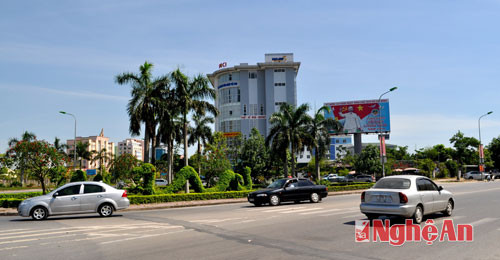 |
| A scenic view along Nguyen Phong Sac Street. |
With the sidewalks being cleared and the road upgraded to its current state, many dog meat restaurants have ceased operations, and services have gradually diversified, though it still shows no signs of becoming a specialized commercial street. The beginning of the street, starting from the Customs roundabout, features inexpensive ceramics, stone steles, and prefabricated tombstones. Further down, near the Provincial General Hospital, along with high-quality medical facilities and the Cua Dong General Hospital, there are increasingly more private pharmacies. The rest of the street offers a variety of services, from office rentals to grocery kiosks selling Thai goods; from beauty salons and jewelry shops to breakfast stalls selling sticky rice and rice noodles; but especially noteworthy are traditional trades such as aluminum and glass welding, scrap metal collection, bicycle and motorbike repair, bamboo mat making, and bird cage making.
Despite its diverse and rustic businesses, the street lacks the chaotic atmosphere of a typical flea market. You can create a small joy for yourself by visiting the bird shop each morning, letting your mind wander as you listen to the gentle cooing of a dove or the clear, melodious chorus of a bulbul or nightingale… The birdcage shop owner won’t scold you for disturbing the opening, but will instead share memories of your youthful days chasing cicadas and butterflies! In the afternoon, after a day’s work, there’s a great place to meet at the newly opened Dai Hue Restaurant, with its inspiring design featuring rustic brown ceramic and tile materials that evoke the spirit of Vietnamese countryside. At night, you can stroll along the sidewalk, enjoying the refreshing breeze from the open Hung Dung Stadium right next to the eastern side of the street, and experience a glimpse of the urban landscape chosen for future development into a modern city with a strong cultural identity. Soon, when the new Vinh Medical University building is completed and the Provincial General Hospital across the street relinquishes its infrastructure to the university before relocating, the street will have a space for lecture halls and dormitories, creating a vibrant and youthful yet profound landmark – a grand structure bearing the marks of time, a testament to a historical friendship.
High-rise buildings are being planned for construction along Nguyen Phong Sac Street, and many new, modern houses are being built along the street. However, I believe that with the charm of the familiar street life here, and the trend of developing traditional services that evoke cultural ideas deeply rooted in the local identity, the street will forever retain its unique appeal. For example, I always want to return to that street, to cherish those pure and familiar memories.
Dinh Sam