

To have a successful summer-autumn rice crop!
(Baonghean) - A successful summer-autumn rice crop is the wish of all farmers. In previous summer-autumn seasons, a complete and successful harvest was mainly due to the spring rice crop being harvested early to allow for timely planting of the summer-autumn rice crop. At the same time, favorable weather conditions at the beginning of the planting season, without drought, and no heavy rains or strong winds at the end of the harvest season that could affect production results.
This year's summer-autumn crop production in our province is facing difficulties and challenges that need to be assessed in advance to find solutions. Due to the extremely low air temperatures (below 16°C) and overcast skies with insufficient sunlight lasting nearly 50 days at the beginning of this year's spring rice crop, the rice growth period has been extended. As a result, the majority of the spring rice crop has to be harvested later than usual, by at least 5-7 days, and in some places even 10 days. This is a major obstacle delaying the planting of this year's summer-autumn crop in our province.
Furthermore, this year's summer-autumn rice crop is likely to face drought conditions. Rainfall in the province has been negligible in recent months. Consequently, water reserves in the 625 large and small reservoirs and dams throughout the province have significantly decreased compared to their design levels. Meanwhile, water levels in rivers and streams, especially the Lam and Hieu rivers, have fallen below their lowest levels due to lack of rain and the retention of upstream water by hydroelectric dams for power generation. Without proper regulation between hydroelectric power and water resources for agricultural production in the areas along the Lam and Hieu rivers and the areas with gravity irrigation under the Do Luong dam system, the situation will be severely affected. In addition, the flood and storm season in our province typically begins after September 10th each year and lasts until early November. Therefore, selecting short-duration rice varieties and planting early is crucial to the success of this summer-autumn rice crop.
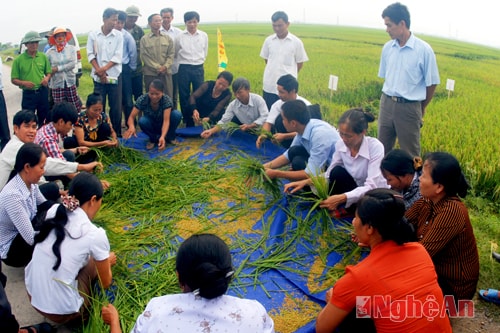 |
| Farmers in Bac Thanh commune check the yield of a new rice variety in the field. Photo: Ho Cac. |
To address and avoid the aforementioned major difficulties and challenges, we need to implement the following key solutions:
First: Water must be managed and used very sparingly. A major drought is certain during this year's summer-autumn crop season. Now that the winter-spring rice crop has been harvested, reservoirs and dams no longer need to release water; instead, they should be closed to retain water. Water should be stored in the fields to ensure sufficient water for timely rice planting. Absolutely avoid draining the fields completely before harvest. Each locality should take advantage of the opportunity to dredge canals and prepare all necessary means to combat drought and prevent saltwater intrusion, which are highly likely to occur, especially in areas irrigated by electric pumps and areas near coastal river mouths.
Secondly: Due to the possibility of a slower-than-usual start to the summer-autumn rice planting season this year, production facilities should instruct farmers to take advantage of the time to transport manure and pile it up along the field edges before harvesting. At the same time, they should plan ahead to purchase sufficient fertilizers and rice seeds to ensure timely sowing of seedlings and adequate fertilization before transplanting the rice seedlings.
Thirdly: Only short-day rice varieties with a growth period of 100 days or less should be planted.
The summer-autumn rice crop is a crop grown to avoid floods and storms, and only by avoiding floods and storms can a successful and complete harvest be guaranteed. Therefore, only rice varieties with the shortest growing season should be planted to ensure a successful harvest.
Based on the agricultural sector's rice variety structure guidelines, farmers and production facilities should select 1-2 varieties per household and 2-3 varieties per production facility for cultivation.
Fourth: Proactively plan the planting season as early as possible. For sowing rice seedlings for this year's summer-autumn rice crop, farmers should look at the rice panicles from the spring crop. If the panicles are in the firm, greenish-yellow stage, proceed with sowing the seedlings so that after harvesting the spring rice, the land can be prepared and the summer-autumn rice crop can be planted immediately.
Fifth: Direct sowing (seeding by broadcasting) should be avoided in the summer-autumn crop season, especially in years when the spring rice harvest is delayed. Direct sowing has the advantage of being quicker and more efficient than transplanting seedlings. However, direct sowing has three major disadvantages: it delays the rice plant's growth period, making it difficult to avoid floods and storms, thus increasing the risk of crop failure; it wastes water due to the need to drain water for sowing, which is crucial for drought prevention; and direct sowing cannot guarantee a uniform rice plant density per unit area, resulting in uneven planting density and making care, weeding, fertilization, and pest control, especially against brown planthopper, very difficult.
Doan Tri Tue