
China is showing clear signs of fear!
As predicted by researchers, China's placement of the HD 981 oil rig in waters under Vietnam's sovereignty is a counterproductive act, because China's arrogance will cause countries with sovereignty and national interests that are at risk of being violated to unite and draw closer together, creating a "bundle of sticks" to counter Chinese expansionism.
(Baonghean)As predicted by researchers, China's placement of the HD 981 oil rig in waters under Vietnam's sovereignty is a counterproductive act, because China's arrogance will cause countries with sovereignty and national interests that are at risk of being violated to unite and draw closer together, creating a "bundle of sticks" to counter Chinese expansionism.
Seemingly anticipating the inevitable trend of alliances among countries with recognized sovereignty in the South China Sea, yesterday (May 21), Chinese President Xi Jinping implicitly warned Asian countries strengthening military alliances against Beijing that this would not be beneficial to regional security. However, it is not difficult to see that this warning contained an underlying sense of fear and apprehension on the part of China.
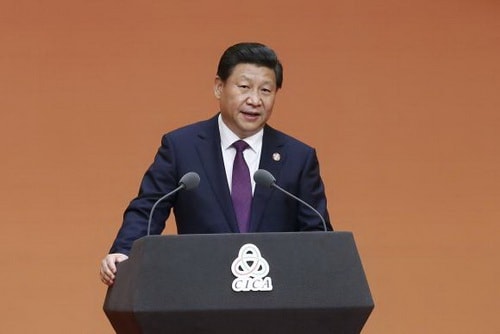 |
| Chinese President Xi Jinping speaks at the 4th Summit on Interaction and Confidence Building in Asia (CICA) in Shanghai - Photo: Reuters |
| RELATED NEWS |
|---|
It is ironic that China, the aggressor, brazenly placed the HD 981 oil rig illegally in Vietnam's sovereign waters on May 1, 2014, and then deployed warships, fighter jets, and numerous military vessels disguised as fishing boats, deliberately provoking and attacking Vietnamese ships, seriously threatening the security of the South China Sea and making the situation tense and dangerous. Yet, Xi Jinping still loudly warns other countries against doing things that are "not conducive to maintaining normal security in the region."
Ironically, at the 4th Summit on Interaction and Confidence Building in Asia, Xi Jinping stated that "China is keeping its commitment to seeking peaceful solutions to territorial sovereignty and maritime disputes with other countries," yet just three days earlier, on May 18th, General Luo Yuan, a retired Chinese general, declared in the People's Daily that China would continue drilling for oil in the South China Sea not only now but also in the future. This hawkish general brazenly suggested that Beijing should adopt a compatible foreign policy to force Vietnam and the Philippines to comply, while threatening that Beijing would soon deploy hundreds of oil rigs similar to the Haiyang 981 to the South China Sea for exploitation, questioning whether other countries would have the strength to send ships to cause trouble. He also threatened "China will retaliate" if obstructed. And while Xi Jinping is reminding other countries about "peace" and "security," Chinese warships and military aircraft are still harassing and attacking Vietnamese law enforcement vessels and fishing boats in the sea within Vietnam's continental shelf and exclusive economic zone.
On the Vietnamese side, despite being a country directly affected by China's blatant encroachment on its sovereignty, as a responsible member state, Vice President Nguyen Thi Doan still attended the 4th Summit on Interaction and Confidence Building in Asia (CICA) along with leaders from other Asian countries, including diplomatic representatives from Japan and the Philippines. However, observers noticed a significant detail: China's state-run CCTV broadcast live footage of the heads of state attending CICA, but omitted the segment where Xi Jinping shook hands with representatives from Vietnam, the Philippines, and Japan.
Among the many reasons why China fears the formation of alliances among Asian nations whose interests are threatened by China, one is certainly the fact that the ASEAN Summit (May 10-11) issued a joint statement on the situation in the South China Sea. And just yesterday (May 21), the ASEAN Defence Ministers' Meeting adopted the three-year work program (2014-2016) and issued a joint statement on "Defense Cooperation for Community and Prosperity".
Also yesterday (May 21), Prime Minister Nguyen Tan Dung arrived in Manila, beginning his working visit to the Philippines and attending the 2014 World Economic Forum on East Asia. It is understood that this forum will discuss economic issues, and if the South China Sea issue impacts the economic situation, it will still be included in the discussion. Previously, on May 20, Philippine President Benigno Aquino stated that he hoped to meet with Vietnamese Prime Minister Nguyen Tan Dung on May 21 to discuss issues surrounding recent confrontations between Vietnam, the Philippines, and China in the South China Sea... These activities are undoubtedly causing China to fear that, in the not-too-distant future, the power of the law will be enforced, and a nation with a legal and moral basis will be able to prevail.
Therefore, despite its strong warnings, China has been unable to conceal its fear.
Chi Linh Son