

Anh Son Agriculture: Positive signs from the new model
(Baonghean) - Tam Son commune is located at the westernmost end of Anh Son district. The land, with its vast areas of acacia plantations, has seen its moisture levels drop, exposing barren, rocky slopes and emitting a sweltering heat. On the road from the commune headquarters to the commercial gac fruit farming models in the hamlets, along the banks of the Lam River, where corn has tasseled, scattered patches of land are scorched by the sun. Irrigation relies on the Khe Coi dam, but a proper irrigation system is still lacking. When asked if there are any emergency solutions, the Chairman of the Tam Son Commune Farmers' Association, Mr. Vo Van Hung, shook his head: "We'll just have to wait for the rain!" With such severe drought, even the task of cultivating new, more water-efficient crops is proving difficult...
It's difficult to recount the hardships faced by Mr. Nguyen Van Hung's family in Hamlet 1, Tam Son Commune, during the months they diligently transported alluvial soil to improve their garden land on the barren, sloping hillside. They hoped that these few acres of land would yield lush greenery and sweet fruit, but after several rainy seasons, the fertile soil would simply flow away into the streams and return to the Ca River. He then hired bulldozers to level and fill the land, burying the alluvial soil several meters beneath the surface. He planted peanuts and sugarcane on the original soil of his garden, but the yields were meager. When the district's commercial gac fruit cultivation project, launched in early 2014, selected him as a model, he was filled with hope...
It's a hybrid black gac fruit. When introducing it to Anh Son district, the District Department of Agriculture and the District Farmers' Association calculated the benefits: It would utilize 500 to 600 hectares of land across 21 communes and towns in the district that previously lacked planning for efficient crop cultivation (field gardens, hillside gardens, home gardens, forest gardens); the projected yield in the first year (2014) was 12 tons/ha, 20 tons in 2015, and 25 tons in 2016... Simultaneously, it would create a joint venture model between businesses and farmers. Accordingly, Nafoods Company (in Quynh Thang, Quynh Luu) would be responsible for supplying seeds, technical assistance, and guaranteeing the purchase of the product for at least three years from farmers at a stable price of 7,000 VND/kg. In 2014, the district only directed the planting of 50 hectares, but farmers had already registered to plant 70.7 hectares. In Tam Son commune, only 2.5 hectares out of 8 hectares suitable for cultivation have been planted so far. For example, Mr. Nguyen Van Hung's model involves planting 63 clumps (190 seedlings) on more than 1 sao (approximately 1000 square meters) of garden land; he started planting in early April, and now the gac fruit vines have climbed the trellis...
Mr. Hung said: "To build the trellises, buy fertilizers, and prepare the soil, the total investment for my gac fruit garden is over 20 million VND. Growing gac fruit is only hard work when digging holes, preparing the soil, and building trellises. The hard work of caring for and watering it is only because of the severe drought! I had to buy dozens of meters of good irrigation pipes and pump water thoroughly every day, but it seems the gac fruit is still developing slowly. With this situation, the gac fruit might bear fruit at least a month later, so I don't know what the yield will be like." - So, if the weather and pest conditions are favorable, how much profit will your family make from gac fruit per year? Hearing my question, the Chairman of the Farmers' Association of the commune quickly calculated and interjected: "If everything goes smoothly, then from the second year onwards, Mr. Hung's 63 gac fruit plants will yield a profit of over ten million dong per year. That means with over 4 acres of land, if we convert everything to gac fruit, we'll get a profit of nearly 50 million dong per year!" - If that's the case, then it's good. But Nafoods Company only signed a contract for 3 years, what about after that? "Ah, 3 years, just from these 63 gac fruit plants alone, my family has already made a profit of about 25 million dong. Any risks will only break even on the initial investment. We farmers, no matter what, can't let our land rest. Whenever there's an opportunity for production support, we seize it, and if we lose this round, we'll try another!" - Mr. Hung chuckled. He added that he will soon be intercropping ginger and turmeric, both to retain soil moisture and to generate additional income.
Following the same model of growing black hybrid gac fruit, next to Mr. Hung's house, Mr. Dinh Viet Hong had 50 clumps of plants that, after being planted for a month, rotted due to waterlogging and had to be replaced with new seedlings. Upon investigation, it was discovered that the heavy rains in early May, before Mr. Hong's spring peanut harvest, prevented water from draining, causing the gac plants to rot. Several neighboring gac growers learned from this experience: although this variety prefers moist conditions, the soil must always be well-drained. In this drought, insufficient watering will cause the shoots to droop, but if the excess water isn't properly drained, the newly planted plants will wilt completely, and even older plants may not produce many quality fruits.
The prolonged drought is causing difficulties for gac fruit growers participating in the project in partnership with Nafoods Company across major growing communes such as Tao Son (10 ha), Cam Son (7.5 ha), Phuc Son (7 ha), etc. This is also a current concern for the district if it plans to expand the model of commercial gac fruit cultivation from home gardens to paddy fields, especially in areas with inadequate irrigation systems. Meanwhile, Nafoods' agreement stipulates that they will only purchase naturally ripened gac fruit that meets quality standards and weighs at least 0.8 kg/fruit.
Alongside the commercial gac fruit cultivation project, earlier this year Anh Son district also launched a project to cultivate fragrant root plants in Cao Son commune, located along the Ho Chi Minh Highway. In fact, in this commune, farmers have spontaneously started planting fragrant root plants on hilly forest land for many years. This spontaneous planting yields a profit of approximately 120 million VND per hectare after deducting costs, ten times higher than planting paper pulp trees. Following the district's project, the commune's Farmers' Association implemented the project in its branches, with 10 member households participating in building a model on a 10-hectare scale. Following the project's procedures, it is expected that each hectare will yield an average of 6 tons of dried product, resulting in a profit of up to 147 million VND after 18 months from the start of planting. If a second crop is planted, the income will be even higher because the growers can source their own seeds and avoid initial land preparation costs (seeds cost 15 million VND and initial land preparation costs 12 million VND per hectare). According to Mr. Phan Sy Huong, Vice Chairman of the Cao Son Commune Farmers' Association: "If these 10 models successfully implement the care and harvesting steps according to the project's guidelines, the total revenue within the project's scope will be nearly 1.5 billion VND in the first planting season. In subsequent years, the association will promote and encourage officials and members to maintain a stable planting area of 40-50 hectares, generating an income of 5-6 billion VND."
Besides the stable tea plantations, the areas planted with paper pulp are gradually shrinking, giving way to the cultivation of fragrant root plants. On many "leopard skin" forest slopes, there are many areas of fragrant root plants thriving despite the drought. However, in the areas planted under the project implemented since March 2014, the leaves are withering. In the forest garden of Mr. Nguyen Cong Phung's household in Hamlet 1, Cao Son, 7 sao (approximately 0.7 hectares) of fragrant root plants planted under the project are in this state of wilting. According to the Vice Chairman of the Farmers' Association of the commune, the roots of the fragrant root plant are very hardy. Even if the leaves burn completely, they will continue to sprout, but the impact on yield is already evident. Mr. Phung's wife explained: "Before planting under the project, my family also planted fragrant root plants. But we've never experienced such a drought right after planting, so we can't help but worry." The Vice Chairman of the Farmers' Association of Phan Huong commune reassured me: "Rest assured, it will withstand it. As soon as the weather cools down, new shoots will sprout all at once, you'll see." Then he turned to me and continued: "Growing fragrant root is a good product. Buyers just come and harvest it on the spot. Promoting the development of fragrant root cultivation is the commune's goal of forming a traditional incense-making village in the area to create jobs and increase income for rural workers. It will be a crop that contributes to sustainable poverty reduction in the commune..."
It can be said that, if not for this prolonged drought, the crops implemented under the 2014 project in Anh Son district would have been expected to yield the desired results. The key is for local authorities to closely monitor and promptly encourage the models to follow the correct care procedures. Also in 2014, the district implemented a commercial cattle farming project to make cattle farming a primary occupation in the area. To implement this, 13 households participating in the model throughout the district received loans totaling 2.6 billion VND to purchase livestock, with the district budget subsidizing interest (300 million VND); each model involved raising 20 or more cows.
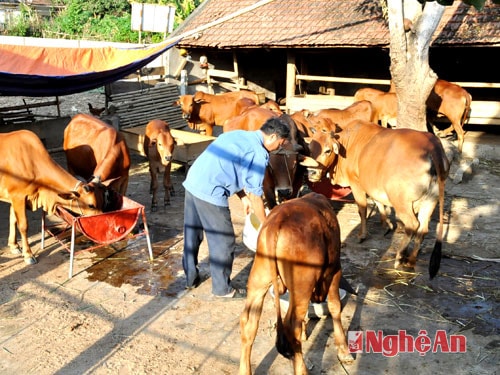 |
| The commercial cattle farming model of Mr. Le Hoai Thanh - Hamlet 1, Tam Son Commune (Anh Son District). |
Mr. Le Hoai Thanh's household in Hamlet 3, Tam Son Commune, raises 21 Sindhi crossbred cows, including 15 breeding cows. We arrived just as he was herding the cows back from the forest. The herd, gasping for breath, huddled together to avoid the sun under the garden trees, having just been fed a mixture of cornmeal and cassava flour. Mr. Thanh built a spacious barn in his garden and a large, always clean concrete yard. He said that he doesn't know how other livestock farming models operate, but with his experience focusing on raising female cows, his income is significantly higher than raising fattened cows. Especially since female cows are naturally docile, one person is enough to herd them for grazing, reducing confinement and allowing them to utilize natural grass. He also calculated that each breeding cow gives birth and sells calves, bringing in an average of 15 million VND per calf. With 15 cows, he earns 175 million VND a year, not including fattening cows. His son and his wife are sufficient to handle the labor. He only focuses on buying and selling cattle and preventing diseases… Does this hot weather affect livestock farming? Mr. Thanh said: “We have to diligently pump water to bathe the cows, and especially keep the barns clean. Besides grazing on natural grass, we have to supplement with elephant grass (he planted up to 21 acres of grass - PV) and add more water whenever we feed them cornmeal or cassava. According to the assessment of officials from the District Farmers' Association, thanks to proper care, the commercial cattle farming model under Mr. Le Hoai Thanh's project is one of the best developing models...”
Thus, along with the long-standing success of melon and pumpkin cultivation in Anh Son, the implementation of the three aforementioned crop and livestock development projects in early 2014 is opening up a direction for restructuring crop varieties to diversify agricultural products, thereby reducing poverty and creating sustainable wealth for farmer members, making a significant contribution to the local area's rural development efforts!
Dinh Sam