

Why did the 2014 World Cup see so many goals?
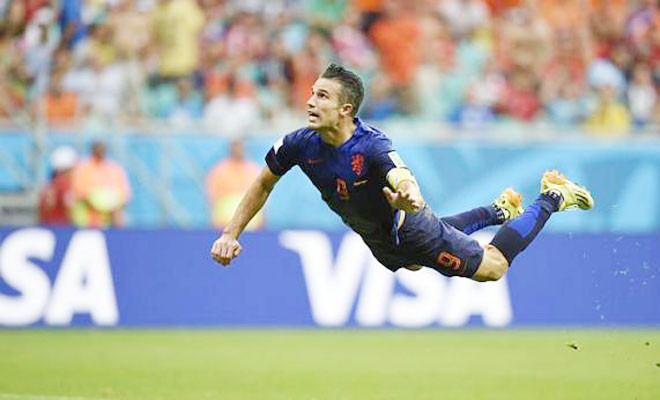
The 2014 World Cup is witnessing an astonishing goal-scoring rate. Before the Belgium-Algeria match, an average of 3.14 goals were scored per game. This is the highest number of goals scored in a single match since the 1958 World Cup in Sweden. What is the reason for this?
 |
1. Many experienced teams are participating in the tournament.
According to statistics from the 1974 World Cup, teams with no prior World Cup experience scored significantly fewer goals than teams with World Cup experience. Specifically:
+ Never participated in the World Cup: Scored 0.87 goals per game.
+ Experience participating in the World Cup: 1.78.
It has also been observed that matches involving teams making their World Cup debut tend to have fewer goals than other matches. Specifically: + Teams participating in the World Cup for the first time: 1974 had an average of 2.37 goals per match; 1990 had an average of 2.21 goals per match. + Other matches: 1974 had 2.6 goals/match; 1990 had 2.59 goals/match. |
The reason might be that teams making their World Cup debut tend to approach the game cautiously. They struggle to score against their opponents, but they also want to minimize the number of goals conceded. Therefore, it's easy to see why the 2014 World Cup had so many goals: the tournament had few newcomers. Only one team, Bosnia, was making their World Cup debut. This is similar to 2010, where only Slovakia was participating in their first World Cup.
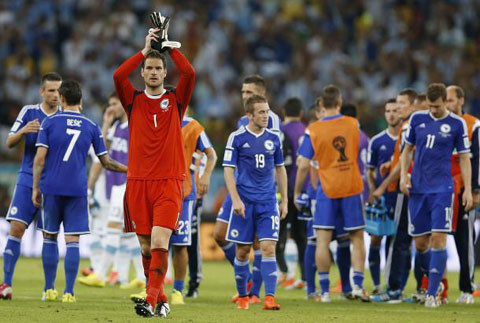 |
| Bosnia was the only newcomer to the 2014 World Cup. |
But the difference was that year, Algeria was returning to the World Cup after 24 years; New Zealand and Honduras were participating for the first time in 28 years. North Korea was participating for the first time in 44 years. They were practically rookies.
This year, every team has participated in two World Cups in the last 16 years. Every team, except Bosnia, has players with World Cup experience.
2. Higher quality players. Greater influence from talented players.
22 out of 23 teams ranked at the top of the FIFA rankings participated in the 2014 World Cup. Only a few exceptions were absent, such as Ukraine, ranked 16th. In South Africa, three high-ranking teams were absent: Croatia, Russia, and Egypt (ranked 10th, 11th, and 12th). The average ranking of the teams at the 2014 World Cup was four places higher than at the 2010 World Cup. This means that the gap in skill level between the teams has narrowed.
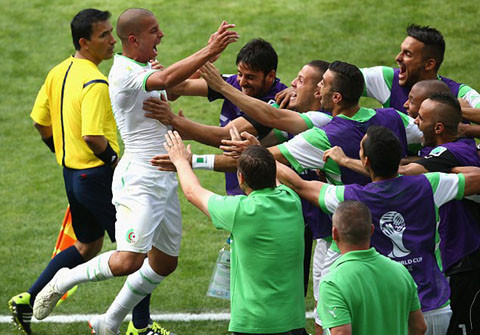 |
| Only Algeria played defensively after the first round of group stage matches. |
The best team of 2010 is no longer as outstanding in 2014. In 2010, Brazil topped the FIFA rankings with 1611 points, while North Korea had the fewest with 285 points. The difference was 1326 points. Now, Spain has the highest score with 1485 points, while Australia has the lowest with 526 points. The difference is 959 points.
Why is this important? Imagine this: You're ranked 105th in the world and you're in a group with all strong teams. What strategy would you use to cope? Obviously, a defensive approach.
3. Diverse tactics
In boxing, they say style creates fighting spirit. Football is almost the same. At the 2010 World Cup, the dominant tactic was 4-2-3-1. Of course, there were variations or teams that used different tactics. Like Mexico. Like Marcelo Bielsa's Chile. But those were extremely rare.
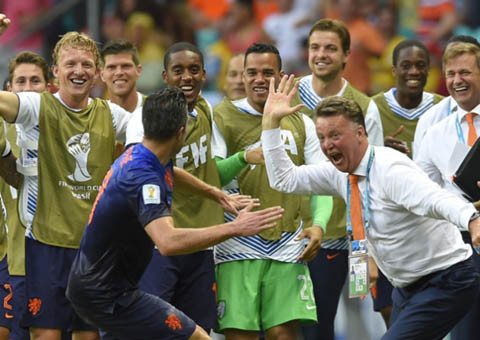 |
| The Netherlands played a 3-4-3 formation against Spain. |
This year, the 4-2-3-1 formation may still dominate, but other styles are more prevalent. The US team uses a diamond midfield. The Netherlands played 3-4-3 against Spain. Honduras played 4-4-2. Many smaller teams dare to use two strikers, such as Ecuador, Chile, or Nigeria. When teams play more directly and push forward more, goals are naturally more common.
According to Opta statistics on the number of passes leading to goals: 2010: On average, teams needed 2.91 passes to create one goal. 2014: On average, it only took 2.63 runs to score a goal. |
This means that teams will try to pass the ball to their forwards as quickly as possible. It doesn't mean they'll use long balls (the percentage of long passes at this year's World Cup has decreased), but there will be more incisive passes. And teams will regain possession in higher positions, making it easier to score.
Opta statistics on crosses per game: 2010: 32.4 crosses per game. 2014: 27.3 crosses per game. Contradiction rate: 2010: 31.3 errors/match. 2014: 26 fouls per game. |
This means that teams rarely pass the ball around to the flanks anymore; instead, they play directly. They also don't have the mentality of stalling for points or committing fouls to disrupt the opponent's play. As a result, the matches are more exciting.
4. The golden age of attacking football. Defensive teams are getting worse.
First, let's review the number of goals scored in the top European national leagues, as shown in the table below.
Tournament | 2006-10 | 2010-14 |
Premier League | 2.58 | 2.79 |
La Liga | 2.67 | 2.78 |
Bundesliga | 2.82 | 2.96 |
Serie A | 2.58 | 2.61 |
It's easy to see that the number of goals scored in national leagues increased from 2010-2014. Why are we considering these leagues? Because over 50% of the players who played in the World Cup competed in these leagues. They are the main source of goals. The change in leagues cannot change the fundamental nature of the teams, which are composed entirely of players from the four aforementioned leagues.
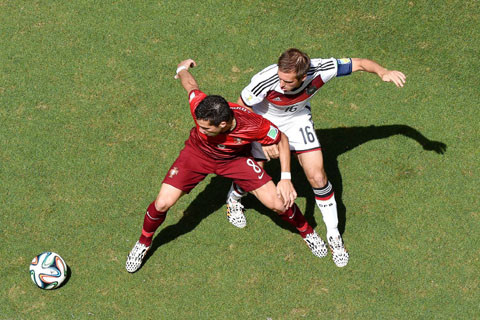 |
| Lahm (in the white shirt), a skilled defender, is now playing as a midfielder. |
We are living in the era of Messi, Ronaldo, Suarez, Ibrahimovic, Cavani, Bale, Aguero, Robben, Ribery, Falcao, van Persie, Neymar – top-class attacking stars. Yet we lack the seasoned defenders of the past. In the top 100 players in the world as compiled by 4-4-2 magazine, only 10 out of the top 30 are defenders. And the best of them, Philipp Lahm, is playing as a midfielder for Germany.
The attacking tendencies of the teams are clearly reflected in the number of shots per match. The 2010 World Cup had 22.4 shots per match, while the 2014 World Cup had 24.4 shots per match. The percentage of goals scored inside the penalty area decreased from 81.4% in the 2010 World Cup to 18.6% in the 2014 World Cup. Meanwhile, the percentage of goals scored with headers increased from 17.2% to 22.7%. Fewer crosses, fewer wing attacks, but more goals scored with headers. Clearly, the defenders are getting worse.
5. Due to the warm weather, many goals were scored.
South Africa is very cold. This World Cup is quite warm. Even hot in some places. Such weather conditions greatly influence how teams approach the game and their tactics. “They definitely have an influence,” said Australia coach Ange Postecoglou. “It contributes to the openness of the tournament, because the matches are played in warmer climates.”
 |
| The World Cup took place in hot and humid weather. |
Recently, some rugby scientists have pointed out that when the weather changes from autumn to winter, the pass accuracy rate decreases. Certainly, the decrease isn't significant, but it's persistent and recurring. From 2007 to 2011, pass accuracy decreased by 8% between September and January of the following year.
Another statistic: Brian Burke, a researcher, points out that teams perform worse when playing indoors than outdoors. He also agrees that passing accuracy decreases in cold weather, but players tend to hold onto the ball longer than usual. Does this trend apply to football as well?
All we know is that if you play in hot weather, players will run less, pass more, press less, and stalemates won't last long. That's a necessary condition for open football.
According to Thethaovanhoa.vn