

Top wind power nations in the world
Besides solar power, wind power is currently a crucial source of energy for many countries around the world, including Vietnam.
Electricity demand in each country and worldwide is constantly increasing. However, coal and natural gas resources for thermal power are no longer abundant, posing a major challenge in addressing severe environmental pollution. Large-scale hydropower is nearing its end. Only nuclear power is playing a significant role, but even that is beginning to show signs of stagnation.
And renewable energy sources have emerged as one of the saving graces. Besides solar power, wind power is becoming an indispensable source of energy for many countries around the world now and in the future, including Vietnam.
Wind turbine technology
The operating principle of a wind turbine is quite simple. Currently, wind turbines are divided into two types: vertical-axis, similar to helicopters, and horizontal-axis. Horizontal-axis wind turbines are the most common, typically having two or three blades. Three-bladed wind turbines are the most widely used. In this type, the three-bladed turbine operates in the direction of the wind, with the blades facing the prevailing wind. The blades capture the wind and rotate to generate electricity based on a simple principle – the opposite of an electric fan; that is, instead of using electricity to generate wind like an electric fan, the wind turbine uses the wind to generate electricity. Specifically, the energy of the wind causes two or three blades to rotate around a rotor. The rotor is connected to the main shaft, and the main shaft transmits the motion to rotate the generator's rotating shaft, producing electricity.
Wind turbines mounted on towers approximately 30 meters high capture most of the wind energy while minimizing disruption from erratic wind currents. The power output of wind turbines typically ranges from 50 kW to several MW. For higher power output, multiple turbines are assembled and connected within a wind farm (plant).
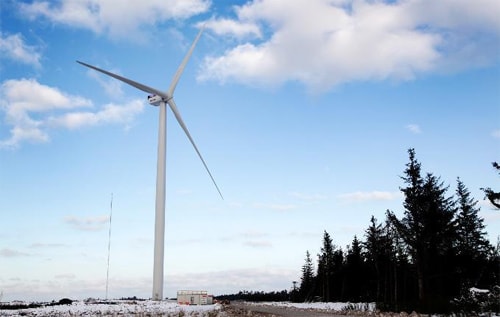 |
| Figure 1 - A prototype of the world's largest wind turbine, the V164-8.0 MW, built at the Danish National Testing Centre. The machine is 20m long, 8m wide, and 8m high, weighing approximately 390 tons. Each V164-8.0 MW unit can power 7,500 European households (according to bit.ly). |
Wind turbines can be used to supply electricity to individual buildings and neighborhoods, and can also be connected to the national grid for wider distribution.
Great advantages, many difficulties.
The advantages of wind power are quite impressive. Wind energy is generated solely by wind, without the use of any other fuel, making it a clean energy source. This is in stark contrast to thermal power plants, which rely on burning coal or natural gas, causing significant air pollution. In many countries, such as Vietnam, there are many windy regions, especially along the 3,000 km coastline. Therefore, the country's wind energy supply is quite abundant, extending beyond coastal areas to remote mountainous regions, plateaus, and rural areas. Wind energy is a renewable energy source whose cost is steadily decreasing due to advancements in science and technology, typically ranging from 4 to 6 cents/kWh. Of course, this depends on the wind source, the financing of the project, and the specific characteristics of the project.
However, expanding wind energy exploitation also faces significant challenges. First, there is the dependence on the location of wind power. Areas with good wind potential are often far from cities – where electricity is in high demand! Thus, the construction location significantly impacts the initial investment cost. Furthermore, wind energy is an intermittent energy source, cannot be stored, and not all wind energy can be harnessed at the time of electricity demand.
The factors mentioned above play a major role in influencing the level of development of top wind power countries.
Top wind power countries in the world
Collector Zachary Shahan used data collected by the Global Wind Energy Council (GWEC) and several other private organizations to compile a list of the world's "strongest" countries in terms of wind power capacity relative to population density.
The results we collected were only fully published up to 2012. These are two graphs showing the top wind power nations ranked by total national wind power capacity per capita (calculated per million people).
In Graph 1, the names of the countries are listed in the left column in descending order. The length of the horizontal columns corresponds to the total wind power capacity (in Megawatts) per million inhabitants. The graph depicts the 47 countries with the highest total wind power capacity per capita (per million inhabitants) in the world. Here, the five countries at the bottom are also considered wind power nations, although data is not yet available, including Vietnam; alongside Iran, Venezuela, Ethiopia, and Pakistan.
The ranked statistics are also described in a different format for the top 15 wind power developing countries in 2012 in Figure 2. The size of wind power capacity per capita corresponds to the size of the area (with relative values in %) of the color code corresponding to the country name in the vertical column on the right.
Additionally, the following table provides statistics on the absolute and relative total wind power capacity per million inhabitants for the top 33 wind power countries in the world.
From the data table above, it is clear that Denmark in 2012 rose to the top of the list of wind power countries per capita. Following Denmark are Spain, Portugal, Sweden, Germany, and Ireland, all within the top 5 "wind power powerhouses." This ranking is relative and easily subject to rapid change as these countries, as well as other major nations, are building increasingly larger wind power plants. For example, Canada, Austria, and Greece are currently outside the top 10, but each has strong wind energy policies for the coming years, and who knows, in a few years, some of these countries might rise to the top 5, or even higher ranks.
Another piece of information worth mentioning before concluding this article: According to data up to the end of 2013, Spain has almost overtaken Denmark to claim the top spot, replacing the "champion" position they held in 2012.
According to Vietnamnet