

Sacred Dai Tue Pagoda
(Baonghean)For over 600 years, Dai Tue Pagoda has been a sacred place in the spiritual lives of the people of Nghe An province. It has been associated with many historical events of the country and holds many legends...
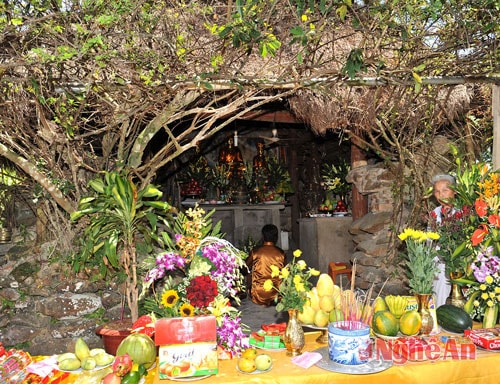 |
| The old Dai Tue Pagoda. |
It's been three generations since I left my hometown, since my great-grandfather left Xuan Ho village to live in the capital. The old village was famous throughout Nghe An province as "Xuan Ho, the land of scholars," with many talented Confucian scholars and patriotic mandarins – my grandfather used to proudly tell me about this. His stories included the Nam Anh hill, the Dai Hue mountain range rising like a fortress wall. On that high mountain was a small but sacred temple, with a chessboard, the tomb of an immortal, and the stone throne of a king. On one side of the Nam Anh hill was a golden turtle hundreds of years old; on the other side of the Nhon hill, a large snake still crossed the rice fields. Nam Dan, a land of spiritual significance and outstanding people, a place of "repeated fame and beauty," I imagined it as a legendary land in my childhood.
Returning home for the family's ancestral commemoration day, after the ceremony, with his cherished childhood dream finally fulfilled, the clan leader named Cuong, not yet 30 years old, invited me to go to the temple.
From Nam Anh village, following the mountain path up to Dai Tue Pagoda is about 5km. The road is under construction and being widened, making it bumpy and difficult to navigate. Purple blossoms bloom on the mountainside, and further up is a lush green pine forest. Standing on Thang Thien slope, one can gaze out at the entire landscape of the Lam River delta, with Vinh City, Cua Lo, the East Sea, and the islands of Hon Mat and Hon Ngu, amidst rolling mountains and rice paddies like a watercolor painting. It's very quiet here, with only the sound of the wind, the chirping of birds, and the cooing of doves echoing in the distance.
Dai Hue, also known as Phong Van Son, is the most sacred mountain in Nghe An province. In the 7th century AD, Mai Hac De used the mountain as a base to raise the banner of rebellion. In the early 15th century, Emperor Ho Quy Ly built a fortress in Nghe An province to resist the invading Ming army. To achieve the Great Victory of Spring Ky Dau (1789), Emperor Quang Trung marched through here and stopped for several days to recruit and train soldiers before marching north to defeat the 290,000 Qing troops. Dai Hue is also the resting place of the mother of King Mai and the mother of President Ho Chi Minh... Reaching Thang Thien slope, Dai Hue Pagoda appears with its monks' and nuns' quarters. This is the newly built area. The old and new main temples are further up the mountain. At the residence, we met Venerable Thich Minh Quang, who is in charge of the current construction of the pagoda.
The monk recounted: Legend has it that Dai Tue Pagoda was built during the reign of King Mai, but history only records its founding during the reign of King Ho Quy Ly. The pagoda was built to worship the Great Wisdom Buddha, because the Buddha manifested herself to help the king build a fortress to defend against invaders. This is the only pagoda in Vietnam dedicated to the Great Wisdom Buddha (representing the wisdom of the Buddha with Wisdom of Enlightenment, Wisdom of the Sword, Wisdom of Strength, Wisdom of the Heart, Wisdom of the Eye, and Wisdom of the Sight). The first abbess of the pagoda, who cared for it and offered incense, was Princess Thai Duong, daughter of King Ho Quy Ly. Many virtuous monks followed, one of whom advised King Quang Trung to march along the Non Bang mountain pass, thus avoiding enemy detection and shortening the route to Thang Long.
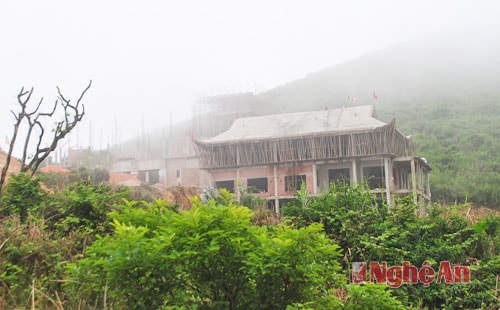 |
| Dai Tue Pagoda is currently under reconstruction. |
The pagoda is situated at an altitude of 500 meters above sea level. The landscape remains unchanged from the poem by Hoàng Giáp Bùi Huy Bích 300 years ago: "The sky stretches across the mountain range like spreading wings / The earth shapes the river like a curved hook." The ancestral hall of Đại Tuệ Pagoda is a small, clean thatched hut, inside which are statues of the Three Buddhas, stone steles, Buddhist scriptures, and several ancient incense burners and ceramic bowls. Today is not a holiday or a full moon day, but there are quite a lot of people visiting the pagoda to admire the scenery and offer incense. For centuries, Đại Tuệ has been a place of religious activity for the people around Nam Đàn and Nghi Lộc. Monk Minh Quang softly recited an ancient poem that has been passed down through generations: "The stone throne is sturdy / The stone bell rings / The stone gong echoes / The immortal's altar is at the top / The lotus pond is fragrant / The sacred well overflows / The pagoda is high in the clouds / Built by man, created by nature"… All the artifacts described in the poem are located not far from this ancestral hall.
About 100 meters west of the temple, there is a large rock, approximately 2 meters in diameter.3When struck with a stone, it produces a sound like a wooden gong, hence called the "Gong Stone"; to the northeast, there is a similar stone, but when struck, it sounds like a bronze bell, hence called the "Bell Stone". In front of the temple is a large stone resembling a chair, called the "Thạch Ngai" (Stone Throne). Not far from the temple is a well whose water never dries up throughout the year, and the "Dai Nam Nhat Thong Chi" (Comprehensive Gazetteer of Dai Nam) records: This is one of the six sacred water sources of Vietnam, where Emperor Minh Thai To annually sent envoys to offer sacrifices.
Right next to the ancestral hall are two large, ancient tombs made of stone, which have existed here for several hundred years. The tombs are meticulously cared for with incense offerings because the locals believe one is the tomb of an immortal and the other is the tomb of Emperor Canh Thinh Nguyen Quang Toan (son of Emperor Quang Trung Nguyen Hue). Whether this is true or not is unclear, but every year on the 20th day of the 10th lunar month, the Ho family in Nam Dan, Hung Nguyen, holds a memorial service for Emperor Canh Thinh here.
Dai Tue Pagoda is currently under construction. Construction began in April 2011, covering over 20 hectares with nearly 20 structures, including the Dai Tue Buddha Mother Tower, the main hall, the Shakyamuni Hall, four halls dedicated to the Four Great Bodhisattvas, the meditation hall, the Pure Land Hall, the ancestral hall, and the rebirth hall, the bell tower, the lecture hall, the library, the refectory, the monks' and nuns' quarters, the guesthouse, the triple-arched gate, the large square, along with numerous statues of Buddhas, Bodhisattvas, and Arhats, as well as the casting of bells and other religious artifacts. Around the pagoda, there will be fruit trees and medicinal plants, a road leading to the pagoda, landscaped gardens, ponds, parking lots, and a temporary shelter. The pagoda features ancient architecture such as the left and right wings, and the bell tower. The nine-story pagoda, the main hall, the monks' quarters, the guesthouse, and the lotus pond under construction suddenly brought to mind a Bai Dinh Pagoda, or some of the majestic ancient temples hidden in the clouds in China that I had visited before…
Leaving Dai Tue Pagoda, Venerable Thich Minh Quang promised: “Next time you visit the pagoda, the roads will certainly be more convenient. This year, Nghe An province is continuing to improve the road to the pagoda; the pagoda is also requesting permission to open another road from Nghi Loc district, so the distance from Cua Lo, in the north, will be shorter. Since Dai Tue Pagoda brought the Buddha's relics here, more visitors from all over have come to admire the scenery and pay their respects…”
Thanh Son