
Continental shelf - scope and legal regime
Question 16. What is the continental shelf? What is its scope and legal regime?
(Baonghean.vn) -Question 16. What is the continental shelf? What is its scope and legal regime?
Reply:The concept of the continental shelf is now familiar to everyone. However, not all issues related to this concept have been clarified. What is the continental shelf? How is the extent of the continental shelf determined? Is the continental shelf part of the territory of a coastal state?...
The concept of the continental shelf emerged in international legal science as a result of advancements in marine science and technology over the past half-century. These achievements have enabled humanity to explore the secrets of the seabed and the subsoil beneath it.
This is why humanity has been driven to find ways to master and exploit the abundant natural resources there to serve life and development in the face of difficulties caused by population explosion and the depletion of resources on land.
 |
In 1942, for the first time in history, the seabed and subsoil in the Pariah Bay, which previously lay outside the territorial waters and were considered part of the high seas (international waters, public seas), were divided between Great Britain and Venezuela, with each country acknowledging its sovereign rights over the respective seabed and subsoil.
In 1945, President Harry Truman's Declaration on "The United States Policy to the Natural Resources of the Seabed and Subsoil" recognized the continental shelf as an extension of the land territory of a coastal state and therefore belonging to that state. From this point on, the doctrine of the continental shelf began to develop and enter into the life of the international community.
However, it was not until 1958 that the concept of the continental shelf was successfully codified in international maritime law with the adoption of the Geneva Convention on the Continental Shelf, along with three other conventions.
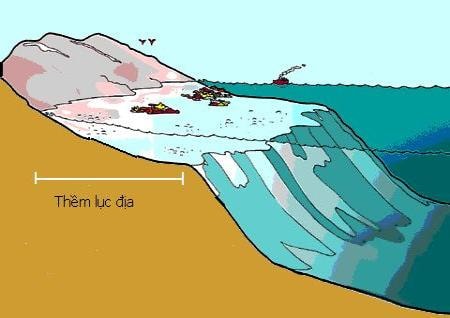
Article 1 of the Geneva Convention on the Continental Shelf defines the legal continental shelf as follows: "...the term 'continental shelf' means (a) the seabed and subsoil of a subsurface area lying outside the territorial sea and extending to a depth of 200 m; or beyond that limit to a depth where the natural resources of such subsurface areas are exploitable; (b) means the seabed and subsoil of a similar subsurface area adjacent to the shoreline of an island."
Article 76 of the 1982 United Nations Convention on the Law of the Sea defines the legal continental shelf as follows: "The continental shelf of a coastal State consists of the seabed and subsoil beneath the seabed beyond its territorial sea, throughout the natural extension of its land territory to the outer edge of the continental margin, or to a distance of 200 nautical miles from the baseline used to determine the width of the territorial sea, where the outer edge of the territorial sea is closer."
For offshore islands of coastal states, only those suitable for human habitation and with their own economic life will have their own continental shelf.
However, the following provisions in Article 76 of the Convention also stipulate that in cases where the outer edge of the continental margin of a coastal State naturally extends beyond 200 nautical miles, as mentioned above, that coastal State may define the outer limit of its continental shelf to a distance not exceeding 350 nautical miles from the baseline or to a distance not exceeding 100 nautical miles from the 2500m isobath, provided that it complies with the specific provisions for defining the outer limit of the continental shelf in the Convention and in accordance with the recommendations of the Commission on the Limits of the Continental Shelf established under Annex II of the Convention.
The legal regime of the continental shelf is expressed through the rights of coastal states. These include the exercise of sovereign rights through the exploration and exploitation of natural resources on the continental shelf. In addition, coastal states have jurisdiction over marine scientific research on their continental shelf; rights over artificial islands, installations, and structures on the continental shelf; and the right to protect and preserve the marine environment.
Other states have the right to install submarine cables and pipelines on the continental shelf (Article 79) and require the consent of the coastal state.
The sovereign rights of a coastal state over its continental shelf are of paramount importance, as demonstrated by:
This is the sovereign right (not sovereignty) of a coastal state over its own continental shelf.
This right is of a privileged nature, meaning that "if a coastal State does not explore or exploit natural resources on its continental shelf, no one else has the right to carry out such activities without the consent of that State" (Article 77, paragraph 2).
This right exists naturally and from the outset; the coastal state does not need to possess it in reality or in name, nor does it need to claim it.
In accordance with the provisions of the Convention, Article 17 of the 2012 Vietnamese Law on the Sea stipulates: The Vietnamese continental shelf is the seabed and subsoil adjacent to and lying beyond the Vietnamese territorial sea, encompassing the entire natural extension of the mainland territory, islands and archipelagos of Vietnam to the outer edge of the continental margin.
If the outer edge of this continental margin is less than 200 nautical miles from the baseline, the continental shelf in that area is extended to 200 nautical miles from the baseline.
In cases where the outer edge of this continental margin extends beyond 200 nautical miles from the baseline, the continental shelf in that area shall be extended no more than 350 nautical miles from the baseline or no more than 100 nautical miles from the 2,500m isobath.
Article 18 of the Vietnamese Law of the Sea clearly stipulates the legal regime of Vietnam's continental shelf as follows:
1. The State exercises sovereign rights over the continental shelf regarding the exploration and exploitation of resources.
2. The sovereign rights stipulated in Clause 1 of this Article are exclusive in nature; no one has the right to conduct exploration activities on the continental shelf or exploit the resources of the continental shelf without the consent of the Government of Vietnam.
3. The State has the right to exploit the subsoil beneath the seabed, and to permit and regulate drilling for any purpose on the continental shelf.
4. The State respects the right of other countries to lay submarine cables and pipelines and conduct other lawful maritime activities on the Vietnamese continental shelf in accordance with the provisions of this Law and international treaties to which the Socialist Republic of Vietnam is a party, without prejudice to Vietnam's sovereignty, national jurisdiction, and national interests in the sea.
The installation of underground cables and conduits requires written approval from the competent state authority of Vietnam.
5. Foreign organizations and individuals may participate in the exploration, utilization, exploitation of resources, scientific research, and installation of equipment and structures on Vietnam's continental shelf on the basis of international treaties to which the Socialist Republic of Vietnam is a party, contracts signed in accordance with Vietnamese law, or with the permission of the Vietnamese Government.
According to the Q&A on Vietnam's Law of the Sea
(To be continued)