

Competitors of Vietnamese goods
(Baonghean) - In recent years, the consumer goods market has seen a reduction in the craze for Chinese products as Vietnamese goods have asserted their position due to improved quality, diverse and abundant product types and designs, and reasonable prices. However, the market share of Vietnamese goods is facing a new challenge: the encroachment of goods originating from Thailand.
Observations show that more and more housewives prefer Thai products. That's why stores selling Thai products are constantly appearing in Vinh City. There are even streets dedicated to selling Thai goods, with Hong Bang Street being a prime example. When people think of Thai products, they immediately think of this street. Here, consumers can find everything they need, from household items like paper towels, dishes, laundry detergent, fabric softener, rice cookers, and blenders, to food items like confectionery, soft drinks, and various types of rice…
Along this street, there are also shops selling Thai silver jewelry. Shoes, fashionable clothing, and cosmetics also tend to be imported from Thailand. Ms. Mai Trang (Le Mao Ward, Vinh City) - a customer at a Thai goods store, said: “I am a regular customer of this store because I often choose household goods of Thai origin. Thai products are durable, reasonably priced, not much more expensive than similar Vietnamese products, while the quality is comparable, and many items are even better.” According to the owner of a Thai goods store: “The number of customers shopping at the store is relatively high on weekdays. Especially during holidays and Tet (Lunar New Year), the number of customers increases 5-6 times.”
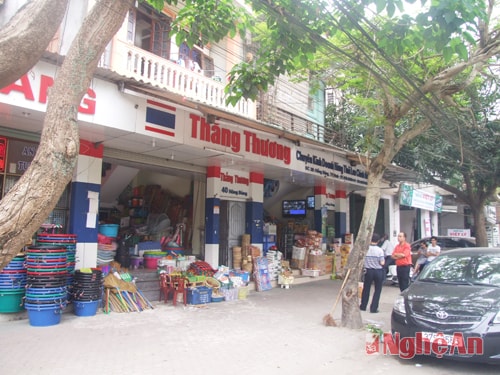 |
| A row of shops specializing in Thai goods on Hong Bang Street (Vinh City) |
In terms of price, Thai consumer goods are slightly more expensive than Chinese goods, but much cheaper than branded goods from developed European and Asian countries like Japan and South Korea, while still maintaining quality. Therefore, Thai goods are very popular in Vietnam. A blender made in Thailand costs between 400,000 and 800,000 VND. Meanwhile, Philips and Panasonic blenders cost between 900,000 and 1,500,000 VND; Sharp and Toshiba rice cookers cost between 700,000 and 2,500,000 VND; Vietnamese Hiep Hung and Kim Cuong rice cookers cost between 200,000 and 600,000 VND, while "budget" products manufactured in Thailand and imported into Vietnam via unofficial channels cost between 500,000 and 700,000 VND. According to Ms. Kim Tien, the owner of an electrical goods stall at Vinh Market, customers still prefer Thai electrical goods because they are more durable than Chinese products, but the price is not too expensive, making them affordable for consumers with average incomes.
About 5-7 years ago, goods from Thailand were mainly cosmetics, cars, and motorbikes, and were only available in a few stores. But now, Thai goods have become widespread, found in dealerships, shops, markets, and supermarkets. According to statistics from the General Department of Customs in 2013, with a trade value of US$3.45 billion, Thailand ranked 4th among the 6 markets where Vietnam had a trade deficit exceeding US$1 billion. The presence of Thai goods has made the consumer market more vibrant, giving consumers more choices. However, Vietnamese goods face competitive challenges, even unfair competition. Besides officially imported goods, a significant amount of goods from Thailand are smuggled into Vietnam through unofficial channels, making them competitive with Vietnamese goods because they are not subject to import taxes. Their quality is not controlled, and therefore, consumer rights are not protected against substandard goods. It is known that authorities have also taken action to prevent smuggling from Thailand and some neighboring countries. However, a large quantity of smuggled goods, including those from Thailand, still exists on the market. According to the Nghe An Market Management Department, in 2013, the Department seized several types of smuggled goods from Thailand, mainly confectionery, household electrical appliances, and cosmetics; in the first four months of 2014, the Market Management Department confiscated and processed 52 rice cookers, 792 kg of confectionery, 608 packages/boxes of confectionery, 144 packages of fabric softener, and other smuggled goods from Thailand.
In my opinion, for Vietnamese people to always trust and use Vietnamese products, besides businesses having strategies to improve quality and design, and minimize production costs to suit the needs and tastes of the majority of consumers, state management agencies also need to be decisive in inspecting and controlling the market to prevent smuggled goods, create a healthy competitive environment for domestic businesses, and protect consumer rights.
Lan Huong