

Social housing still has many shortcomings that need to be addressed.
The supply of social housing, rental housing, lease-to-own housing, and land for social housing construction is receiving special attention from state management agencies, as many shortcomings in the implementation process need to be addressed.
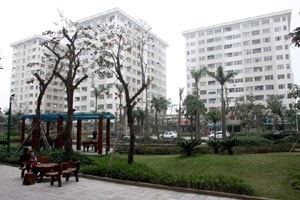 |
| Low-income housing area in Dang Xa commune, Gia Lam district (Hanoi). Limited land available for construction. |
Specifically, Hanoi is implementing 14 projects for low-income earners, with a construction scale of approximately 11,900 units. Ho Chi Minh City is implementing 9 projects for low-income earners, with a construction scale of approximately 7,200 units.
However, the process of implementing social housing projects still faces difficulties and limitations.
Specifically, there is a shortage of social housing supply, especially in large cities like Hanoi and Ho Chi Minh City. There is also a lack of land for investing in and constructing social housing in convenient locations; many industrial parks have been established but have not allocated land for building housing for workers.
In addition, some localities have not allocated the required 20% of land in new urban areas and commercial housing projects for the construction of social housing.
In Hanoi, an inspection of the 20% land allocation in 12 projects revealed that 11 out of 12 projects had allocated land for social housing construction. However, the land allocated for social housing construction was largely not being used for its intended purpose.
Of the 11 projects, only 3 are being developed as social housing; 3 projects have been converted to resettlement housing, and 3 projects have been converted to commercial housing or have had their land use rights auctioned.
Developers have shown little interest in clearing the land for social housing construction. Currently, there are 11 plots of land designated for social housing in various projects, covering approximately 8,696 hectares, but only 4 plots, totaling 5,601 hectares, have been cleared.
Some investment incentives for social housing construction (such as support for infrastructure construction inside and outside the project boundaries and support from local budgets...) have not received adequate attention; the level of incentives depends on the conditions of each locality, thus failing to attract businesses to invest in housing construction for industrial park workers.
In reality, only a few localities, such as Da Nang, Thanh Hoa, Bac Ninh, and Thai Nguyen, have shown interest and implemented specific support policies for project investors. Other localities, including some major cities, lack specific incentive and support mechanisms from local resources to attract businesses to participate in social housing construction. As a result, the number of investors involved in social housing construction and rental housing projects remains very limited.
Businesses are not yet enthusiastic about renting out properties.
According to surveys, Hanoi currently only has 3 social housing projects for rent or rent-to-own (using 20% of the land fund): the CT19 project in Viet Hung Urban Area (Long Bien district) with 515 apartments; a rent-to-own project with 300 apartments also in the same urban area; and a 300-apartment rent-to-own and 300-apartment rent-to-own project in Dang Xa Urban Area, which Viglacera recently started construction on in May.
However, the reality also shows that the supply of social housing for rent in major cities is too low because many real estate businesses are not enthusiastic about this type of housing. Even the overall social housing fund is still insufficient, and the fund for social housing for rent or rent-to-own is even smaller.
Most businesses focus on investing in housing construction for sale to recover capital quickly. Building social housing for rent, however, requires a longer payback period. This is why real estate businesses are not enthusiastic about this type of housing.
Mr. Tran Anh Tuan, Director of Viglacera Infrastructure Development Investment Company, shared: “If it weren't mandatory, no one would want to build social housing for rent because it's like 'investing a large sum to receive a small amount'. But because of our responsibility to the community and the reputation of the business, we still allocate 20% of our social housing fund for rent or rent-to-own at a preferential price of about 25,000 VND/m².2"
According to Mr. Tuan, out of a total of 1,500 social housing units in phase 3 of the Dang Xa urban area, the investor will allocate 20% for rent; 20% for rent-to-own and the remainder for sale. Therefore, to rent an apartment with an average area of approximately 50m².2It only costs about 1.2 million VND/month, while outside the urban area, the rent for a similar apartment is around 2.6 million VND/month.
It is known that, in order to promote the development of social housing for rent, the draft Law on Housing (amended) has dedicated an entire chapter to regulating social housing policies. This includes preferential tax and credit policies from the State; exemptions and reductions in land use fees; and various forms of financial support to help disadvantaged individuals improve their housing conditions. The draft also stipulates that local authorities must plan specific areas for the development of social housing projects for rent.
According to chinhphu.vn