Lúng túng xây dựng mô hình!
(Baonghean) - Với lợi thế về đất đai và thị trường tiêu thụ, những năm qua, Thành phố Vinh đã chú trọng đầu tư phát triển diện tích rau màu an toàn. Đây là hướng đi mới nhằm nâng cao giá trị cho sản phẩm hàng hóa và bảo vệ sức khỏe người tiêu dùng. Vùng sản xuất rau an toàn theo hướng VietGAP được thành phố quy hoạch đến năm 2017 có quy mô tối thiểu 50 ha trên địa bàn 4 xã Nghi Ân, Nghi Liên, Nghi Kim và Hưng Đông; mang lại thu nhập tối thiểu 150 triệu đồng/ha/năm. Tuy nhiên, người dân đang lúng túng với mô hình sản xuất này.
(Baonghean) - Với lợi thế về đất đai và thị trường tiêu thụ, những năm qua, Thành phố Vinh đã chú trọng đầu tư phát triển diện tích rau màu an toàn. Đây là hướng đi mới nhằm nâng cao giá trị cho sản phẩm hàng hóa và bảo vệ sức khỏe người tiêu dùng. Vùng sản xuất rau an toàn theo hướng VietGAP được thành phố quy hoạch đến năm 2017 có quy mô tối thiểu 50 ha trên địa bàn 4 xã Nghi Ân, Nghi Liên, Nghi Kim và Hưng Đông; mang lại thu nhập tối thiểu 150 triệu đồng/ha/năm. Tuy nhiên, người dân đang lúng túng với mô hình sản xuất này.
Tiềm năng và thách thức
Sản xuất rau là nghề truyền thống và thế mạnh của xã Nghi Liên. Qua sản xuất, nông dân đã tích luỹ được nhiều kinh nghiệm trong luân canh, xen canh rau màu, từ đó tăng hệ số sử dụng đất trồng rau lên đến 4 - 5 vụ/năm, và việc quy hoạch vùng sản xuất rau an toàn theo hướng VietGAP là định hướng phát triển bền vững của nông nghiệp xã. Hiện tổng diện tích đất trồng rau của toàn xã là 50 ha, sản lượng đạt trung bình từ 1.500 - 1.700 tấn rau/năm; riêng diện tích rau an toàn (RAT) là 25ha tập trung tại các xóm 2, 3, 4, 5; trong đó có 19 hộ đầu tư xây dựng 7.042m2 nhà lưới. Theo nhận xét của ông Nguyễn Văn Cần - ở xóm 3: “Trồng rau xanh vất vả hơn các loại cây trồng khác, nhưng do vòng đời của rau ngắn nên có thể luân canh được nhiều vụ. So sánh về lợi nhuận thì trồng rau hiệu quả kinh tế khá cao. Gần đây, nhờ có chính sách hỗ trợ đường điện tưới, bể chứa nước, giếng khoan nên việc sản xuất rau thuận lợi hơn nhiều”.
Sau khi triển khai mô hình sản xuất RAT tại xã Nghi Liên, thành phố cũng đã cung ứng một số địa chỉ để người trồng rau Nghi Liên có thể tiếp cận khâu tiêu thụ, như các siêu thị, trường học mầm non và bếp ăn tập thể. Nhưng hợp đồng giao dịch chỉ kéo dài được khoảng nửa năm. Có nhiều lý do cản trở sự hợp tác, như đối với các trường học, vì nhu cầu của trẻ ăn tinh bột nhiều, nên các trường đều yêu cầu cung ứng các loại củ, quả như cà rốt, khoai tây, cà chua… trong khi Nghi Liên chủ yếu chỉ sản xuất các loại rau ăn lá. Hay khi đưa rau lên giới thiệu ở Siêu thị Metro, với đầy đủ các loại giấy chứng nhận tiêu chuẩn do các cơ quan có uy tín chứng nhận như: Chi cục Đo lường và Chất lượng, Chi cục Bảo vệ thực vật… hai bên đã đi đến thỏa thuận mỗi ngày Nghi Liên sẽ cung cấp cho siêu thị 3 tạ rau.
Tuy số lượng chỉ rất nhỏ so với sản lượng thu hoạch được hàng ngày, nhưng bà con ai cũng phấn khởi vì có nơi “ăn hàng” ổn định, nhưng mới được dăm tháng hợp đồng đã phải hủy bỏ. Nguyên nhân là rau Nghi Liên vụ chính thường chỉ có từ tháng 11 đến khoảng tháng 4 năm sau, trong khi đó siêu thị yêu cầu phải có nguồn hàng cung cấp quanh năm. Trao đổi về việc này, ông Trần Đức Oanh- Trưởng ban Nông nghiệp xã Nghi Liên cho hay: “Trên thực tế xã Nghi Liên có truyền thống trồng rau, nhưng lâu nay bà con vẫn trồng theo lối tự phát, theo thói quen chứ chưa theo nhu cầu của thị trường. Do đó, vào mùa chính vụ thì trồng quá nhiều như rau cải, bắp cải, su hào dẫn đến thừa, trong khi các loại rau cao cấp, đòi hỏi giống tốt thì lại không có. Ngoài ra, nguyên nhân chính là khâu tiêu thụ sản phẩm kém. Khi xây dựng dự án, việc thu mua sản phẩm là do thành phố đảm nhận, nhưng hiện tại trên thành phố chưa có một địa điểm nào bày bán rau an toàn. Thậm chí bao bì sản phẩm để chứng minh đây là rau sạch cũng chưa ai nghĩ tới. Vì thế, rau an toàn bị đánh đồng với các loại rau khác cũng là một lẽ dĩ nhiên”.
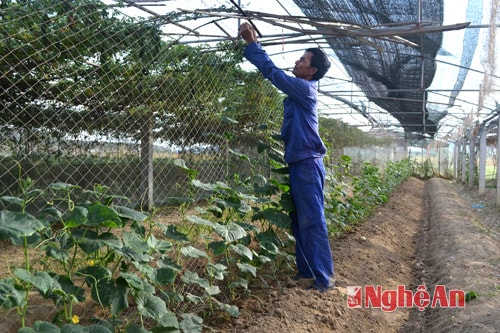 |
| This is the model of growing clean vegetables in a greenhouse by Mr. Nguyen Dinh Ky in Hamlet 3, Nghi Lien Commune. |
In 2012, Vinh City implemented a project to grow clean vegetables in greenhouses in three communes: Nghi Kim, Nghi An, and Nghi Lien, with the expectation of providing a source of clean vegetables for residents in the city and surrounding areas. In Nghi An and Nghi Kim communes, farmers produced with the support of the Vinh City Plant Protection Station and Phu Tu Private Enterprise, while in Nghi Lien commune, the project was managed by the local government. To implement this project, the Vinh City People's Committee provided farmers with a subsidy of 100,000 VND/m2 for the greenhouse, with the remaining infrastructure investment costs borne by the farmers themselves.
However, due to unsuitable greenhouse designs, unclear intensive farming processes, and uncertain market outlets for vegetables, in the past two seasons, households growing vegetables in greenhouses have been struggling with planting, caring for, managing pests, and selling their products. Mr. Nguyen Dinh Truc, Vice Chairman of the Nghi An Commune People's Committee, said: "In Nghi An commune, 43 farming households in Kim Binh and Kim Trung hamlets benefited from the greenhouse-based clean vegetable program, covering an area of over 11,000 m2. Farmers were enthusiastic about participating because they received support from the enterprise and assurances from relevant departments and agencies that they would have completely clean products, purchased directly from the fields. However, after the first production season, farmers became less enthusiastic because the products they produced were not purchased by the enterprise, so they were not keen on this new production method."
Sustainable development solutions
From 2008 to the present, the city has implemented many safe farming models according to VietGAP standards in Nghi An, Hung Dong, Nghi Lien, and Nghi Kim communes. Simultaneously, the City People's Committee has also provided support policies and invested in infrastructure to facilitate production. For example, in 2011, the city invested 1.4 billion VND in a 5.5-hectare clean vegetable production area in Hamlet 2 (Nghi Lien commune), including a guard house, electricity for irrigation, underground drainage pipes, and an irrigation system consisting of drilled wells and a 12m³ water tank. In 2014, Vinh City continued to provide production capital from the New Rural Development program to Nghi Lien commune with 250 million VND to invest in drilled wells and wells in Hamlets 2, 3, and 4; and to Nghi Kim commune with 50 million VND to build three earthen wells and a drainage system using earthen ditches in the production area of Hamlet 10. Hung Loc commune spent 140 million VND on building greenhouses; Nghi An commune spent 50 million VND on upgrading the power lines to serve safe vegetable production… Currently, there are more than 19,000 m2 of vegetables grown in greenhouses in Vinh City, but due to poor efficiency, some households have dismantled the greenhouse roofs. The reasons include the lack of uniformity in greenhouse construction, farmers not knowing how to operate, maintain, and use the greenhouses, and a lack of investment in the greenhouse vegetable farming model.
According to Mr. Tran Quang Lam, Head of the Economic Department of the Vinh City People's Committee: The city has implemented many programs, projects, and investment models to support the production of agricultural and fishery commodities. Priority has been given to programs for expanding and developing production areas for safe agricultural products according to VietGAP standards and for product consumption, but the effectiveness has not been high. The reason is that the models and programs have not taken into account economic efficiency according to market orientation and have not considered the feasibility of farmers becoming independent from state support. This has led to models using available budget capital not truly prioritizing business efficiency linked to investment efficiency; even if such a goal is set, it has not considered the ability of individual farmers to ensure it.
Regarding greenhouse production, farmers are still not diligent enough, not investing enough effort in implementing proper cultivation techniques; they lack dynamism and responsiveness in applying and sourcing the types of vegetables and fruits the market needs at different times and seasons, and still hold the mindset of monoculture… Currently, some households in Hamlet 3, Nghi Lien Commune, such as those of Mr. Nguyen Dinh Ky, Mr. Nguyen Ba Duc, Mr. Nguyen Van Cau… are actively growing various types of vegetables and fruits, applying proper greenhouse production techniques, and investing in lighting and irrigation systems to ensure year-round production, especially for off-season vegetables. In terms of sales, they proactively seek out their own customers such as schools, restaurants, and hotels, guaranteeing the quality and reliability of their products. Within just 500m2 of greenhouse space, they can earn 4-5 million VND per month…
To overcome difficulties and open up new avenues for the development of safe vegetables, Vinh City has developed a project on the sustainable development of safe vegetable growing areas, with a target of 2017. The project aims to create a stable safe vegetable production area by June 2017, adhering to VietGAP standards, with a minimum scale of 50 hectares across four project-implementing communes. This includes ensuring the purchase of all produced goods with a complete system for preliminary processing, processing, preservation, and distribution; and successfully building the "Vinh City Safe Vegetables" brand, widely accepted and consumed in the market. The total project budget is over 7.5 billion VND, of which nearly 5 billion VND will be mobilized from the local population. Although the project is highly anticipated in promoting the sustainable development of safe vegetables in Vinh City, significant challenges remain for its success, especially if Vinh City fails to identify the causes of previous failures and find solutions to overcome them.
Ngoc Anh