

Use energy efficiently and effectively.
(Baonghean) - Saving and using energy efficiently is one of the major orientations of the Party and State, which has been developed and institutionalized into law. In Nghe An, the implementation of this policy has initially achieved certain results, not only bringing economic benefits to businesses and reducing expenses for people, but also contributing positively to environmental protection…
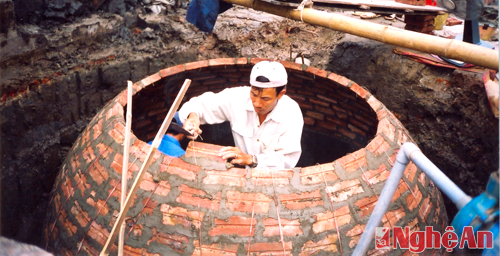 |
| Construct a biogas digester to utilize biogas. |
Survival solution
Hoang Thi Loan Textile and Garment Joint Stock Company is one of the largest enterprises and also the biggest electricity consumers in Nghe An province, consuming around 40-50 million kWh of electricity annually, equivalent to tens of billions of VND in electricity bills. The reason is that the previously invested yarn spinning line is old and runs continuously for three shifts, and the lighting system uses incandescent bulbs, resulting in high energy consumption. Since 2011, in accordance with the Energy Saving Law and with the support and encouragement of the Electricity sector, the company has implemented many solutions to invest in and upgrade equipment, making electricity usage increasingly economical and efficient. As a result, electricity consumption is reduced by approximately 5% each year. To continue saving electricity in production, the company prioritizes capital for installing and replacing equipment to save electricity and reduce costs.
Another example of energy saving in our province is Trung Do Joint Stock Company. Mr. Le Xuan Dat, Director of Trung Do Granite Factory, stated: Because the factory was built later, the first priority was to install a modern, energy- and fuel-efficient production line. The company invested hundreds of billions of VND to acquire a modern brick production line from Europe. However, brick and tile production consumes a significant amount of electricity, approximately 10 million kWh per year, accounting for 5.2% of the product cost structure. Therefore, the company always prioritizes finding energy-saving solutions. Thanks to numerous operational innovations, the company has saved nearly 10 billion VND per year, contributing to reduced production costs and enhanced product competitiveness.
Besides the two aforementioned businesses, other large enterprises in Nghe An province, such as TH Group, Saigon Song Lam Beer and Wine Corporation, Sabeco Song Lam Packaging Company, and Nghe Tinh Non-Ferrous Metals Joint Stock Company, have implemented numerous energy-saving solutions based on their own interests, contributing to Nghe An's annual savings of tens of millions of kWh (27.563 million kWh in 2013).
Another energy-saving initiative contributing to environmental cleanup and protection in Nghe An province is the use of natural energy sources. According to surveys by relevant agencies, Nghe An is one of the localities with the highest solar radiation index in the country. Therefore, several commendable models of applying natural energy to daily life have emerged in the province. These include the application by the Transport sector in installing solar panels for traffic safety warning signs at intersections on national and provincial roads; and the installation of solar panels for lighting, electric fans, and televisions by some military units on the border or islands without access to the national power grid. Most recently, the largest solar energy project has been implemented at the Vietnam-Laos International Cemetery in Anh Son district. Mr. Tran Van Hien, Head of the Management Board of the Vietnam-Laos International Cemetery, stated that the project began in 2011 but has only been operational for lighting for nearly three weeks. With 120 large solar-powered light poles already installed and 11,000 smaller ones planned for the cemetery areas, the entire cemetery will be illuminated by solar energy. Using solar power, this lighting system is well-suited to the sunny climate of Anh Son, while also ensuring aesthetics, cost savings, and safety. Also utilizing solar energy, through a support mechanism, many buildings and households in Nghe An have begun investing in and installing solar-powered water heaters, with 550 households installing them in the two years of 2012-2013.
Another solution that is becoming increasingly popular and showing significant effectiveness in the province is the use of renewable biogas energy. This solution best demonstrates the goal of environmental protection by using waste materials to generate energy for daily life, most notably through biogas digester technology in agriculture. Projects in this field have been implemented since 2003, before the Energy Saving Law was enacted, but have truly become a major movement in rural areas. In 11 years, the Livestock Support Project has assisted farmers in Nghe An in building nearly 8,400 biogas facilities, contributing to environmental protection and promoting sustainable livestock development. Several districts are leading in the application of biogas, such as Dien Chau, Yen Thanh, and Quynh Luu…
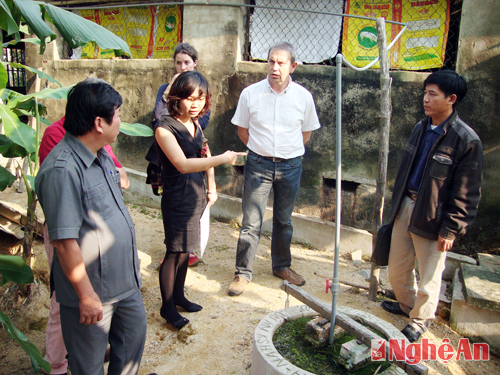 |
| Officials from the Provincial Agricultural Extension Center inspect the biogas project in Do Luong. |
Practical and effective solutions are needed.
Using clean and energy-efficient methods is not only economically effective but also sustainable because it solves the problem of development while protecting the environment for the community. However, generally speaking, the application of natural energy in production and daily life remains limited.
First, regarding electricity conservation, due to limited funding, the policy has so far only focused on raising awareness among the people, without significant material support. Even installing solar water heaters, a very good solution, still faces many limitations and technical obstacles, as not every family can afford it. A representative from the Nghe An Electricity Department stated that their family wanted to install a solar water heater but had to give up because the design and installation are quite complex; they don't want to dismantle or renovate their house once they're living there…
Furthermore, although Nghe An province has abundant sunshine, not all areas are suitable for installing solar panels. The mountainous regions, which desperately need them, are only accessible in certain areas like Tuong Duong, Con Cuong, and Anh Son. In highland districts like Ky Son and Que Phong, the limited sunshine hours and high humidity make installation less effective. Regarding the construction of biogas digesters, recent frequent disease outbreaks, inefficient livestock farming, and limited investor support (only covering 10-15% of the project cost) have led to a slowdown in the investment and application of biogas in rural areas.
It must be affirmed that saving and using energy efficiently is an essential requirement for any business to survive in the current system. Using energy efficiently, especially using natural energy sources or biogas through renewable energy from waste, also contributes to reducing emissions and treating waste. This is a mandatory requirement, so whether we like it or not, we must implement it. In the near future, according to the provincial roadmap, there will be several policies and investments in energy-saving projects targeting two main groups: key energy-consuming facilities and budget-funded agencies and units. Nghe An is a poor province, and environmental pollution in some areas is increasingly widespread and difficult to control. Energy sources such as hydropower and thermal power are becoming depleted and more expensive; investment must also take into account environmental and population impacts.
From the perspective of the relevant authorities, given the province's limited budget for direct support, the immediate priority is to conduct more in-depth and specific awareness campaigns so that businesses and citizens understand the benefits of energy conservation and environmental protection. Furthermore, while promptly recognizing projects and units that apply clean, environmentally friendly, and energy-saving technologies in production and daily life, we must also criticize and penalize those that waste energy and cause environmental pollution. In the long term, alongside focusing on exploiting energy sources that Nghe An has strengths in, such as solar, wind, and water resources, the province needs to encourage the use of non-fired building materials and limit outdated, energy-intensive production lines and technologies, as these not only harm businesses but also negatively impact daily life and the surrounding environment.
Nguyen Hai