

The "agricultural revolution" in Thanh Tuong
(Baonghean) - In just one year, thanks to innovative methods and effective propaganda work, Thanh Tuong commune (Thanh Chuong district) has become a commune that "started later" but "came ahead" in the land consolidation and exchange process, leaving behind many valuable lessons...
VIn Thanh Tuong commune (Thanh Chuong district), amidst the scorching May sun, the fatigue seems to vanish as we witness the bountiful harvest on this arid land. Instead of fragmented, small plots of land with varying elevations, the vast semi-mountainous region of Thanh Tuong is now filled with the warm, vibrant color of rice plants laden with grain stretching as far as the eye can see. Proudly leading us on a tour of the harvest fields, Mr. Luu Van Hoa, Chairman of the People's Committee of Thanh Tuong commune, shared his joy of the bountiful harvest: "This year's great success is due to many factors: First, the people followed the correct planting schedule, and the crop varieties recommended by the district's Department of Agriculture were suitable for the climate and soil. Especially, thanks to the completion of land consolidation and exchange, the people had an easier time cultivating, resulting in significantly higher yields!"
He took us to visit the family of Mr. Nguyen Huu Hai (Hamlet 7, Thanh Tuong). A year ago, Mr. Hai's family, along with other households in the hamlet, opposed the commune's land consolidation plan. However, thanks to the persuasion and propaganda of commune officials, and after witnessing firsthand the positive developments in infrastructure improvement, the households that had previously disagreed have become pioneers in the conversion, even encouraging their relatives and friends to accept adjacent plots of land to "consolidate them into one place," making cultivation and harvesting easier.
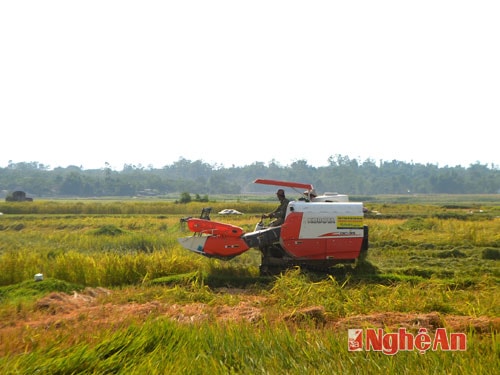 |
| Combine harvesters in the fields of Thanh Tuong commune. |
Standing beside him, Mr. Nguyen Trong Huu – Mr. Hai's brother-in-law – gestured amidst the sound of the combine harvester, joining the conversation: “My extended family of 18 people all cultivate this plot of land. Before land consolidation, each family cultivated 5 or 6 plots spread across Lang Rong, Mau Seo, Dong Hoi… and each plot was only as small as the palm of a hand. It would take a whole day to visit the whole field because of the time wasted moving from one place to another. Now it's much better. This is the first season that all the family members are working together on the new plot of land, saving effort and increasing productivity.”
The Mau Trai area, the new farmland of Mr. Hai's extended family, has always been considered a difficult area by the people of Thanh Tuong commune. The higher areas are barren and rocky, while the lower areas are constantly flooded. Yet now, "with human effort, even rocks can be turned into rice," and a yield of 3.3 quintals per sao (approximately 330 kg per 1000 square meters) in the first year of cultivation on the new land has brought immeasurable joy. The family has also actively improved the land and restructured their economy by building pig pens, digging fish ponds, and raising pigeons, generating hundreds of millions of dong in income each year.
Looking at the fields and riverbanks of Thanh Tuong, it's easy to see the difficulties the commune faces in implementing the land consolidation and exchange policy, as the plots of land are scattered in a "comb-like" pattern. Following the Party and State's policy, in 1994, land in Thanh Tuong was divided equally among households, with each household receiving scattered plots in 5-10 different areas, and in some exceptional cases, even more than 20 different plots. This fragmentation and dispersion caused many difficulties, from transportation to irrigation and fertilizer use. In 2008, the first land consolidation and exchange program launched by the Thanh Chuong District People's Committee partially addressed this situation, but overall, many shortcomings remained. The work seemed to be completed by 2011, when the land consolidation and exchange plan was discussed and closely supervised by the entire population, but it was still hampered by the lack of consensus from hamlets 7 and 8. The first difficulty remained unresolved, and by 2013, when most communes in the entire district had achieved their targets, Thanh Tuong faced new challenges regarding its internal field transportation system, irrigation, and drainage canals.
Recognizing the difficulties in finding suitable solutions, Thanh Tuong commune focused on renovating and opening new rural roads and improving the irrigation system to facilitate and reassure the people in their production and business activities. On the other hand, it intensified propaganda and mobilization efforts to gain the people's consensus on the Party and State's major and correct policies, and organized study tours to learn from successful communes that benefited from land consolidation and exchange. Many good, creative, and dynamic approaches, along with high determination, have now brought vast fields and agricultural mechanization closer to the people of Thanh Tuong commune. Ms. Nguyen Thi Lan (Hamlet 2) excitedly said: “Before, the harvest season was incredibly hard work, but now we have machines replacing human labor! On average, the combine harvester can harvest one sao (a unit of land measurement) in 10 minutes, handling all stages. Thanks to land consolidation and exchange, the fields are spacious and open, unlike before when each plot was only a small area, and the harvester would finish the field before it even got hot, which was very costly and labor-intensive!” Lan's family voluntarily accepted 3 sao (approximately 0.3 hectares) of rice fields in a difficult area. "Although it's far from home, it's convenient for water, fertilizer, and machinery... That's great, it's fair, because if we had accepted fields closer and with good soil, we would only have gotten 1 sao. That's the commune's policy of encouraging voluntary acceptance of distant and difficult fields!" – Lan happily shared.
Mr. Le Dinh Thanh, Head of the Agriculture Department of Thanh Chuong District, affirmed: “The land consolidation and exchange project has been implemented throughout the district with many practical support policies, such as providing 1 million VND per hamlet if the project is completed on schedule. From a district facing many difficulties in land conversion, Thanh Chuong has basically completed it. Thanks to this, agricultural mechanization has also made strong progress; previously, the entire district only had 80 agricultural machines of various types, but by the beginning of 2014, there were nearly 800 machines. The internal field transportation system has met standards, creating many advantages for farmers to stay on the fields and produce. However, currently, there are still 3 out of 38 communes in the district that have not completed land consolidation and exchange: Cat Van, Vo Liet, and Thanh Lam. The lessons learned from Thanh Tuong are very useful for those communes, because knowing how to turn disadvantages into advantages is a great lesson from Thanh Tuong commune in the land consolidation and exchange process, bringing success after only one year of accelerated progress.”
| After three years of implementing the National Target Program for New Rural Development, combined with the second phase of land consolidation, Thanh Chuong district has 35 out of 38 communes completed land consolidation and exchange. The entire district has opened over 293 km of new rural roads, straightened and widened over 675 km; and installed more than 41,000 traffic and irrigation culverts, creating favorable conditions for agricultural production. |
Phuong Chi