
Drug-resistant malaria and solutions.
Recently, according to information from the Institute of Malaria, Parasitology, and Entomology and the Department of Preventive Medicine under the Ministry of Health, an alarming situation of drug-resistant malaria has been reported in several localities such as Binh Phuoc, Gia Lai, Dak Nong, and Quang Nam provinces, with a fairly high rate, making treatment difficult. To overcome this situation, the Ministry of Health issued guidelines for the diagnosis and treatment of malaria under Decision No. 3232/QD-BYT dated August 30, 2013, which includes provisions on combating resistance.
Recently, according to information from the Institute of Malaria, Parasitology, and Entomology and the Department of Preventive Medicine under the Ministry of Health, an alarming situation of drug-resistant malaria has been reported in several localities such as Binh Phuoc, Gia Lai, Dak Nong, and Quang Nam provinces, with a fairly high rate, making treatment difficult. To overcome this situation, the Ministry of Health issued guidelines for the diagnosis and treatment of malaria under Decision No. 3232/QD-BYT dated August 30, 2013, which includes provisions on combating resistance.
What is drug-resistant malaria?
According to the World Health Organization, drug-resistant malaria is the ability of the malaria parasite to survive and develop despite treatment and absorption of a dose of medication equal to or higher than the usual dose. Drug resistance can be relative if increasing the dose within the human tolerance limit can kill the malaria parasite. Drug resistance can be absolute if using a dose exceeding the human tolerance limit still fails to kill the malaria parasite. With a 28-day trial period, classification is divided into sensitivity (S) and three levels of resistance (RI, RII, RIII).
There are four main types of malaria parasites that cause disease in humans: Plasmodium falciparum, Plasmodium vivax, Plasmodium malariae, and Plasmodium ovale. Later, Plasmodium knowlesi was added, a malaria parasite that parasitizes monkeys but can infect humans. When discussing drug-resistant malaria, scientists in Vietnam usually refer to Plasmodium falciparum, which is resistant to commonly used treatments; this type of parasite accounts for a relatively high percentage, from 70-90%, of the disease-causing parasites. For other types of malaria parasites, drug resistance is not a major concern because common drugs still provide good treatment outcomes.
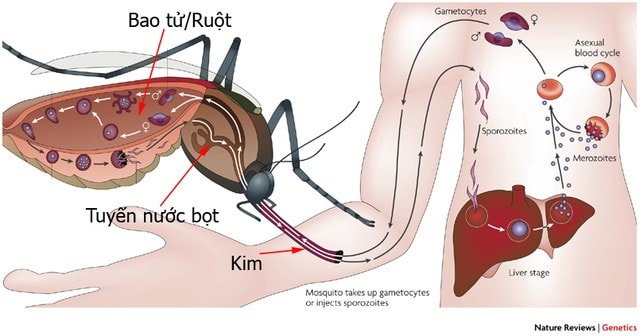 |
| Mosquitoes transmit malaria to humans. |
Antimalarial drugs
According to alarming reports on drug resistance in several localities, malaria parasites are primarily resistant to artemisinin or artesunate alone, with resistance rates trending upwards from 16% to 22%. The World Health Organization recommends that where resistance rates exceed 10%, that drug should not be used for treatment as it is ineffective. Given the reality of drug-resistant malaria occurring in provinces such as Binh Phuoc, Dak Nong, Gia Lai, and Quang Nam, and the potential for it to spread to other areas, the Ministry of Health's guidelines for the diagnosis and treatment of malaria, issued in 2003, stipulated the use of artesunate alone for treatment. However, the guidelines issued in 2009 revoked this provision. Accordingly, since 2009, the Ministry of Health has directed all medical facilities nationwide not to use artesunate alone to treat malaria, but to use combination therapy.
The combination drug mentioned here is a drug containing artemisinin derivatives, abbreviated as ACT (artemisinin base combination therapy), such as dihydroartemisinin combined with piperaquin, with the brand names arterakine or CV artecan. Also, since 2009, following the issuance of this regulation, the Ministry of Health has advised pharmaceutical companies not to manufacture, trade, or distribute artesunate tablets alone; however, injectable artesunate is still produced for initial management in cases of severe and malignant malaria.
The guidelines for the diagnosis and treatment of malaria issued by the Ministry of Health in 2009 and subsequently in 2013 stipulated specific treatment to address drug-resistant Plasmodium falciparum malaria by using first-line and second-line drugs. Therefore, when dealing with malaria patients infected with Plasmodium falciparum that may be drug-resistant, treatment should be a first-line combination of dihydroartemisinin-piperaquin (arterakine, CV artecan) for 3 days, combined with a single dose of primaquine for all positive cases to eliminate gametocytes and prevent transmission. During monitoring, if the patient shows dangerous signs within the first 3 days and still has malaria parasites, they should be treated as severe malaria. If malaria parasites reappear within 14 days, treatment should be with second-line malaria drugs. Alternative treatments include quinine for 7 days in combination with doxycycline for 7 days; for pregnant women and children under 8 years old, quinine for 7 days in combination with clindamycin for 7 days.
To prepare for the potential continued development of drug-resistant malaria with the aforementioned drugs, the Ministry of Health's guidelines issued in 2013 proposed the use of several other combination regimens as recommended by the World Health Organization, such as artesunate combined with mefloquine, artemether combined with lumefantrine, and artesunate combined with amodiaquine. Therefore, pharmaceutical companies should produce pre-combined drug formulations for convenience, and should not produce artesunate tablets alone, as using them without combination therapy will further increase the rate of drug resistance.
Although there is currently alarming information about drug-resistant malaria, concrete measures have been taken to address the issue. To limit the potential spread of drug-resistant malaria, healthcare facilities must adhere to the guidelines for the diagnosis and treatment of malaria issued by the Ministry of Health.
According to Health and Life