

How are airplanes protected from lightning?
When an airplane is struck by lightning, the parts most affected are the wingtips or tail, but nothing serious will happen if the aircraft is designed to protect against lightning strikes.
Fear of flying
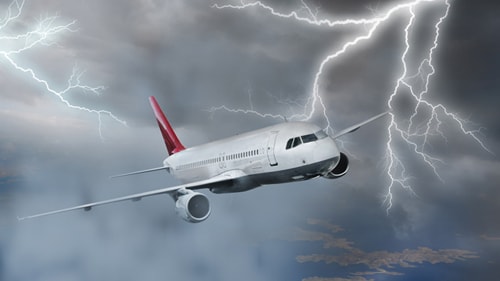 |
When struck by lightning, aircraft may have to descend, make an emergency landing, or divert to ensure safety. This recently happened to easyJet flight EZY6025. When struck by lightning, the plane carrying 154 passengers en route from Bristol, England, to Barcelona, Spain, had to divert and land at a different airport.
According to estimates from an American technology company, on average, each American commercial aircraft is struck by lightning more than once a year. The last time a commercial aircraft crashed due to a direct lightning strike was in 1967, when a lightning strike caused an explosion in the fuel tank. Private aircraft are considered less susceptible to lightning strikes, as they are smaller and can often avoid conditions prone to lightning. Typically, aircraft are affected at sharp points such as the tail or wingtips.
Since then, numerous studies have been conducted to understand the impact and effects of lightning on aircraft, and protective technologies have improved over time. Today, aircraft are tested and inspected to confirm their safety when flying in lightning-prone weather conditions.
When lightning strikes an aircraft, passengers and crew may see a flash of light and hear a loud noise, but nothing serious will happen. The aircraft will continue to fly, passing through the lightning strikes. On the aircraft's fuselage, the electrical current flows through the outer shell or other structures and concentrates in pointed areas such as the tail. Pilots may see flickering sparks of electricity briefly on these parts of the aircraft.
Aircraft lightning protection design
Since the 1930s, aircraft have been designed with features to protect against lightning strikes. Essentially, the design ensures that lightning strikes are scattered by antenna-like devices on the wingtips, causing the electrical current to flow only around the aircraft.
Aircraft fuselages are primarily constructed from aluminum, a good conductor of electricity. With a seamless design, electrical current flows only through the outer shell of the aircraft, without affecting the interior. Modern aircraft, constructed from advanced composite materials that conduct less electricity than aluminum, are lined with additional layers of conductive fibers or membranes. This design ensures that the aircraft's external structure and sensitive internal equipment remain unaffected.
For modern passenger aircraft, aircraft protection solutions also include kilometers of wiring, equipment, computers, and other control components. Components of the aircraft's safety system during flight or landing must be certified by the manufacturer according to the standards of the U.S. Federal Aviation Administration (FAA) or similar agencies in each country.
A critical component of an aircraft is the fuel system, where even a small spark can cause a disaster. To ensure safety, the outer casing of the fuel tank must be thick enough, and connections and fasteners must be tightly designed to prevent electrical current from flowing from one area to another. The tank doors, fuel tank caps, vents, fuel lines and pipes, and engines need to be tested for lightning resistance. Today, many airlines use a new, less explosive fuel to reduce the risk of accidents.
The conical radar housing on an aircraft is a particularly important area for protection against lightning strikes. The radar's protective casing isn't made of conductive material; instead, it features external lightning dispersion strips. This structure functions similarly to a building's lightning rod.
Generally, airline aircraft should avoid flying over or near areas prone to thunderstorms and lightning. During flight, pilots are the ones who pay attention to even the slightest changes or anomalies in weather conditions. The FAA has issued its own set of rules to ensure the safety of passenger aircraft against the effects of lightning and unusual weather conditions.
In fact, minor lightning damage to aircraft wingtips, propellers, or light-steering components has been recorded throughout the history of world aviation.
According to VnExpress.