

New traces of the Battle of Bach Dang have been discovered.
Wooden stakes, human bone fragments, glazed pottery... recently discovered within the Bạch Đằng battlefield (Quảng Ninh province) contribute to understanding the strategy, preparation process, scale, and developments of the naval battle against the Mongol invaders in 1288 by the Trần dynasty.
Last summer, several archaeological teams excavated and explored the Bach Dang historical site (Yen Giang ward, Quang Yen commune, Quang Ninh province). There, they discovered many important traces and artifacts related to the third naval battle against the Mongol invaders (1288) fought by the Tran dynasty.
A team of researchers from the Institute of Archaeology, led by Dr. Le Thi Lien, while excavating a large area of 75 hectares in the Yen Giang field, discovered a cylindrical wooden stake with a fairly large diameter (27-28 cm), 1.2 m high, with many small bevels carved into its base, embedded in a layer of brown mud, reaching the sand layer at the bottom of the river.
According to Dr. Lien, the rare presence of these wooden stakes has once again reinforced previous conclusions about the scale of the stake field and the method of stake driving used by the Tran Dynasty's army and people. "Detailed research into the stratigraphy and distribution of artifacts contributes significantly to interpreting the strategy, preparation process, scale, and course of the 1288 battle," Dr. Lien said.
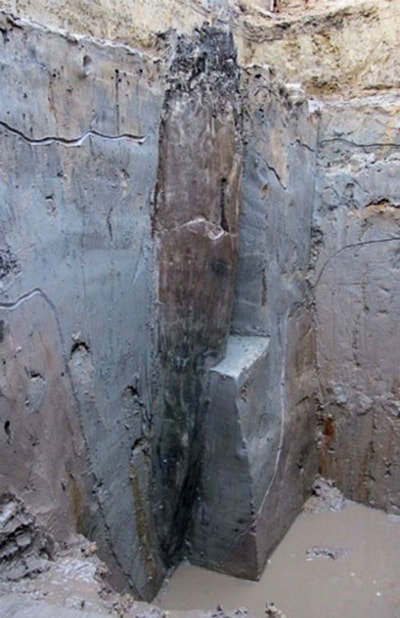 |
| The wooden stakes found at the Yen Giang stake field reveal the scale of the stake field and the method of stake driving used by the Tran dynasty's army and people. |
The excavation team, led by Dr. Nguyen Viet (Southeast Asian Prehistory Center), discovered a 5 cm long bone fragment with jagged fracture marks at one end and a diagonal cut at the other. After biological comparison and study of the cut, archaeologists concluded that this was a segment of the left forearm bone of a human, the part closest to the radius and scapula.
"There is a basis for assuming that these are traces related to human injuries from the Battle of Bach Dang in 1288," said Dr. Nguyen Viet. According to him, Vietnamese history has seen many wars of national defense, many of which involved tens of thousands of soldiers and civilians from both sides, such as Bach Dang, Song Cau, and Chi Lang... Typically, near residential areas, weapons and corpses were collected after each battle. While remnants of the battle have been scarce over time, they are not nonexistent.
During several excavations in the Bạch Đằng stake field area, five more sets of human remains were discovered. After research and radiocarbon dating, these bones are believed to be more or less related to the battle of 1288.
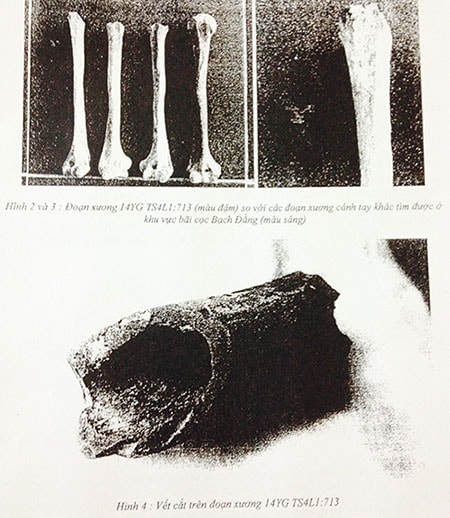 |
| A human bone fragment with fresh cut marks was unearthed in the Bach Dang stake field area. This artifact has been temporarily handed over for preservation to the Bach Dang Museum, under the Cultural, Information and Sports Center of Quang Yen town (Quang Ninh province). |
Another team of researchers from the Institute of Archaeology, while excavating at the Yen Giang stake field area (May 2014), discovered many ceramic artifacts dating from the Dai La period (10th century) to Mong Cai (20th century), but the majority belonged to the Tran dynasty (13th-14th centuries).
These new archaeological findings were considered important by experts present at the 49th Archaeological Conference (held at the end of September), providing a clearer picture of the Vietnamese naval battles when invading armies from the North advanced by sea, and further strengthening the evidence regarding the 1288 naval battle against the Mongol invaders (the third invasion) by the Tran dynasty.
According to Vnexpress