

Village Gate: Past and Present
(Baonghean) - Village gates have existed since very early times, closely linked to the formation and development of villages. Beyond defining boundaries, village gates clearly reflect the style and soul of the village. Village gates also preserve many unique traditional cultural values, sometimes even containing the meaning of safeguarding something sacred, which is why the movement to restore and rebuild village gates is increasingly flourishing...
I once heard the Hanoi scholar Nguyen Vinh Phuc and the painter Quach Dong Phuong – who spent decades traveling throughout the villages of Northern Vietnam photographing village gates – explain: Village gates are ancient Vietnamese architectural products with a defensive function. During times of war, invasion, or unrest, the village gates were closed. At night, patrol teams were always on guard. Just as houses have gates, so do villages. Gates are a symbolic boundary between villages, representing the authority of the village community. They divide residential land from agricultural land, separating the lives of the living from the afterlife. Village gates consist of a front gate and a back gate; the front gate usually faces southeast to welcome the auspicious breeze, while the back gate faces west towards the setting sun. Traditional village gates are rich and diverse in style and material, ancient architectural works that, besides their historical and cultural value, also reflect the soul and character of each Vietnamese village.
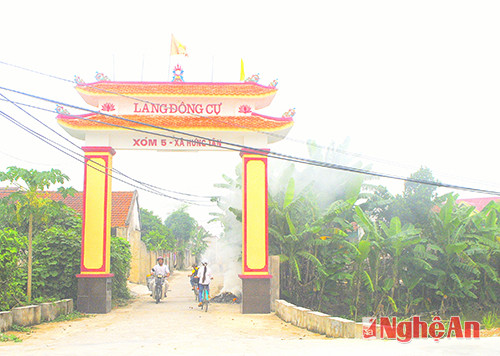 |
| Trung village gate, Hung Tan commune, Hung Nguyen district |
I have often found myself lost in thought beside ancient terracotta village gates, listening to the echoes of the village gates in the poetry of Bang Ba Lan: "Even though I am far away today, when I return to the banyan tree at the edge of the village, so many dreamlike scenes appear when I glimpse the village gate through the bamboo"; listening to the melody of the song "Village Gate Festival Drums" by the poet and musician Nguyen Trong Tao. And I have come to know one thing: the village gate is both familiar and sacred, witnessing not only the ups and downs of the village itself, but also the ups and downs of each person's life. The beauty of the village gate is linked to the rice-farming civilization, sketching and evoking the aspirations of the community from generation to generation… Wanting a unique image of a village gate to warm my soul, I have often lingered before the gate of Vinh Citadel.
Last year, I took my mother back to Dong Cu village (Hamlet 5, Hung Tan Commune, Hung Nguyen District) for the village festival. My mother has lived in the city for so many years, but she always remembers her roots. The inauguration of the Dong Cu village gate was truly lively. My mother still remembers the old days, when the village had a grand gate and a temple… Now, Hung Tan is a model commune for building new rural areas, so in addition to modern electricity, roads, schools, and health stations, and a thriving economy, the people are focusing on developing family culture and preserving and promoting traditional cultural values. The village gate has been rebuilt. My uncle, a veteran now over 75 years old with gray hair, smiled and said: “The village gate was built with the love and kindness of our people, my child. Those who went away contributed money, well-off families in the hamlet contributed as they pleased, and the poor did not. Straw is the origin of those who left, the gate is a historical witness welcoming those who returned victorious. The village gate is a witness, a symbol of will and a source of strength…” Unlike the imposing gate of Trung village nearby, the gate of Dong Cu village is smaller, built in the single-gate style, tall, slender, simple, and otherworldly.
Life is improving, rural areas are transforming, and people's lives are becoming more prosperous and comfortable. Preserving and restoring traditional values is becoming more important. Many villages, suburban areas, and even urban blocks are experiencing a surge in the movement to restore and rebuild traditional village gates. To me, this is a very encouraging development, mixed with some concerns. I heard a story from a flood-affected area in a neighboring province: Village and commune officials decided to build grand village gates, but after completion, they lacked the funds and owed money to the contractor. After the historic flood, just as the villagers received relief money from charitable organizations and individuals, the village and commune officials immediately deducted the money from the debt owed for the gate construction.
During my work trips throughout the province, I've seen many large and imposing cultural village gates. Many districts, such as Hung Nguyen, Nam Dan, and Do Luong, are focusing on rebuilding these gates. To date, many districts have achieved over 50% of their villages having new gates; Do Luong, for example, has 100% of its cultural villages with gates. For me, many of these magnificent village gates are incomplete. The gates are grand, but the lives of the people remain very poor; some gates in mountainous villages are beautiful, but their beauty reflects the architecture of the Kinh people rather than the unique identity of their ethnic group; village roads are narrow, and the gates are built in the traditional three-arched style; many village gates and welcome gates are neglected and forgotten, resulting in cracks, dirt, and graffiti. And as I said, the joy would be more complete if, behind each of these village gates, the people lived in prosperity, peace, and a rich, distinct cultural life…
I still wish my hometown had its village gate again, but even more so, I wish it were free from poverty. Then I hope that more village gates will be built in the future, whether simple or magnificent, reflecting the soul and character of my hometown; that everyone living behind those gates will uphold the inscriptions, so that those who leave will remember them – and upon returning, respectfully bow their heads as they pass through.
Text and photos:Thanh Son