

Final article: Encouraging private schools to assert their quality
(Baonghean) - Faced with certain difficulties, private preschools in Vinh City need to be proactive and find solutions to adapt and develop. In fact, many preschools have adopted creative approaches, maintaining stable operations and creating more choices for parents.
| RELATED NEWS |
|---|
Compared to many other private kindergartens, Hung Phuc Private Kindergarten (Vinh City) has quite a few advantages when it first started operating, because to date, the ward still does not have a public kindergarten. Hung Phuc ward is one of the areas with the highest number of private kindergartens, including Hoa My Kindergarten – the city's only private kindergarten that has been recognized as meeting national standards.
Taking over Hung Phuc Private Kindergarten at just over 22 years old and with no prior experience in early childhood education, Principal Hoang Thi Vinh confided: “In the beginning, I was extremely worried and anxious. However, because a large amount of my family's assets had been invested in the school, I and the members of the management board had to find every solution to gradually build the brand. I also proactively went to Hanoi to work for a year at one of the capital's top kindergartens to learn management, childcare, and familiarize myself with the school's new curriculum. Although I didn't completely adopt that kindergarten's curriculum, I learned their advanced teaching and childcare methods.”
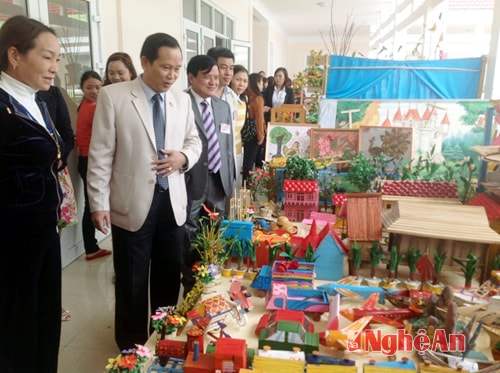 |
| Competition for teaching aids at Hung Phuc Kindergarten (Vinh City). |
At Hung Phuc Private Kindergarten, the design of the space, tailored to the age group of preschoolers, creates a friendly impression for both children and parents. The classrooms are meticulously designed and fully equipped with toys and learning materials. The school pays special attention to children's meals; for example, for toddlers, in addition to two main meals, there are two supplementary meals (twice as many as in public schools). The menu for kindergarten children changes daily, and the nutritional value of the supplementary meals is equivalent to that of the main meals. Regarding teacher quality, parents can monitor through a 24/7 networked camera system. Parents' feedback helps teachers improve their performance. In addition to salaries, the school offers monthly bonuses, with the amount increasing progressively based on A-B-C-D ratings, to encourage teachers to strive for excellence.
According to many parents, Hung Phuc Kindergarten's investment in meal quality is a smart move. This is because, in 2012, all public kindergartens in the city simultaneously discontinued breakfast for children, causing significant inconvenience for parents in bringing their children to school. Therefore, the flexibility of Hung Phuc Private Kindergarten allowed parents to proactively schedule their time, and although the tuition was higher, parents no longer had to rush every morning (especially those from civil servant families). Later, other private kindergartens also implemented similar practices, even though meal costs did not increase.
According to the leaders of Sunrise Kindergarten (Vinh City), besides investing in facilities and equipment, the quality of the teaching staff is a crucial factor determining the quality of childcare. Therefore, when recruiting, the school strives to select qualified teachers. During the teaching process, experienced teachers mentor new teachers to gradually improve the quality of all staff. Sunrise Kindergarten charges higher tuition fees than private schools, but students who take extracurricular subjects such as drawing, dancing, and singing do not have to pay extra.
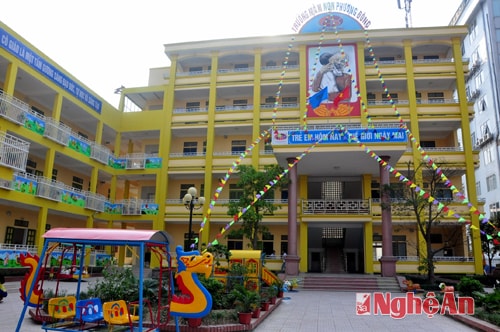 |
| Phuong Dong Kindergarten has been invested in and boasts modern facilities. Photo: Thanh Le |
Phuong Dong Kindergarten, despite only starting operations in April 2014, has already attracted approximately 400 children (reaching nearly 70% of its target). The school's most practical approach is establishing a reasonable tuition fee structure so that families with average incomes can still afford to send their children to school. Currently, with tuition fees (reduced by up to 25%) ranging from 650,000 to 700,000 VND per month, while still quite different from public schools, it offers significant competitiveness compared to some other private schools. Families with two children attending the school receive an additional 5% monthly tuition discount for the second child. Groups of three or more children enrolling receive an additional 5% discount on the first month's tuition for each child. Furthermore, annual tuition payments receive an 8% discount, half-year discounts receive a 4% discount, and quarterly discounts receive a 2% discount.
For early-established preschools like Tam Viet Preschool (Hung Binh Ward), despite limited facilities, the school has adapted to increasing competition, including tuition fees. According to Ms. Nguyen Thi To Uyen, Vice Principal of Tam Viet Preschool, the tuition fee of 360-400 thousand VND/month has been maintained for many years, and the school offers a 20% tuition reduction (per child) for families with two children enrolled; and reduced fees for children from impoverished families and orphans. Because the majority of students are children of laborers and small business owners, the school is willing to keep children until 6-7 pm and provide classes all day Sunday to accommodate parents.
Thus, through the above methods, the "services" offered by private preschools have now become somewhat superior to those of the public preschool system. This has certainly attracted attention and positively impacted the choices of parents, especially those with financial means. In fact, in the current circumstances of many families in Vinh City, parents, when choosing a school for their children, tend to prioritize the quality of the school and childcare rather than tuition fees. Therefore, some are willing to forgo public schools and spend 5,000,000 - 7,000,000 VND/month to send their children to a private school that meets international standards. This also confirms that, with the right approach and dedication, private preschools can also work alongside public preschools, creating a diverse educational environment and fostering healthy competition in service quality among childcare facilities.
However, to help this system develop more stably and sustainably, the City Education Department needs to do better in implementing the preschool education program, creating conditions for teachers to receive regular professional development, participate in excellent teacher competitions, and attend workshops similar to public preschools. The Education Department also needs to coordinate with relevant sectors to regularly inspect, supervise, and be responsible for ensuring that schools properly implement the salary and bonus system for teachers, especially in contract signing and insurance contributions, so that teachers can feel secure and committed to the school in the long term. At the same time, it should advise the City People's Committee to develop documents to direct wards and communes to strengthen the management of non-public preschool education facilities in accordance with State regulations.
Schools with inadequate facilities and teaching staff, failing to ensure the safety and quality of childcare and education, must be suspended from operation. Schools themselves must adjust and improve the quality of education and childcare. At the same time, they must continue to invest in facilities, standardize the teaching staff, and implement tuition reduction policies to attract children. This trend will also force public kindergartens to self-regulate, improve the quality of education, invest in facilities, or find solutions to expand classrooms, avoiding the current overcrowding situation. Mr. Nguyen Trung Chau, Vice Chairman of the City People's Committee, shared: “The shortage of public kindergartens and their failure to meet regulations has significantly affected childcare. Naturally, the quality of education is therefore not commensurate with the city's potential and advantages, not truly sustainable, not outstanding, and has not created a significant gap compared to other districts, cities, and towns in the province…”
Regarding the planning of the school network, according to Mr. Luu Duc Thuyen, Deputy Director of the Department of Education and Training: At this time, the population size in Vinh City has grown quite high, and if following the cycle, there will be a period of stagnation. Therefore, in planning and licensing school construction, the city's leaders must consider carefully and avoid building schools too haphazardly, leading to a "surplus" crisis later. Given the city's limited budget, investment should not be scattered and piecemeal, but rather focused on building 1 to 2 schools per year. During new construction, attention must be paid to the scale of schools and classrooms, ensuring sufficient space according to regulations and guaranteeing the safety of children. Strengthening state management and professional management, improving the quality of operation of private schools, and actively promoting quality schools will build trust and reassure parents in their choices. The Department of Education hopes that, in addition to the efforts of the sector, the State will issue policies to supplement the staffing of commune and ward officials responsible for managing private preschools, or provide financial support for officials who hold dual roles; add more staff to be in charge of preschool education at all levels of education management; and have policies to support the provision of equipment, teaching materials, and toys for private preschools in accordance with Circular No. 02/2010/TT-BGDĐT of the Ministry of Education and Training issued on February 11, 2010.
My Ha - Dinh Nguyet