

Hoa Hoi: The bustling season of reeds
(Baonghean) - Hoa Hoi village (Nghia Hoi commune, Nghia Dan district) appeared before our eyes after crossing the long dike, with its red tiled roofs, vibrant green mustard gardens glistening in the sun, and spacious courtyards bustling with laughter and conversation. For so many years, that lively atmosphere has remained undiminished in this rural area, despite the ups and downs of the broom-making trade...
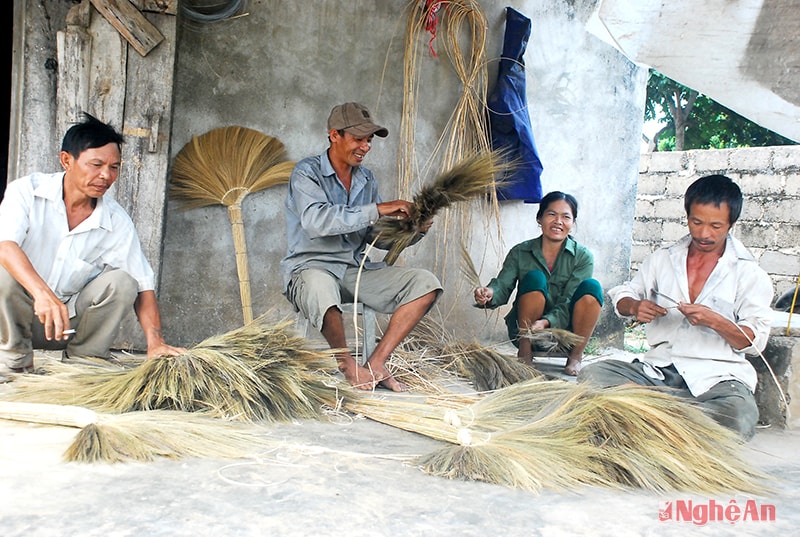 |
| A broom-making workshop in Hoa Hoi. |
We stopped by the porch of a 76-year-old man named Phan Son, who was both skillful and talkative. He recounted that he had been involved in broom making since he was born. That's not an exaggeration; from the moment he was born, the sound of brooms being pounded echoed in his ears. His grandmother's hair and his father's clothes were stained with broom dust. Brooms covered everything from the house to the street. At that time, the people of Hoa Hoi only made brooms for household use, not for commercial purposes like they do now. Then, a few houses in the village started making brooms and hanging them on wire in front of their yards, accompanied by signs on small pieces of cardboard or wood that read: "Brooms for sale." Hoa Hoi village began to develop an "economic mindset" with such signs.
When the first broom was bought by a customer and praised for its beautiful weave, the people of Hoa Hoi were overjoyed. The first brooms were exchanged for butter, rice, bundles of rice, oil lamp shades... This simple exchange and trade strengthened their resolve, faith, and passion for the broom-making craft. In those days, whether poor or well-off, everyone "invested" in building a storage shed for reeds and rushes. It was called a shed, but it was really just a small house thatched with dry straw. Every few harvest seasons, the villagers would replace the straw roof to protect the reeds and brooms from rain and storms.
Once or twice a month, the villagers would travel up the slopes of Quy Hop, Quy Chau, and Que Phong to search for reeds and rushes. Mr. Son recounted that the thudding sound of pounding the reeds to make the flowers fall was the most familiar and memorable sound in the lives of the people of Hoa Hoi village. Mr. Son couldn't remember how many times he had been bitten by leeches and snails while gathering reeds in the forest, how many times his shoulders were scratched and bruised from carrying reeds and sharing rice balls on stormy nights in the vast forest... Then, under the moonlight, by the light of oil lamps, the people of Hoa Hoi would sit diligently weaving each reed stalk. There were times when the village's products seemed to have no "market," and the warehouses were overflowing with brooms, yet the people of Hoa Hoi never gave up, never abandoned their craft.
Having been involved in the craft since the most difficult times, building the "brand" of Hoa Hoi brooms was not easy or quick. The people of Hoa Hoi tell each other, "We still do the craft to ease our homesickness and to preserve the image of a village with skilled people famous throughout the region." "Easing homesickness" isn't just about the craft itself, but also about living in the vibrant atmosphere of working with reeds and rushes. "Like me," Mr. Son said, "now I don't do this for food and money like before, but because I love broom making so much. I feel sad if my hands don't touch the reeds and rushes every day." Hoa Hoi village is always bustling with laughter and conversation, even when the brooms haven't sold out. Sometimes, each household only sells five or seven brooms a week, but that doesn't discourage or demoralize anyone. That's how you know that broom making isn't just about food, clothing, and children's education, but about passion and belief in the profession of journalism..."
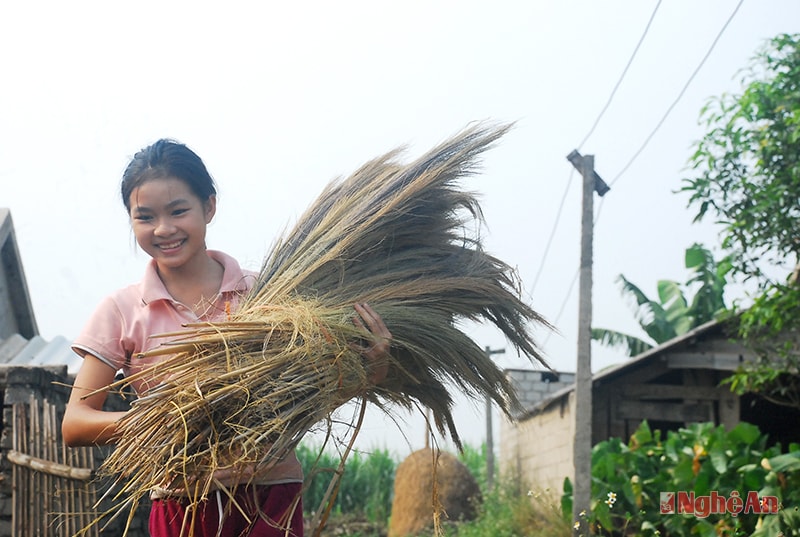 |
| Help Mom hang up the mops to dry. |
Beginners in the craft can only make five or seven brooms a day, while experienced broom makers can make thirty or forty a day. First, they split the reeds and select the steel (the reeds and steel are used to tie the broom handles). Before tying the broom, they must choose evenly sized reeds; larger reeds are used to make larger brooms, and smaller reeds to make smaller brooms. This ensures the broom is strong and sturdy; tying the reeds together will not create a secure broom. To make a beautiful broom, the craftsman always shakes off the dust from the reeds until they are completely clean before tying them together. The same applies to the reed stalks; they must be evenly sized and strong. Some brooms have handles made from the reed stalks themselves, while others have handles made of plastic (because some consumers prefer plastic handles). The craftsman must select evenly sized reed stalks and tightly bind them with plastic or steel wire so that the broom feels firm in the hand. Typically, a reed broom used for frequent use can last five to seven months...
Mr. Son added that in Hoa Hoi, there are people who are very passionate about making broomsticks. Mr. Tuat's family is an example. On the straw-strewn road, we arrived at Mr. Pham Van Tuat's house. Although he never spent years trekking through the forest with his father to find broomsticks during the reed blooming season, he had helped his parents make brooms every night since he was a child. Then, he became skilled and dedicated to the craft, loving and becoming attached to broommaking as if it were a natural part of him – Mr. Tuat confided. Following in his parents' footsteps, after getting married and having children, Mr. Tuat has spent almost 25 years making brooms. He can't even count how many brooms he's made. Currently, his wife and he make brooms their main occupation, averaging 30-40 brooms a day. On average, they earn around 30 million dong per year...
It's not entirely accurate to say they're rich from their craft, but in Hoa Hoi, the broom-making profession has helped many families rise above poverty and provide their children with money for education. The family of Mr. Tran Van Phuong has two children studying at Hanoi University of Civil Engineering and Ho Chi Minh City University of Economics, thanks to the income from their parents' broom-making. Mr. Phuong said: “The great thing about broom making is that you can work in the rain or shine and still earn money. You see, in Hoa Hoi, every household makes brooms together. It's harvest season now, so everyone's out harvesting; otherwise, it would be very lively. During the day, they make brooms under the trees and on the porches, and at night they work in the yard. Working together is both fun and efficient. The people are very supportive and caring; if one family finds a buyer, they immediately inform another. That's why the community spirit is so strong.” And it's not just Mr. Phuong's family; every year, in Hoa Hoi village, 5-6 students pass the entrance exams to universities, not to mention the number of students attending colleges, vocational schools, or training centers, thanks to their parents' broom-making craft, which allows them to focus on their studies.
Mr. Pham Van Hao, Head of Hoa Hoi Broom-Making Village, said: "For a long time, when people mention Hoa Hoi, they think of brooms. The Hoa Hoi broom-making village was established in the 1970s and 1980s. Through its development, from a time when people only knew how to produce brooms for personal consumption, it has now shifted to commercial production. Currently, 98 out of 113 households in the village are engaged in the craft, with 198 main workers and more than 200 auxiliary workers. Recognizing the advantages of broom-making, such as simple production space, independence from weather, and especially the utilization of local labor, almost every household in Hoa Hoi village now has someone making brooms. Along with rice farming, broom making is considered the main source of income (accounting for 65%) for families. Notably, on December 31, 2007, the People's Committee of Nghe An province signed a decision recognizing Hoa Hoi village as a broom-making craft village." From then on, the villagers were all happy and excited, striving to refine their skills to produce high-quality products that were favored and trusted by the market...
Currently, Hoa Hoi village is considered the wealthiest village in the entire commune. Each year, the village produces approximately 500,000 brooms, generating a profit of 3 billion VND; the average per capita income is nearly 30 million VND/person/year.
While there are many reasons for joy, there are also many concerns. These include the increasingly scarce supply of raw materials for the craft village, as well as the growing difficulty in finding markets to export brooms. Despite being recognized as a craft village for seven years, the collective organization of the Hoa Hoi broom-making village remains fragmented and inconsistent, with each person working independently. For a long time, the villagers have had to travel over 200 km to the mountainous Ky Son district, near the Vietnam-Laos border, to purchase the broom grass raw materials; those who are quick get more, while those less fortunate have to wait for the next shipment. Even when the brooms are ready for export, the villagers themselves have to search for markets throughout and outside the province, a very arduous and time-consuming process.
“The people's aspiration, as well as the determination of the Nghia Hoi Commune People's Committee in maintaining and developing the Hoa Hoi broom-making village, is to soon establish a formal, systematic handicraft cooperative with specific and clear task assignments. This will allow broom makers to understand the rules of the craft village and feel secure in their production without worrying about shortages of raw materials or finding customers…,” said Mr. Dau Khac Long, Chairman of the Nghia Hoi Commune People's Committee.
Text and photos:Thu Huong