

Kobani falls: Is Türkiye secretly rejoicing or mourning?
(Baonghean) - On Thursday, October 9th, the Islamic State (IS) nearly captured the city of Kobani. Thus, after almost a month of resistance, Syria's third-largest Kurdish stronghold appears poised to fall soon, and the number of refugees will likely be much higher than the 300,000 who have arrived since mid-September. This event is the subject of intense debate between the West and Türkiye – surprisingly, Syria, the host country, seems unconcerned about losing more territory to IS.
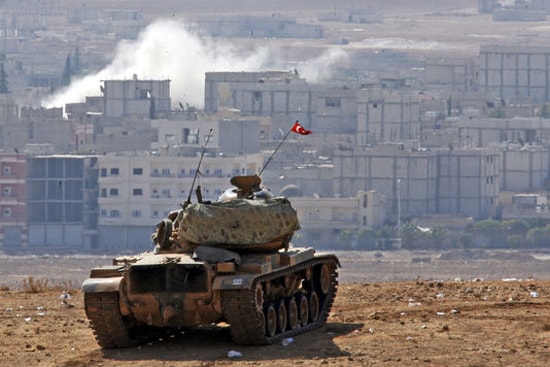 |
| Turkish tanks on a hill in Suruc, with the city of Kobani in the background, October 9. |
| RELATED NEWS |
|---|
This is because Türkiye's internal political situation is already complex, especially concerning the Kurds, so the Ankara government must be cautious and carefully consider every move. First, regarding the Kurds in Kobani: since November 2013, Kobani has declared independence from the Syrian government of Bashar al-Assad. The Kobani community comprises 30 to 40 million Kurds living in Turkey, Iraq, Syria, and Iran, forming a non-governmental community. An independent Kurdish nation, long conceived, is gradually developing and taking shape. The controlling force in this community is the armed movement inspired by Marxism-Leninism, the Kurdistan Workers' Party (PKK), and its Syrian political branch, the Democratic Union Party. The armed forces of this party are the Kurdish People's Protection Units (YPG), which also protect Kobani.
Since July 2012, this movement has established its own institutions in Syria, alongside its opposition to the government of President Bashar al-Assad. Relying on harsh repressive measures, the movement claims to act in the name of a social project promoting gender equality, the integration of religious minority communities, and a form of local autonomy. The PKK, founded in 1978 in Türkiye, led a war for independence against Ankara's military, resulting in 40,000 deaths over 30 years, including 7,000 members of the Turkish security forces. Unsurprisingly, the idea of a Kurdish autonomous state led by this formidable enemy, growing stronger across the border, is causing Ankara considerable anxiety. For the Turkish state, the threat from the PKK is at least as significant as, or even greater than, that of ISIS. Turkish President Recep Tayyip Erdogan has repeatedly stated: "ISIS and the PKK are the same thing."
From January 2013, Ankara and the PKK committed to a historic peace process. The Turkish government signed an agreement with the legitimate representatives of the Kurdish rebels – the Party for Peace and Democracy (BDP), specifically with leader Abdullah Ocalan – who was sentenced to life imprisonment on Imrali Island after purges since 1999. However, by the time Turkey signed this commitment, the Kurdish movement in Syria had grown significantly. The Ankara government feared that this growing strength in Syria would lead the PKK to make new demands. Therefore, Turkey requested that the Kurdish authorities in Syria expand their relations with other Kurdish movements and separate from the PKK. Meanwhile, Abdullah Ocalan threatened to break the peace agreement if Türkiye did not intervene militarily, allowing jihadist elements to kill Kurds in Kobani. Significantly, this is precisely the pretext the PKK is hoping to use to disrupt the long-term peace process with Ankara – the prospect of this compromise being the PKK's disarmament and dissolution. Thus, internal conflicts from both sides exist within this peace agreement. Thirdly, on October 7th, protests and subsequent violence erupted, killing 18 people in Kurdistan, followed by a curfew and increased military presence in the region, signaling a resurgence of socio-political crisis in Turkey.
Thus, on the one hand, Ankara does not want to "breathe life" into the Kurds in Syria, fearing it would further strengthen the PKK – which would be like harboring a viper in one's bosom! The excuse Ankara gives to justify its stagnation in the fight against IS in general and the defense of Kobani in particular is that eliminating IS will not weaken the government of Bashar al-Assad, and may even have the opposite effect. It is clear that on the chessboard laid out before the Ankara government, there are three threats: Bashar, IS, and the PKK. Declaring war directly on Bashar and the PKK is not an option, but if Ankara were to openly fight IS, it is uncertain who would prevail, but the PKK would clearly benefit from weakening two formidable opponents without firing a single shot. With such calculations in mind, Ankara is sitting idly by, waiting for the outcome to be decided. It's clear that the PKK and the YPG are losing ground to IS, which could put the PKK at a disadvantage in peace negotiations.
Despite careful and shrewd calculations, Türkiye is facing significant pressure to intervene in Syria, given the growing influence of ISIS. This week, the US will send a military delegation to Ankara to debate with Turkish military officials about the country's responsibilities in the joint fight against ISIS. The US immediately rejected Ankara's request to establish a buffer zone on the Syrian-Turkish border, instead criticizing the government's irresponsible and passive attitude. Furthermore, Ankara is under domestic pressure as constitutional elections are scheduled for June 2015. President Erdogan understands better than anyone that the support of the 20% of Turkey's population who are Kurds will be crucial to the success or failure of his AKP party.
Reishi Mushroom
(Compiled from Le Monde)