

Being close to and sharing with the people.
(Baonghean) - During his lifetime, President Ho Chi Minh taught our army: "Our people are the foundation, the parents of our soldiers," and "Apart from the interests of the people, the army has no other interests"... Remembering his teachings, the armed forces in the province have "stayed close to the area, stayed close to the grassroots, stayed close to the people" to successfully complete their tasks.
We met Lieutenant Colonel Le Van Luan – Acting Commander of the Quynh Phuong Border Guard Station (Quynh Luu district) – at Lach Con wharf. He was waiting for offshore fishing boats to return so he could gather more information on national security and maritime border security. Lieutenant Colonel Luan said: Over the past few years, the Quynh Phuong Border Guard Station has coordinated with the Military Command, the authorities of Quynh Phuong ward, Quynh Lien commune, and Quynh Lap commune to establish a force of maritime propagandists. In this force, boat owners play a key role in disseminating the Party's guidelines and policies, and the State's laws and regulations to their own crew members. In addition, boat owners regularly monitor the situation regarding vessels violating sovereignty, illegal fishing, and theft of fishing gear; and mediate collisions between vessels at sea. Currently, the station's team of collaborators numbers over 50 people.
People living in coastal areas spend their lives far from shore, constantly exposed to the elements. It's not easy to ensure that fishermen understand national security policies and guidelines, feel secure in their work at sea, and actively cooperate in safeguarding national security. To win them over, border guards in particular, and the armed forces in general, must truly empathize and work closely with the people. Lieutenant Colonel Lèo Văn Luấn stated: Besides regularly visiting and providing dedicated assistance to those in difficult circumstances and rescuing fishermen in distress at sea, each officer and soldier must share their joys and sorrows, their gains and losses, maintain security and order in their assigned maritime areas, and ensure the interests of the fishermen are protected. Each officer and soldier participates in guiding and disseminating effective fishing and exploitation models to the fishermen. When necessary, they are ready to go out to sea with them.
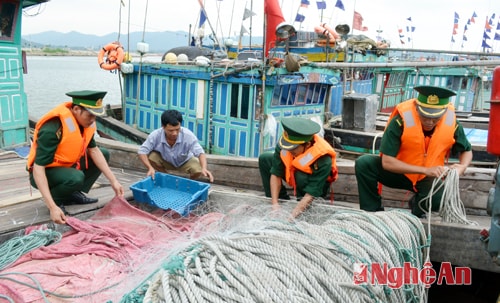 |
| Border guards from Quynh Phuong Post help local people clear away fishing nets to prepare for the storm. Photo: Hai Thuong. |
In a conversation with Mr. Nguyen Van Chau, Chairman of the People's Committee of Quynh Phuong Ward, it was learned that: Over the years, the locality and the Border Guard Post have effectively coordinated the dissemination of information and education on the responsibility of the people and fishermen in participating in the management and protection of the sea area (once every 3 months). From 2008 to the present, they have rehabilitated and educated 10 individuals and 18 children who violated the law. In the field of national security – maritime security, the post and the locality have fought against and suppressed many types of crimes, notably investigating and clarifying 7 gambling cases, handling 18 individuals; verifying and clarifying the identity of a woman returning from China; handling dozens of cases of intentional injury and disturbing public order in the area; and ensuring the safety of the annual Corn Temple Festival. In 2013, the border guard, maritime militia of the ward and other forces rescued and towed 3 vessels with nearly 20 fishermen in distress, bringing them safely ashore. Since the beginning of the year, maritime security has been well maintained… Border guards have become a pillar of support, helping fishermen stay afloat on long voyages, venturing out to sea and into the open ocean, maintaining security and order in the sea areas and territories under their responsibility.
Meanwhile, the people of Tri Le commune, a border area in Que Phong district, truly consider the officers and soldiers of the Border Guard as "family," benefactors who helped them combat drug abuse in the area and develop their household economy. Five years ago, poverty and limited awareness led Ha Van Thanh, as well as some other people in Na Lit village, Tri Le commune, to commit crimes, engaging in the illegal trafficking and transportation of narcotics. After serving his prison sentence and returning to his hometown, he received help from the officers and soldiers of the Tri Le Border Guard Post, who provided him with strong moral support to improve his life. Now, Thanh has clearly recognized his wrongdoings and is grateful to those who helped him rebuild his life, determined not to repeat his past mistakes. Mr. Thanh shared: “After serving a 36-month prison sentence, my family faced great difficulties. I had no profession, my wife was frail, my children were young, and I felt ashamed in front of the village, not knowing where to turn for help. Fortunately, the border guards and local officials came to encourage us and showed us how to grow passion fruit, raise chickens and black pigs for commercial purposes, cultivate bamboo shoots, and grow peaches for fruit… Now life is stable; we’re not rich, but we’re not starving. I often tell my children: stay away from drugs, and always remember the kindness of the border guards.”
In Tri Le, there are many cases where border guards have helped people. For example, in Bo village – located about 2 km from the commune center, with 35 households and 151 inhabitants – thanks to the active involvement of officers and soldiers of the Tri Le Border Guard Post and the local government, 12 people have successfully quit drugs. Mr. Luong Van Hoa, the head of Bo village, expressed his gratitude: "Every month, officers and soldiers of the Tri Le Border Guard Post come down to the village to educate and encourage people to be vigilant, voluntarily commit to ensuring security and order in the village, and prevent social evils, especially drug abuse. Households have signed commitments not to participate in or assist individuals involved in drug-related activities in the area. Families with relatives who unfortunately become addicted to drugs register with the village management board for education and rehabilitation, organize home-based rehabilitation, or send them to rehabilitation centers…"
Propagating the message to local people to effectively combat drug abuse is not easy. To achieve this, each border guard officer and soldier must be a role model of "saying and doing." Captain Nguyen Ngoc Tan, Deputy Political Officer of Tri Le Border Guard Station, said: Tri Le Border Guard Station regularly deploys officers to the area to implement the "4 together, 3 closely" approach with the people. Specifically, experienced officers who understand the customs and traditions of the ethnic minorities are assigned to directly "stay in the villages" to stay close to the people, the area, and the targets, sharing meals, living together, working together, and speaking the ethnic language with the people. Every day, they also go to the fields and farms with the people to actively increase production and alleviate poverty. They actively assist the locality in training, creating sources, and developing new Party members. They also build and strengthen Party branches and mass organizations to operate in an orderly manner. Thanks to the trust and support of the people, from the beginning of the year until now, the Anti-Drug Crime Prevention Department of the Provincial Border Guard Command, together with the Tri Le Border Guard Station, has detected 13 drug trafficking cases, arrested 15 suspects, and handed them over to the relevant authorities for legal processing.
With compassion for the people, a sense of responsibility towards their work, and possessing knowledge and effective methods of mass mobilization, the officers and soldiers of the provincial armed forces have assisted local Party committees and authorities in building political foundations, helping people settle down and stabilize their lives, guiding them in farming, livestock raising, and restructuring production, helping to build socio-economic infrastructure, providing healthcare for the people, and teaching literacy to the illiterate. They have truly demonstrated "devotion to the people," contributing significantly to the economic and social development of their areas of operation. Typical examples include the soldiers of Phuc Son Border Guard Post (Anh Son district) teaching literacy to the people; Mon Son Border Guard Post helping the people of Dan Lai adapt to new lives and production methods; and the Border Guard units of Tam Hop (Tuong Duong district), Nam Can, and My Ly (Ky Son district) developing economic models such as raising black pigs and cattle, growing lilies and pumpkins, and raising fish, which are being popularized to help people escape poverty. Furthermore, they also provided hands-on guidance, donated livestock, and built houses for disadvantaged families. Specifically, the 4th Economic-Defense Brigade of the 4th Military Region has, over the past few years, introduced high-yield "poverty alleviation" crops into the project area, helping people improve their lives and achieve sustainable poverty reduction. These practical actions further strengthen the bond between the military and the people, like fish and water.
Thanh Son