
Tan Ky: The benefits of off-season green squash
(Baonghean) - This time of year, farmers in some localities of Tan Ky district are entering the off-season harvest of green pumpkins. The pumpkins are intercropped in rubber plantations, bringing high economic efficiency...
(Baonghean) - This time of year, farmers in some localities of Tan Ky district are entering the off-season harvest of green pumpkins. The pumpkins are intercropped in rubber plantations, bringing high economic efficiency...
In Tan Phu commune, rows of green squash are intercropped in rubber plantations aged 1 to 3 years, with densely packed fruit waiting for traders to come and buy them. At the rubber plantation of Mr. Nguyen Quoc Manh's family in Tan Yen hamlet, he and his wife are currently tidying up the irrigation system using plastic pipes for their squash garden. Standing in front of the squash garden ready for harvest, Mr. Manh excitedly said: "This irrigation system using Tien Phong plastic pipes is a one-time investment that can be used for several years. Because after each harvest, we diligently collect and store the produce, waiting for the next season to use it. If we leave it in the garden, during the process of caring for the rubber trees or preparing the land for intercropping, the pipes will be damaged, wasting investment costs."
Mr. Manh's family's rubber plantation covers 8 sao (approximately 0.8 hectares) and is three years old. Every year, following the principle of "using short-term gains to support long-term growth," the couple intercrops their rubber trees twice a year with crops such as watermelons, green squash, chili peppers, or corn. This season, they built trellises to grow off-season green squash. After four months of care, the squash was ready for harvest in early September. They estimate a harvest of over 10 tons, with the current selling price to local traders being 4,000-5,000 VND/kg. After deducting all investment costs for seeds, fertilizers, and supplies—approximately 15 million VND—their profit is over 30 million VND.
Mr. Manh added: Growing green squash requires careful care, investment in proper trellises, suitable fertilizers, and consistent watering. Therefore, investing in a reliable irrigation system ensures a high yield. Rubber trees only need to be tapped after 6 years, so it's necessary to intercrop with short-term crops to have the resources to invest in rubber and cover living expenses. Intercropping vegetables in rubber plantations not only increases income but also helps rubber trees grow faster, as the trees benefit from the care of the intercropped plants. This rubber plantation will be 4 years old next year, but intercropping is still possible.
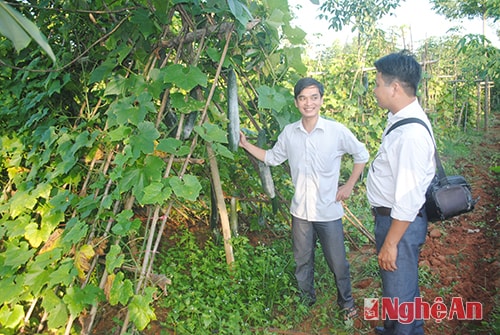 |
| Visiting the off-season green squash garden intercropped within the rubber plantation of Mr. Nguyen Quoc Manh's family. |
According to information from Song Con Agricultural Company Limited, this season, the company has intercropped over 20 hectares of pumpkins in rubber plantations aged 1-4 years, mainly in Tan Phu commune. The average pumpkin yield is 2 tons per sao (approximately 1000 square meters). Farmers here have years of experience in intercropping vegetables in rubber plantations, so they have good cultivation practices. Previously, they often grew watermelons, but due to the unstable market for watermelons, few households continue to grow them. Last season, the company collaborated with a South Korean enterprise to grow chili peppers, with many households cultivating 30 hectares of chili peppers, yielding high incomes. After harvesting the chili peppers, the farmers planted off-season green pumpkins.
In early October, some households harvested their pumpkins, and traders came by car to buy them directly from the gardens. This is the transitional season, and the market is not very rich in green vegetables, so green pumpkins are in high demand. However, compared to last year's pumpkin crop, the selling price is lower this season, but pumpkin growers still earn a relatively high income. One hectare of intercropped pumpkins this season yielded 20 tons of fruit, selling for nearly 100 million VND. After deducting expenses, the profit was still over 60 million VND. Currently, the entire company has 430 hectares of newly planted rubber trees, which can be intercropped with short-term crops. Therefore, the unit regularly promotes and guides farmers to intercrop various vegetables to increase income and have the resources to care for the rubber plantations...
Text and photos:Xuan Hoang