

Kites soaring in the wind…
(Baonghean) - "Homeland is a blue kite/My childhood I flew in the fields" - for each person, the kite is associated with childhood, with memories of their homeland, a "thread" connecting them to the earth, sky, and nature. The passion for kite flying and kite flying has created the simple yet noble beauty of the countryside...
Kite and flute artisan
Every afternoon, in Hamlet 5, Lac Son Commune, Do Luong District, on the embankment, barefoot children run after kites soaring in the clear blue sky, their laughter echoing in the wind. These wind-filled kites are crafted by the skillful hands of the elderly members of the Lac Son Kite Club.
For decades, artisan Dinh Xuan Quang of the Lac Son Kite Club has been making bamboo flute kites, each step of the process deeply ingrained in him. While meticulously carving and shaping each flute, he explains: "Making kites is easy, but making bamboo flute kites requires learning and dedicating time and passion to it. A bamboo flute kite consists of many flute tubes combined together. There are many different names for each tube. For example, in a five-tube flute set, the two smallest tubes are usually called bird flutes or baby flutes... their sound is soft, sometimes whistling like a whistle. The two medium-sized tubes are called gong flutes or mother flutes... their sound is both low and high, very smooth like a song. The largest tube is called the gong flute or father flute... its sound is resonant like a gong. When it flies into the sky, the sounds of all the flutes combine to create an incredibly poignant melody.” Pointing to his collection, Mr. Quang shared: "Although they are similar in the number of flutes, made from the same bamboo, and crafted by the same hands, each set has its own unique sound. It's like birds; even though they are of the same species, they sing differently."
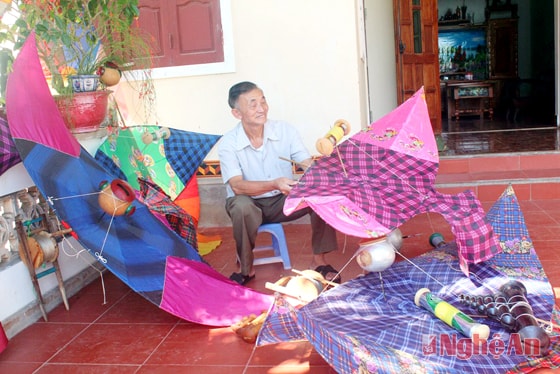 |
| Mr. Dinh Xuan Quang makes bamboo flute kites. |
Going back in time, kites have been a part of Dinh Xuan Quang's life from childhood to adulthood. In 1960, answering the call of the country, the young man enlisted in the 531st and 473rd Regiments in the Southern battlefield. After his discharge, upon returning to his hometown, Dinh Xuan Quang was trusted and elected to the village Party committee, and held positions such as Chairman of the Veterans Association of Lac Son commune, Chairman of the Elderly Association, and Chairman of the Ornamental Plants Association of the commune...
Alongside his social work, his passion for kite-making has stayed with him from childhood to old age. To perfect his kite-making techniques, Mr. Quang asked his children and grandchildren to buy kites for him whenever they visited famous kite-making villages like Dai Tra (Kien Thuy, Hai Phong) and Ba Duong (Hanoi). At home, he meticulously disassembled the kites to observe the process and learn from the experience. Thanks to this, his kites became increasingly improved and famous in the region. With his passion for kite-making and his desire to pass on his skills to his descendants, he proposed to his contemporaries the establishment of the Lac Son Kite Club. To date, the club has 8 core members and many more members who share his passion for kite flying.
Speaking about his childhood passion, Mr. Quang recalled: "In my hometown, after each rice harvest, it was kite-flying season for the children in the village. The fields after the harvest were the ideal place to fly kites. We loved flying kites until late at night, only returning home when our parents came to call us. The bamboo groves and rice field embankments were usually where we gathered to make kites. Bamboo was readily available; we just had to choose flexible branches, whittle them, and dry them in the sun. We didn't have to buy paper either; we used old cardboard. Back then, there was no glue, so we soaked rice in water until it became a paste and used it as adhesive. Making kites required meticulous work, but flying them demanded even more 'art'. Some kites looked very big and beautiful, but they didn't fly as high as smaller ones. Therefore, to make the kite fly high, the flyer had to 'run a little' to get the string going. When the kite was in the air, the flyer had to loosen the string slowly until the kite was halfway up the mountain before securing it. Back then, we often gathered together to compete in kite-flying competitions." The kite that flies the highest will have its owner hailed as the "leader." The old man explained: The sound of the flute is both music and a weather predictor. Because the sound of the flute changes with the seasons, temperature, and wind types. Based on the sound of the flute, listeners can know what the weather will be like in the coming period, and farming will therefore be more prosperous.
Preserve the country melody.
In Lac Son, many people fly kites, but only the elders Dinh Xuan Quang, Dinh Tan Phat, Le Tri Ti, and Hoang Van Hoa can make kite flutes. The flutes consist of nine types: am, i, bi, bu, bo, do, de, di, and di. Kite flyers must know how to listen to the flute's sound, depending on the timbre. The size of the flutes in a set must follow a decreasing order of size. To make a kite flute perfectly, kite makers must invest a lot of time and effort. To hear the flute sound accurately, kite flyers, in addition to understanding musical theory, need keen ears and a "pure" soul to appreciate the sound. Listening to the kite flute is not just with the ears, but with the heart and passion.
Mr. Tran Doan Tam, a cultural official of Lac Son commune, said: "Mr. Tran Xuan Quang's kite-making club is very active, promoting cultural and spiritual values and contributing to preserving the traditional beauty of our homeland. During the Cua Lo River Festival in 2007, the kites of Mr. Quang's kite-making club left a deep impression on visitors. Every year, the Lac Son Kite-Making Club represents the district in kite-flying exchanges with other localities in the province. With many years of experience in kite flying, Mr. Quang has always been concerned about how to pass on the tradition of kite-making to future generations. However, because making kites is very laborious and time-consuming, the children of the village have gone away to work, and the younger generation is busy with school, so they lack the opportunity and enthusiasm to make kites."
Over time, thanks to people with love and passion, the traditional kite-flying game in Lac Son has not faded away. However, preserving this beautiful traditional culture is a cause for concern. Nowadays, children, whether in rural or urban areas, don't have to struggle to make kites like we did in the past, because ready-made kites are sold at the market. These kites are more beautiful, bigger, more colorful, and more diverse in shape. The space for flying kites is also no longer as spacious and open as before, because the fields have now been transformed into densely populated residential areas...
Pham Ngan