
Do Luong: Proactively preparing fish for the third crop season.
(Baonghean) - After 10 years, raising fish in the third crop has become a strong development movement in localities such as Do Luong, Nam Dan, Thanh Chuong, Hung Nguyen, Dien Chau, and Yen Thanh, contributing to increased economic efficiency per unit area. However, due to a shortage of fingerlings, fish fry have been in short supply for many years. Faced with this situation, farmers in Do Luong have found a solution that both ensures the supply of fingerlings and further improves efficiency per unit area of rice land.
(Baonghean) - After 10 years, raising fish in the third crop has become a strong development movement in localities such as Do Luong, Nam Dan, Thanh Chuong, Hung Nguyen, Dien Chau, and Yen Thanh, contributing to increased economic efficiency per unit area. However, due to a shortage of fingerlings, fish fry have been in short supply for many years. Faced with this situation, farmers in Do Luong have found a solution that both ensures the supply of fingerlings and further improves efficiency per unit area of rice land.
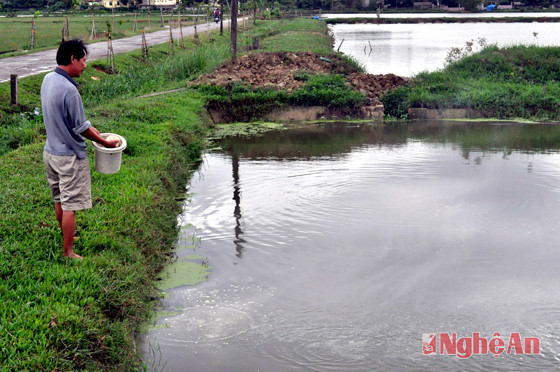 |
| Mr. Le Van Do (Block 5, Do Luong Town) takes care of fish fry. |
| RELATED NEWS |
|---|
Previously, on the leased land, he cultivated two rice crops. After harvesting the summer-autumn rice, he built embankments to raise water for a third fish crop. However, realizing the low efficiency of the summer-autumn crop, this year, along with other leased households, he switched to raising fish for seven months. After harvesting the winter-spring rice crop, he renovated the fields and released fish fry. After three months of raising them, at the time of releasing the third fish crop, he selectively harvested the fish to sell the fry. At this point, the fish reached a weight of 6-10 fish per kilogram, selling at 50,000 VND per kilogram. Currently, he has earned 30 million VND. He will continue to raise the remaining fish until the end of the season, then drain the pond and harvest them to prepare for the winter-spring rice crop. With an area of one hectare, he will yield more than one ton of fish. Furthermore, because the fish are raised in rice paddies without industrial feed, the meat is flavorful and delicious, promising a relatively high income for his family.
After saying goodbye to Mr. Nguyen Trong, we visited the "fish farm" of Mr. Le Van Do in Block 5, Town - the first person to initiate the 7-month fish farming movement. Mr. Do bid for 2 hectares of rice-fish farming from the cooperative and has over 10 years of experience in raising fish in the third crop. Every year, when it's time to release the fish in the third crop, he has to rush around to find and buy fish fry. Many years he bought a batch of "stunted" fish that didn't grow, resulting in a loss. As someone with experience in the profession, a question kept lingering in his mind: why not produce his own fry instead of depending on the market? With that concern in mind, on his 2 hectares, after the winter-spring rice crop, he designated an area for raising fish fry. After a few years of successful experimentation, for the past three years he has expanded the practice on his land. In December, he goes to fish fry production facilities to buy fish larvae to raise into fingerlings and then fish fry. Like Mr. Trong, after selling some of the fish fry, he continued to raise the remaining ones until the winter-spring rice harvest, then released them into the rice fields. This year, with 20 cups of fishmeal, he raised over 200 kg of fish fry, earning 20 million VND. After another 3 months of raising the fish for the third crop in the area, he harvested 1.2 tons, earning 60 million VND. The remaining fish in the rice fields will continue to be raised until the end of the year, yielding an additional 2 tons and approximately 100 million VND.
According to Ms. Nguyen Thi Hanh, Head of the Do Luong District Agricultural Extension Station: With a third-crop fish farming area of over 500 hectares, the annual demand for fish fry is very large. Because fish fry production facilities do not produce this type of fish, a shortage of fry often occurs during the stocking season. Farmers often have to find fry from unreliable sources on the market, and in many years, they encounter fish carrying diseases or stunted growth, leading to losses for producers. The 7-month fish farming model in Do Luong Town helps farmers proactively source fish fry with clear origins and controlled quality. On the other hand, the fish fry producers in the town are experienced and can advise farmers on farming techniques and disease prevention during the farming process.
Based on the initial results from several small-scale farmers, in 2014, Do Luong district developed a plan to convert all 70 hectares of Cau Tien rice fields from third-crop fish farming to seven-month farming. The district provided financial support for conversion, training, and technical assistance to the farmers. According to Mr. Tran Doan Hung, Head of the Agriculture and Rural Development Department of Do Luong district, thanks to the conversion to seven-month fish farming, the district has been able to secure sufficient fingerlings for the third crop this year. Based on this year's results, the district will allocate enough area to supply fingerlings for the entire district when the total area for third-crop fish farming in the district reaches 700 hectares. Currently, the district is surveying the area of unsustainable summer-autumn production to convert to seven-month fish farming because the demand from localities is very high.
Based on the results of the 7-month fish farming model in Do Luong, localities with large areas of third-crop fish farming such as Thanh Chuong, Dien Chau, and Nam Dan can refer to this model to plan for converting their farming methods to the 7-month model of Do Luong, in order to proactively secure seed sources and improve efficiency per unit area.
Mr. Tuan