

Medicines that treat headaches in postpartum women.
According to traditional medicine, postpartum headaches in women are known as "winter headaches".
This condition is commonly seen in women who are weak, give birth after the age of 35, are addicted to drugs, alcohol, or tobacco, or suffer from hypertension, diabetes, or blood clotting disorders. During childbirth, exhaustion and blood loss, combined with exposure to cold or foul-smelling blood containing toxins rising from the body, can also cause headaches.
If the illness is caused by excessive blood loss, the headache will occur occasionally, mild in the morning and severe in the afternoon, with alternating periods of pain and relief; pain in both temples and eyelids, yellowish complexion, and neither fever nor cold body temperature. If left untreated for a long time, the person will become even weaker, the headache will persist indefinitely, and it will develop into a condition called "headache."
If the illness is caused by stagnant blood, the headache will be mild in the morning and severe in the afternoon, fluctuating between pain and relief; however, the temples and eyelids will not ache, the person will remain normal, not excessively thin or weak, and will experience abdominal fullness and pain. If left untreated for a long time, the headache will persist, the illness will worsen, and the person may suddenly collapse, with convulsions of the limbs, resulting in a stroke.
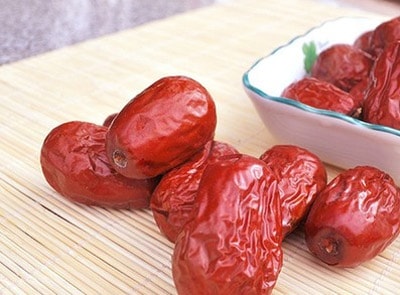 |
Jujube is an ingredient in the "Eight Treasures Decoction" which nourishes the blood and qi, and is very good for women who suffer from headaches after childbirth.
Some medicinal remedies:
For excessive bleeding, use the following prescription: 12g ginseng, 12g Poria cocos, 12g Angelica sinensis, 12g Paeonia lactiflora, 12g Atractylodes macrocephala, 12g Astragalus membranaceus, 12g Rehmannia glutinosa, 12g Ligusticum chuanxiong, 12g licorice, 3 slices fresh ginger, 3 red dates, 12g Vitex trifolia. Boil in 6 bowls of water until reduced to 2 bowls, divide into 2 doses and drink twice daily.
If there is no pain in the temples or eyelids, it means there is no external wind (a type of wind). Use the following prescription: ginseng 12g, Poria cocos 12g, Angelica sinensis 12g, Paeonia lactiflora 12g, Atractylodes macrocephala 12g, Astragalus membranaceus 12g, Rehmannia glutinosa 12g, Ligusticum chuanxiong 24g, licorice 12g, 3 slices of fresh ginger, and 3 red dates.
This disease is caused by blood stasis. Use the following prescription: 8g of Ligusticum chuanxiong and 120g of Angelica sinensis. Grind into a powder, take 10g at a time, decoct with one bowl of water and two cups of wine, and drink half a bowl hot at a time.
If the temples and eyelids are also painful, it indicates external wind (a type of wind), use the following prescription: 8g of Chuan Xiong, 120g of Dang Gui, and 120g of Man Jing Zi. Grind into powder, take 10g each time, decoct with 1 bowl of water and 2 cups of wine, and drink half a bowl hot at a time.
Note:Women should avoid foods that are considered "heating" or "inflammatory" such as chicken, duck, goat, crab, and sea fish, as well as fatty and spicy foods, hot foods, aromatic foods, or stimulating foods like pepper and coffee.
Although the illness was cured, the patient's vital energy and blood were deficient, their complexion was pale and sallow, and they were mentally fatigued. Therefore, they were prescribed the "Eight Treasures Decoction" daily: ginseng 8g, Poria cocos 12g, Rehmannia glutinosa 12g, Ligusticum chuanxiong 8g, Paeonia lactiflora 12g, Glycyrrhiza glabra 8g, Angelica sinensis 12g, red dates 5, fresh ginger 5 slices. Decoct and drink one dose daily.
According to Health and Life