

Maximizing the effectiveness of farmer groups with shared interests.
(Baonghean) - With the help of the "Community Development Project for Ethnic Minorities in the Northern Mountainous Region of Vietnam" (ADDA), funded by the Vietnam Farmers' Association and the Danish Agricultural Development Organization in Asia, many groups of households with shared interests in livestock farming and crop cultivation have been formed in Nghia Dan district over the years. This approach has proven effective in various localities.
In Hamlet 18, Nghia Trung Commune, a pig farming interest group was established in 2012. Currently, the group has 8 members. During a discussion, Mr. Le Xuan Vinh, the group leader, stated: “Establishing an interest group is very beneficial for farmers in pig farming. When participating in the group, farmers receive training in pig farming techniques from ADDA project instructors, who regularly visit to inspect and advise on the group's activities and disease prevention techniques every three months. In addition, the group leader also receives training in techniques and knowledge about investment, finding capital, pricing products from the beginning to the end of farming, and finding markets for the products… and then disseminates this information to the members. Especially, a practical benefit of the group is that during the monthly meetings, members exchange experiences in pig farming, how to choose breeding stock, prevent diseases, and select the most profitable time to sell pigs…”
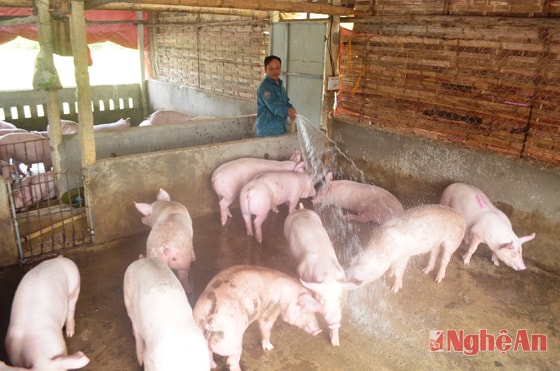 |
| Mr. Hoang Van Mo's pig farm is located in Hamlet 18, Nghia Trung Commune, Nghia Dan District. |
Among the group's members, Mr. Hoang Van Mo has the largest pig farming operation. His family owns two pig farms with a total of 170 fattening pigs and 4 breeding sows. On average, he sells 20-30 pigs every 20 days at current prices, yielding a profit of approximately 500,000 VND per pig. Currently, he is focusing on caring for his herd in preparation for the Tet (Lunar New Year) market. In an interview, Mr. Mo stated: “In pig farming, selecting high-quality breeds accounts for 60-70% of success. Furthermore, from the beginning, farmers must understand accounting and plan the optimal time for selling pigs to create a rational farming strategy; they must also proactively prevent diseases, maintain hygiene in the pens, and regulate nutrition during each stage of pig farming… This leads to a higher success rate.” With such experience, during group meetings, Mr. Mo exchanged and shared knowledge with other members to help each other develop. He also supplies animal feed to the group members.
Another benefit of interest groups is that members contribute to a revolving fund to provide capital for each other's production and livestock development. In the livestock farming interest group of Hamlet 18, Nghia Trung Commune, members contribute 200,000 VND/month, and to date, the group's fund has provided revolving loans of 20 million VND to its members. In Nghia Dan District, the ADDA project was implemented from 2010 to 2014. In the first phase, the project supported the opening of training courses for farmers on integrated pest management (IPM) for vegetable crops. Since 2012, the project has continued to select 35 groups of farmers with shared interests to provide training on advanced techniques in crop cultivation, livestock farming (buffaloes, cows, pigs, chickens), pumpkin cultivation, and fruit tree farming. In addition, the project supports these groups in constructing infrastructure projects valued at 25-30 million VND per project, benefiting not only the groups but also the local community. In 2014 alone, nine projects, including rural roads, canals, and culverts, received support for construction. Currently, the project is supporting six projects across six groups.
Regarding the effectiveness of farmer groups with shared interests, Mr. Vo Quang Hoa, Chairman of the Nghia Dan District Farmers' Association, stated: “Establishing farmer groups with shared interests is very beneficial for farmers from production to product consumption. Because farmers are linked together in groups, the output for products is unified in terms of timing and price, leading to more stable production; at the same time, it helps farmers produce in a commodity-oriented way when the groups are oriented towards cooperatives. According to assessments, about half of the groups operate highly effectively, while the rest operate relatively effectively compared to when farmers were not linked in groups. The effectiveness of the groups' activities, as well as the support projects of the project, also contribute to building new rural areas in the locality. According to the plan, the project was supposed to end in 2014, but the district requested an extension until early 2015. The District Farmers' Association has also selected four of the most exemplary groups to propose that the project continue to support them in the future.”
Thanh Duy