
Love can resolve hatred.
(Baonghean) - Despite losing both her son and husband, the relatives of the victim, NN A, went to the prison to encourage the defendant, D. Before the court, swallowing his tears, A's father did not utter a single word of reproach, only hoping that the court would consider reducing the sentence for the defendant so that D could soon return to fulfill his filial duties to his adoptive mother.
(Baonghean) - Despite losing both her son and husband, the relatives of the victim, NN A, went to the prison to encourage the defendant, D. Before the court, swallowing his tears, A's father did not utter a single word of reproach, only hoping that the court would consider reducing the sentence for the defendant so that D could soon return to fulfill his filial duties to his adoptive mother.
Nearly a year has passed, but the events of that trial are still deeply etched in my mind. It was a case that once shocked public opinion when two drivers, after a conflict over their livelihoods at a drinking party, decided to use their "means of earning a living" to destroy their opponent. The trial was filled with tears, but not tears of hatred, but tears of remorse, compassion, and forgiveness.
At three months old, Trinh Phuc D (born in 1991) was adopted by Mrs. Nguyen Thi Q and her husband (Hung Loi commune, Hung Nguyen district). The lingering effects of years of fighting in the Truong Son Mountains robbed Mrs. Q and her husband of their ability to have children. Therefore, all their love and hopes were poured into their adopted son. Due to difficult family circumstances, D only studied until the 8th grade before staying home to help his parents. Afterward, D learned to drive and joined a taxi company in Vinh City. Mrs. Q felt more at ease when D married a beautiful and kind woman. The couple were preparing to welcome their second child when tragedy struck. She was stunned to receive the terrible news: D had been arrested for murder! During a drinking session with friends, a dispute over the bill arose between D and his colleague NNA (residing in Trung Do ward, Vinh City). Although they were separated, they went their separate ways, but a short time later, D called A to meet him at Ben Thuy bridge to "settle the matter." After A threw stones at his vehicle, D drove straight into A, causing the victim to fall to the ground. In a fit of rage, D then turned the vehicle around and ran over A, killing him instantly.
 |
| Illustration: Hong Toai |
D's crime not only took the life of his colleague but also dealt a fatal blow to Mrs. Q's hopes. Furious with her son, deep down, she felt immense maternal love for D. She used all her savings, intended for her old age and illness, to help A's family arrange a proper funeral for the victim. A mother's sins are her son's responsibility; she hoped to atone for some of his wrongdoing, hoping that A would at least find some peace in the afterlife. After the funeral, Mrs. Q decided to mortgage a piece of ancestral land for 165 million dong to "compensate" A's family. Losing a child is painful for anyone, but perhaps the sincerity of this non-biological mother touched and soothed the pain of the victim's parents and wife. She was grateful for the forgiveness and understanding of the victim's family. Even more grateful was that Mr. NVT – A's father – didn't utter a single harsh word to her and even went to the prison to encourage D. Seeing A's elderly father, T, hobbling into prison on crutches (T had lost a leg in an accident) to visit and encourage the man who had killed his son, Mrs. Q felt heartbroken. She told her son, "Your crime is great, but the kindness the man showed you is immense. Live in a way that is true to your conscience."
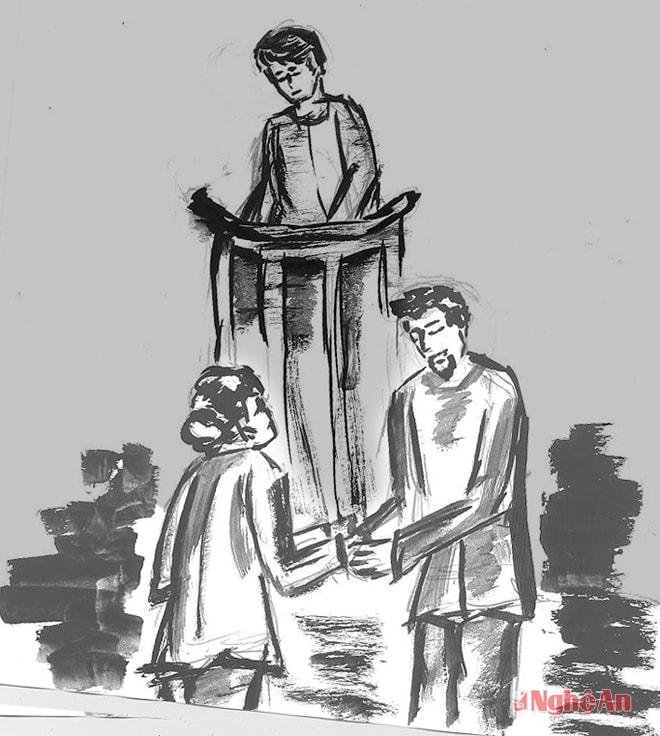
The heartfelt words of his mother and the forgiveness of the victim's family made D cry throughout the trial. Standing before the court, Mr. T and his daughter-in-law – the wife of the victim, NN A – also pleaded with the court to consider mitigating the sentence so that D could return home to care for his parents and raise his children. Fifteen years in prison was the punishment the law imposed on D. Mrs. Q fainted from grief. People say children rely on their fathers, and the elderly rely on their children; she only had D, and for those fifteen years, who could she rely on? Pushing through the crowd outside the courtroom, Mr. T approached. He took the mother's hand and offered words of comfort. Two elderly people, two gray-haired individuals with two different sorrows, yet so close to each other through forgiveness and understanding. I understand that there are pains that reach the very limits of a person's endurance, but all pain, all hatred, can be resolved by love.
Although we know that the courtroom is a solemn and cold place, where tens of thousands of people entangled in legal troubles have been judged, behind those verdicts there are still compassionate and forgiving hearts that help warm the lives of those who have erred, giving them a chance to rebuild their lives on the path to righteousness and rehabilitation.
Khang Hoa