

The "extended arms" in the fields
(Baonghean) - In recent years, the province's agricultural production has made remarkable progress in both productivity and output. The structure of crops and livestock has shifted in a positive direction. Large-scale specialized production areas with high economic efficiency are gradually being formed. To achieve these results, in addition to the efforts of farmers and the support and investment mechanisms of the province, the contributions of grassroots agricultural extension officers have also been significant.
Following Mr. Le Dinh Quang, Deputy Head of the Agriculture Department, in charge of Plant Protection and agricultural extension officer of Phuc Thanh commune (Yen Thanh district), to learn about the agricultural production situation, we felt the enthusiasm and dedication of those working in agricultural extension. He visited a trial corn field with a new variety in Hamlet 1, then rushed to inspect the overall foliar fertilizer model for spring corn crops in Hamlet 4. He also didn't hesitate to go into the livestock and poultry pens of households to monitor the growth and development of animals and provide guidance on disease prevention and control according to the season. He also proactively coordinated with various organizations and advised the Commune People's Committee on developing work programs and plans suitable for each season and year. Thanks to the effectiveness of agricultural extension work, farmers in the commune are increasingly improving their skills in intensive cultivation of key crops such as rice and corn.
Mr. Le Dinh Quang shared: “Working in grassroots agricultural extension requires staying in the fields, wading through rice paddies with farmers to guide and assist them in production, ensuring it aligns with the plan and seasons. Even when I'm out and about in the neighborhood, I take the opportunity to spread awareness and help people apply the correct techniques in livestock farming and production. Besides that, I also have to listen to the opinions of the people themselves to find the most suitable way to communicate scientific and technical advancements, making them easy for the farmers to understand and confidently apply.”
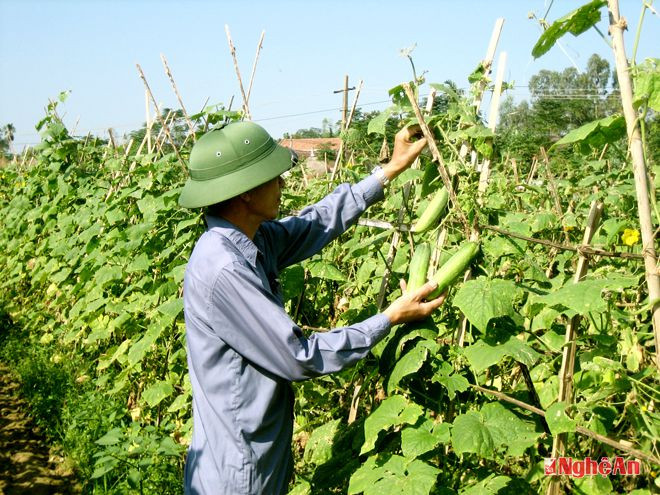 |
| A model for growing cucumbers according to VietGAP standards in Xuan Lam commune (Nam Dan district). |
In Phuc Thanh commune, the grassroots agricultural extension system is assessed by the District Agricultural Extension Station as operating quite effectively. Besides advising the station, the commune People's Committee builds demonstration models and provides training in science and technology for farmers. Commune agricultural extension officers also coordinate harmoniously with village and hamlet agricultural extension workers to regularly inspect fields and predict and forecast pests and diseases in a timely manner. Specifically in 2014, the agricultural extension system and the commune's Agricultural Committee actively promoted and encouraged farmers to convert low-yield rice land to high-value cash crops; disseminated and selected plant varieties and intensive farming techniques, helping to increase the productivity of various crops.
In Yen Trung hamlet, 8 hectares of low-yield rice fields have been converted to corn cultivation, achieving a yield of 50 quintals/hectare, and 8 hectares of rice fields have been converted to high-yield bean cultivation. In coordination with the Agricultural Extension Station and seed companies, successful pilot models have been established for hybrid corn varieties PAC 999, 669, and 339 on a 5-hectare scale; a 2-hectare model for foliar fertilization with Lactofol for winter corn; and a 1-hectare model for intensive cultivation of purple glutinous corn in winter. The results of the trials of the three hybrid corn varieties showed yields 30-40 kg/sao higher than the control variety (C919). The foliar fertilization model in the experimental model achieved a yield of 56.7 quintals/ha, 4.7 quintals/ha higher than the control, with a profit of 25,840,000 VND/ha, nearly 5,000,000 VND/ha higher than the control… According to the commune leaders, these models need to be replicated for subsequent seasons and planted in different areas because this corn variety brings high economic efficiency and reduces pesticide costs.
In recent years, the grassroots agricultural extension system in Nghia Dan district has operated relatively stably, and the specialized agricultural extension officers at the commune level are gradually becoming younger. According to Mr. Bui Quoc Tuan, Head of the Nghia Dan Agricultural Extension Station: Currently, there are 25 commune-level agricultural extension officers and 311 village-level agricultural extension officers in the district. Every year, the station organizes 10-12 training courses for grassroots agricultural extension officers. Each officer is assigned to implement, monitor, supervise, and evaluate agricultural extension models in their locality; coordinate with the station to train and hold workshops on models for farmers… In 2014, the station directed grassroots agricultural extension officers to coordinate with localities to organize production and supply of plant and animal breeds according to people's needs; successfully built demonstration models, such as applying appropriate planting density combined with sprinkler irrigation technology for sugarcane on a 1-hectare scale in Nghia Hieu commune; According to the evaluation, the model yielded 82 tons/ha, with a net profit of 26,000,000 VND, a 30% increase compared to conventional farming. The model for cultivating LK 92-11 sugarcane on 2 hectares achieved a yield of 81 tons/ha, with a total revenue of 64,000,000 VND/ha, resulting in an 18% increase in net profit compared to conventional production. Similarly, the model for raising new breed broiler chickens according to VietGAP standards, with a scale of over 1,000 birds, a survival rate of over 95%, and chickens reaching an average weight of 2.2-2.5 kg/bird, saw a profit increase of over 17% compared to conventional farming…
Currently, the province has 468 communes and wards engaged in agricultural production, each with one agricultural extension officer based on one of two positions: Plant Protection or Veterinary Officer. The main job of each commune agricultural extension officer is to direct and guide the people in production to ensure adherence to the planting schedule, especially for key agricultural and forestry production programs in each district. In addition, agricultural extension officers are a core force that regularly inspects fields, detects pests and diseases affecting crops and livestock, and reports to local authorities and specialized agencies for timely and effective prevention and control measures. Each agricultural extension officer is also an active communicator, acting as a "bridge" to bring the Party and State's policies on agriculture and rural areas to farmers. Organizing training courses and transferring scientific and technical advancements to promptly meet the needs and production seasons at the grassroots level, actively supporting farmers in applying these advancements to practical production at home, preventing and controlling diseases, and protecting production effectively. Agricultural extension workers also regularly advise farmers on understanding the mechanisms, policies, and development orientations of the local agricultural, forestry, and fisheries economy, applying technical advancements to production, and processing agricultural products after harvest to increase product value and price.
Assessing the role of this force, Mr. Cao Xuan Tuan - Deputy Director of the Nghe An Agricultural Extension Center said: “The grassroots agricultural extension workers are the farmers' friends, knowledgeable about the fields, and therefore easily convey information and knowledge of science and technology to farmers. Therefore, for many years, grassroots agricultural extension workers have been a powerful arm of the agricultural sector in understanding the thoughts and aspirations of farmers, thereby formulating correct policies and methods that bring about effective results, contributing to gradually increasing income per unit of cultivated area and developing agriculture towards high-quality, commodity-oriented production. However, in some localities, grassroots agricultural extension workers are not truly passionate about their work, lack initiative in building agricultural extension programs and plans; coordination with organizations, sectors, and associations in the area is not high. The position of commune-level agricultural extension officer is unstable due to frequent changes, resulting in a lack of experience in agricultural extension activities. The main expertise of grassroots agricultural extension workers is currently limited.” "The focus is mainly on the fields of crop cultivation, plant protection, veterinary medicine, and animal husbandry; other fields such as fisheries and forestry account for a relatively small percentage."
Agriculture is increasingly developing and achieving significant successes with the application of science and the production of new, high-yielding, and economically valuable plant and animal varieties. However, successful implementation in each locality requires farmers to improve their awareness and production and livestock farming skills. To achieve this, the active involvement of grassroots agricultural extension officers plays a crucial role, helping farmers have bountiful harvests.
Ngoc Anh
| RELATED NEWS |
|---|